
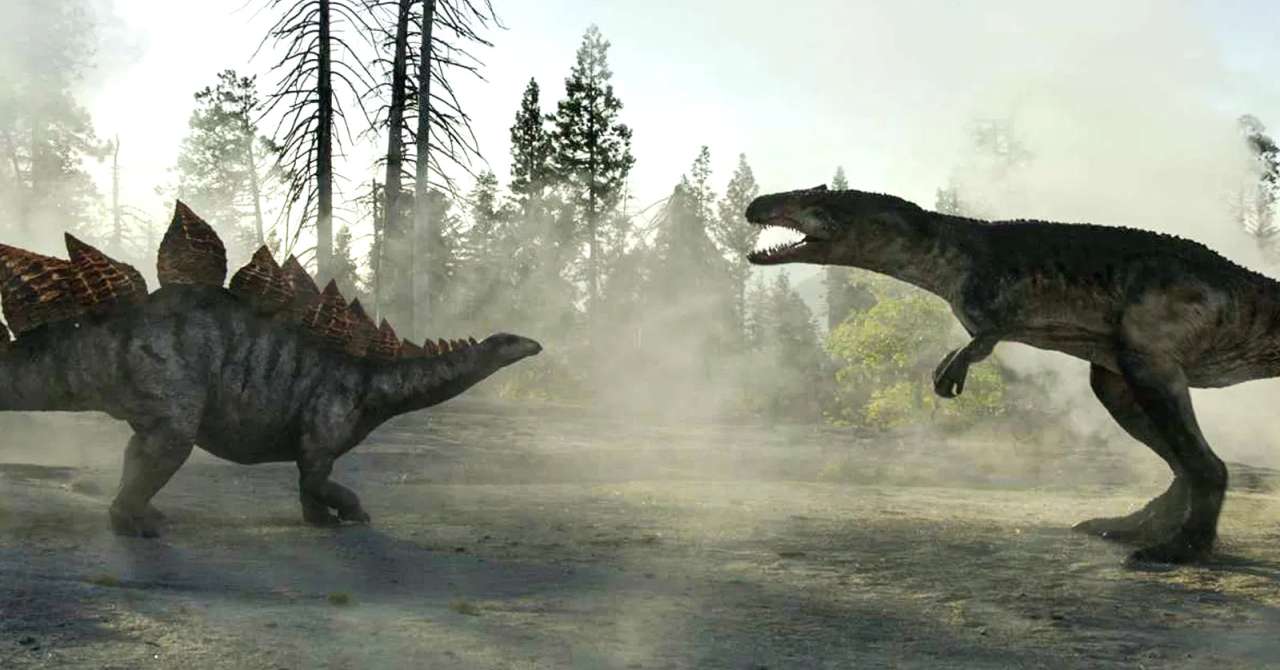
Spielberg’s Dinosaurs are still as beautiful, still as moving
33 years after Jurassic Park, the filmmaker is producing this Netflix documentary mini-series narrated by Morgan Freeman and boosted by the visual effects of Industrial Light & Magic. Impressive.
It all begins with the image of a mosquito trapped in a drop of sap, as the Earth changes and life finds a way…
Thirty-three years after Jurassic Park, Steven Spielberg returns to dinosaurs, no longer behind the camera but as producer of an ambitious Netflix docuseries, Dinosaurs, which plunges back into the dizzying depths of time. A mini-series in four episodes already ranked number 1 in France. It must be said that it is as fascinating as it is impressive.
Carried by the deep and almost cosmic voice of Morgan Freeman, it goes back 235 million years to tell the story of the rise of the dinosaurs. Welcome to the supercontinent of Pangea, a strange hot and arid place, where reptiles like the Rynchosaurus thrived in the Triassic era. Dinos don’t yet have a place in this particular ecosystem. But major climate change, caused by cascading volcanic eruptions, will lead to a biblical flood. Endless rains which will last for almost a million years, causing an upheaval of the biotope. This time, the dinosaurs will be able to flourish…
This is how the Netflix docu begins, which aims to tell the story of our planet traveling through the ages, millions of years after millions of years, to tell the story of the rise of the craziest monsters that have ever populated our Earth, and their evolution, from Procompsognathus to Tyrannosaurus.
Without trying to bombard us with data and scientific reflections, Dinosaurs is above all a playful variation of the Jurassic documentary. He first seeks to amaze us. And he gets there without difficulty. Visually, it’s stunning. To recreate this vanished world, Spielberg called on a historical ally. Industrial Light & Magic had already played a decisive role in the creation of the dinosaurs in Jurassic Park (1993). The studio then developed revolutionary computer-generated images, mixed with animatronics designed by Stan Winston. This mixture of digital effects and mechanical creatures gave the film an unprecedented realism, marking a major milestone in the history of special effects. Thirty years later, ILM is back to bring to life a new generation of digital dinosaurs.
Following on from Life on Our Planet (already produced by Spielberg and released in 2023) which already retraced the history of life on Earth, Dinosaurs acts almost as a natural extension. The result is an intoxicating stroll through 165 million years of history, where we obviously witness titanic clashes between long-toothed predators – from Liliensternus to the gigantic Spinosaurus or Giganotosaurus. But the series is not limited to these apex predator fights. She also observes ecosystems, survival strategies, migrations, births. A page of prehistory almost like a tale, the final chapter of which is well known: an asteroid is hurtling towards them at a speed 50 times the speed of sound. With a force of destruction comparable to a billion atomic bombs, the natural disaster will end the reign of these exceptional creatures in many ways. It’s strong. It’s beautiful. It’s instructive. And that leaves us wondering… In front of this dizzying fresco, we say to ourselves that we are really very little on the scale of the Earth.
Dinosaurs currently on Netflix.


