
Yoshiyuki Okuyama: “I wanted viewers to come away seeing life in different colors”
For his live-action adaptation of a film by Makoto Shinkai, Yoshiyuki Okuyama explores the doubts, impulses and tiny hopes that run through a young man who takes stock of his life, Takaki. His goal? Offering spectators a renewed perspective on their own existence.
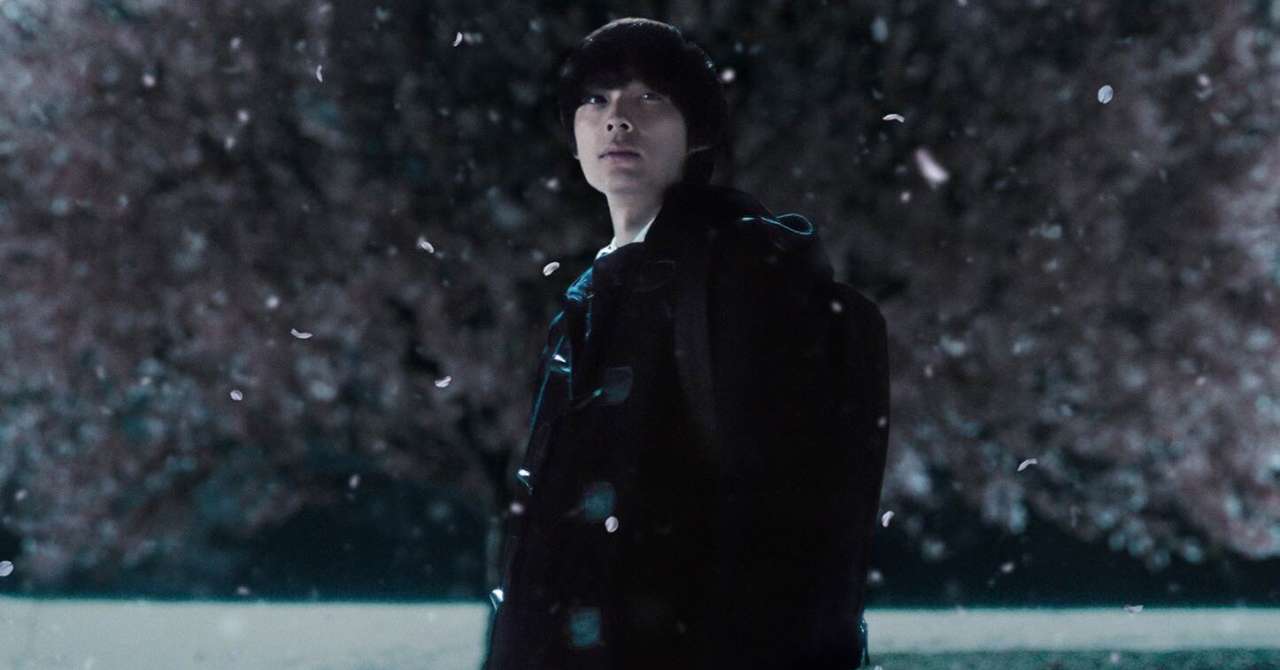
In this live action adaptation of 5 centimeters per seconda short but seminal animated work by Makoto Shinkai (the genius to whom we owe Your Name, Suzume Or Children of time), the director chooses to focus on Takaki Tono’s emotional journey. The latter is a boy then a young man, undone by a heartbreak, and who will live for several years crossed by doubt and weighed down by the weight of what he never knew how to say to others. Faithful to the original material without being locked into it, Okuyama enriches the narration with elements invisible on the screen: fragments of the past, historical details or descriptions… all supports intended to better anchor the characters in reality. Through meticulous work on framing and camera movements, the film follows Takaki’s inner evolution, from the vibrant freedom of childhood to the resigned coldness of adulthood. By assuming this visual and emotional shift, the filmmaker seeks less to copy Shinkai than to translate what constitutes the heart of his cinema: the way in which the intimate touches the universal, and how a tiny step forward can be enough to recolor the perception of the world. All this deserved a meeting with Yoshiyuki Okuyama, an artist little known in the West but famous in Asia, who here tackles an immense work.
This is the first time that Makoto Shinkai has authorized a live action adaptation of one of his works. How did you gain his trust?
When I was offered the project, the producer, Hiromasa Tamai, had already gained Shinkai’s trust. There was also Ms. Suzuki on the screenplay. I believe that their passion and ability to reinterpret the anime while preserving its charm played a decisive role. Their very in-depth thinking convinced Comics Wave that the adaptation could really see the light of day.
Did you have a particular relationship with Shinkai’s work before this project?
Yes, I really liked it Suzume. And of course, I had seen 5 centimeters per second. What touches me about his style is his way of starting from the intimate – something very personal, almost secret – to reach the universal. It highlights both the micro and the macro. By going as close as possible to human emotions, he reaches the laws of the universe. It’s this breadth that fascinates me about him.
The original work is very short, about an hour. How did you work with the screenwriter, Fumiko Suzuki, to enrich the story without betraying it?
When I was called, the first version of the script was already written and validated. The structure existed, and some additional scenes had already been integrated. From there, we worked for a year: all-day meetings, every week or every two weeks. Our goal was to decide together what to keep or remove.
I only met Shinkai once before production. He did not make specific requests. We simply rewatched the anime together, and he talked to me about what he himself had animated, about his deep intentions. It was very valuable.
The anime depicts very deep, intimate emotions. Were you also able to project yourself into Takaki, especially in his adult version?
Yes, absolutely. When I received the proposal, I shared a lot with the adult Takaki. Your thirties are a time when you carry regrets about the past and worries about the future. We feel a sort of diffuse panic, a discomfort that we cannot always name.
As a teenager, then in my twenties, I was on the contrary exalted, stimulated by everything I discovered. But later I asked myself: “Did I make the right choices? Did I get where I wanted to go? »
This is precisely when the project arrived. And I told myself that I could film Takaki fairly, because I shared his doubts.
You come from photography and music videos. How did this journey shape your direction for this adaptation?
I have taken photos and clips, but I don’t consider myself a visual artist in the strict sense. On the other hand, I attach enormous importance to preparation, like in music or photography. For this film, we read a lot, rehearsed, analyzed. I also created a textbooka notebook of more than a hundred pages which brought together the past of each character, elements absent from the scenario, but also information on the eras crossed – the 90s, the 2000s. I added notes on the professions represented, such as engineering or surfing.
This document was shared with the entire team, so that once on set, everyone knew exactly where their character came from and in what context they evolved.
Did you try to find Shinkai’s direction, his framing, his camera movements?
There are shots where I followed the anime exactly, and others where I deliberately took another direction. I first captured all the shots from the animated film. I drew a detailed table, with the camera movements used for each scene: pans, zooms, close-ups… then I drew up graphs with the distribution by period. It was a document of several hundred pages. From there, I decided, shot by shot, whether I should stick to Shinkai or, on the contrary, detach myself from him.
Precisely, you have chosen a worn camera for childhood and a fixed camera for adulthood. Why this breakup?
Takaki as a child is driven by boundless energy. He feels like he can go wherever he wants, that he has no limits. A handheld camera makes this heat, this movement permanent.
As we age, this warmth goes out. He cools down inside. A rift develops between him and the others, between him and society. So I filmed adulthood with a fixed camera, sometimes almost like a surveillance camera. Something cold, breathless.
For the high school period, I used a jiba crane equipped with a camera, for an intermediate sensation: not as free as childhood, not as fixed as adulthood.
You said that deep down, your desire was to offer a little hope to spectators. What kind of hope?
When we go to the cinema, we rarely go with a completely light mind. We all have personal problems on our minds. Few people say to themselves: ” Everything is fine “ when entering a room. I would like those who have concerns to see in Takaki a character who, even if he only takes a very small step forward, still manages to move forward.
If, leaving the room, the spectators look at their environment with a different nuance, with a little more color – even imperceptible – and they say to themselves: “Life is complicated, but I will continue to move forward”then this film will have accomplished something.
It is this tiny inner shift, this clarification, that I want to offer.


