Fed up with the heatwave? Revise your classics in theaters!
A Mexican melodrama, a spaghetti western, a Japanese fortress, the Arabian desert or the Australian bush… No need to take the plane, they’re in theaters! Workforce review.
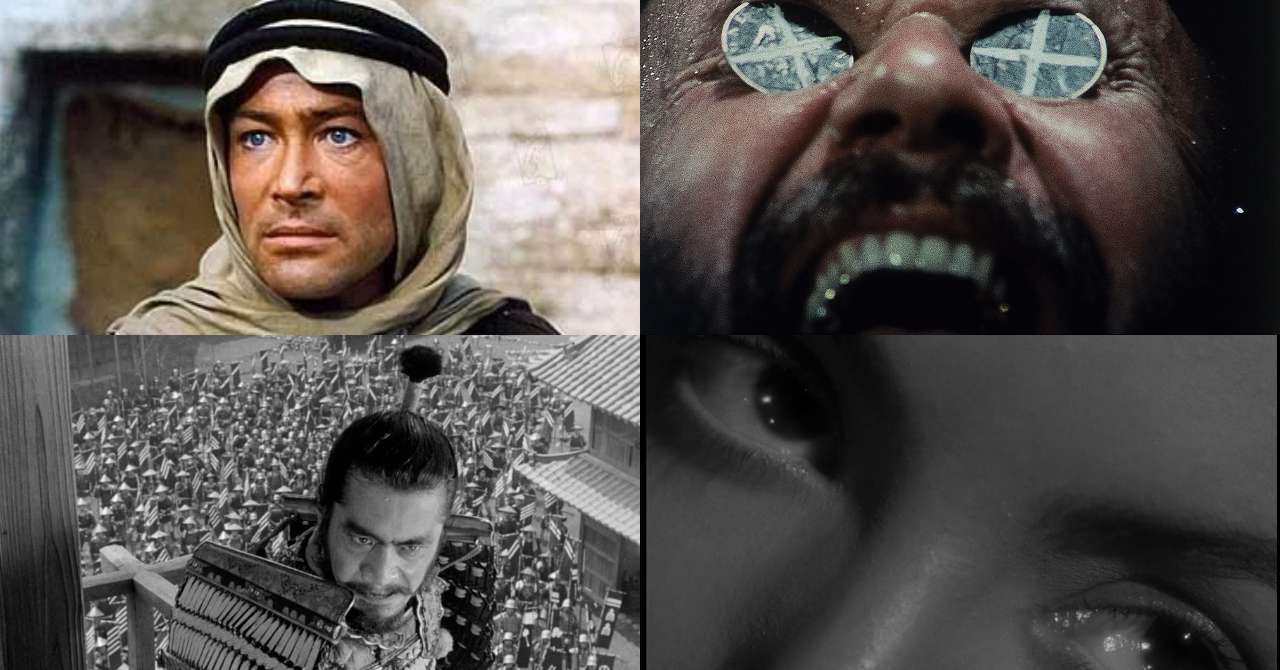
There are the almost transparent blue eyes of Peter O’Toole, the miraculously blurred silhouette of Omar Sharif arriving from nowhere in the middle of the sands, the weathered passion of Anthony Quinn overplaying the Arab leaders, the orange hues of a desert barely reinvented in Technicolor and Superpanavision, the heroic charge of a thousand Bedouins with drawn sabres or even the assumed lyricism of the brass unleashed by Maurice Jarre… Lawrence of Arabia filmed between 1961 and 62, assembled then dismantled to please producers concerned about performance, has had several lives but immediate recognition with seven Oscars to boot. Discovering it other than in the cinema is a crime.
Enamoradaby Emilio Fernandez (1947), August 5
It’s the gem of this summer, a Mexican melodrama of breathtaking beauty! The thing is carried, it is true, by the firepower of the national glory, Maria Félix. In the midst of the Mexican Revolution, a rebel general (Pedro Armendáriz) arrives in a sleepy provincial town. There, he intends to bring the notables into line but soon falls in love with the very well-born Beatriz (Félix). The current obviously doesn’t flow between them until hearts fall in love. Beyond a certain emphasis specific to the genre and a preachy discourse, the power of the film lies above all in the heterogeneity of its moods. Here the trivial and the superior, the pure and the impure, constantly rub together as if to better seal otherness. Filmmaker Emilio Fernandez can thus move from a slapstick comedy sequence between our two lovebirds to sumptuous tracking shots on the ornaments of a church. A grotesque character belches profanities from the top of his watchtower, the next moment the handsome general theorizes on a 19th century painting. The magnificent restoration magnificently accentuates these contrasts. A discovery.
Final part of the so-called trilogy Dollar, The good, the bad and the ugly is a willingly cynical, nihilistic and disillusioned western. It is a dark portrait of a universe soiled and ravaged by the very people who are supposed to preserve it. America in the middle of the Civil War is killing each other. In the middle of the rubble and disjointed soldiers, Blondin (Clint Eastwood), Tuco (Eli Wallach) and Sentenza (Lee van Cleef), last survivors of the apocalypse, seem to take charge of all the faults of the human species on their shoulders. The Sad Hill cemetery where these three will meet for the finale is the center of a world that is now over. Beyond the hills there is nothing. We know the music: very close-ups, the chords of Ennio Morricone, the cigarillo, the poncho, the hot sand and the loot in the grave. After this masterpiece, Leone swore never to make any more westerns. Hollywood will decide otherwise. The trilogy of Once upon a timewas going to happenAwakening in terror.
If you want to convince someone who is reluctant to spend more than two hours watching a black and white Japanese film, tell them: “ This is the film that inspired Star Wars! » It should have a little effect. George Lucas, a fan of Akira Kurosawa before the eternal, has, in fact, never hidden what he owes to the author of Seven Samurai. Shot on extra-wide, this adventure film sees a princess and a general escorted by two peasants through 16th century Japan. In the case there is also a treasure arousing all covetousness. The bold narrative choices of Kurosawa and in particular this way of letting his plot move from different points of view would have seduced the young American. It is also said that the latter would have modeled his famous princess on that of this Fortress. As for the sense of timing in the action scenes, we have (almost) never done better since. The Kurosawa Mini Retro also includes: The Spider Castle (1966) and Sanjuro (1972)
Wake in the Fright (Waking up in terror), by Ted Kotcheff (1971), August 19
This feverish thriller from 1971 was seen for the first time in 2014 when its director, Canadian Ted Kotcheff, visited the Lyon Lumière Festival. The guy had taken advantage of the celebration of his hit Rambo (1981) to remind us that things had seriously started in the Australian bush with this Waking up in terror (its title in French) We follow the ordeal of a professor from a godforsaken town (Gary Bond) wanting to reach Sydney, which he will never really reach. Blame it on alcohol, Donald Pleasence, gambling, an angry mob or even a kangaroo hunt in a jeep. Imagine it After Hours of Scorsese who would have met the Walkabout of Roeg or the Delivery by Boorman and you have the winning equation of your summer.