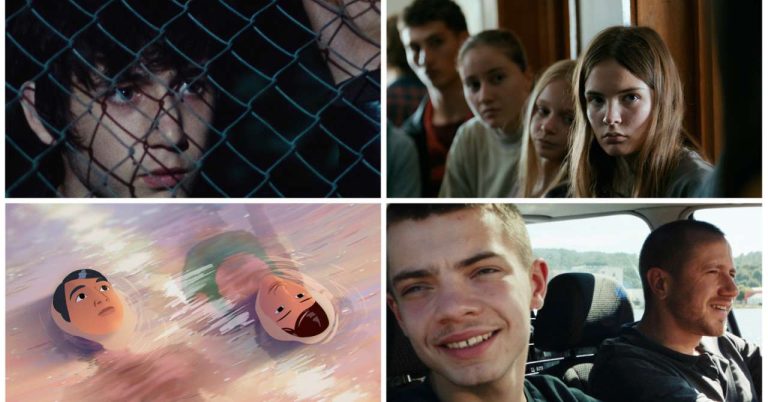
Three Farewells, Salvation, La Frappe: what’s new at the cinema this week
What to see in theaters
THE EVENT
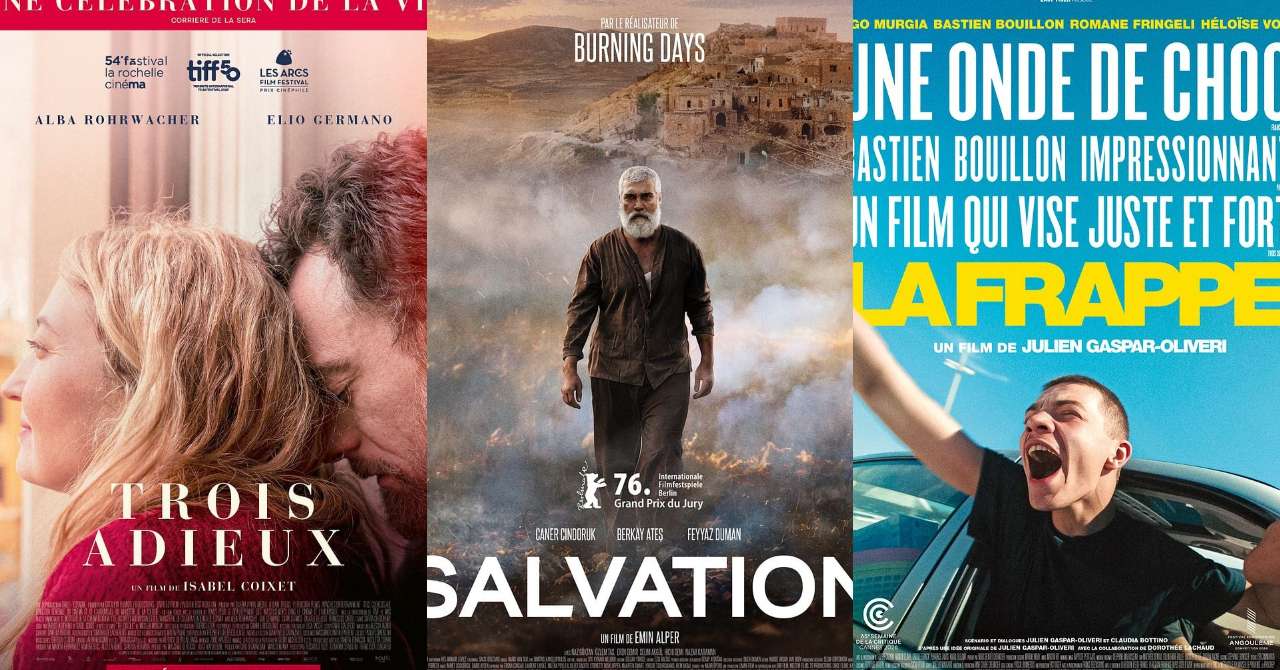
THREE GOODBYES ★★★★☆
By Isabel Coixet
The essentials
Isabel Coixet adapts a novel by Michela Murgia where an announced death does not prevent a life drive. A beautiful melodrama with restless modesty carried by the great Alba Rohrwacher. Impressive
Isabel Coixet (My life without me) here adapts the last autobiographical novel by Michela Murgia, who died of cancer at the age of 51 in 2023. It all begins with a separation between Marta (brilliantly played by Alba Rohrwacher) and Antonio in a Rome far from mass tourism. Marta relearns solitude, embraces new energy before the revelation of her illness shakes her certainties. However – and this is precisely the beauty of this story – this shaking is not seen as a tragedy where fate would break all creative energy but on the contrary offers an impulse. Marta redoubles her desires, the unexpected, her love… Isabel Coixet abandons all pathos without repressing the outpouring of feelings. The modesty, the humor, the finesse of the staging impose a gentleness that is certainly restless but also knows how to be generous and gracious.
Thomas Baura
Read the full review
PREMIERE LIKED A LOT
SALVATION ★★★★☆
By Emin Alper
If Emin Alper (Burning Days) was inspired for Salvation by a very real tragedy (a massacre that occurred in a village in Turkish Kurdistan in 2009), the Western framework of his film, almost mythological, immediately gives it a universal dimension. Two rival communities look at each other here like earthenware dogs. One lives in a village perched on a hill, the other in the valley below. Soon, the residents above, who feel economically wronged, will be hysterized by the head of a paramilitary organization posing as a religious leader. Alper intends to question fanaticism, genocidal violence, down to its most indecipherable roots. Then he plunges into the irrational, through scenes on the edge of the fantastic, where the fascinating intertwining of village streets which serves as his setting turns into a mental maze. And he proves to be as gifted at making people feel the concreteness of the world he depicts as its secret, dreamlike, almost hallucinatory dimension.
Frédéric Foubert
Read the full review
FIRST TO LIKE
THE STRIKE ★★★☆☆
By Julien Gaspar-Oliveri
Double awarded at Angoulême, this first feature opens with a close-up of a skin without us knowing to whom it belongs. This sequence sets the tone for what will follow: the desire to leave uncertainty at the heart of the story. Because when Anthony leaves prison and finds Enzo, his 19-year-old son, and Carla, his 20-year-old daughter, trying to start a new family, we know nothing of this man’s past. Nothing that landed him behind bars. Nothing about the details of his relationship with the children. Yet trouble and anxiety reign, even behind the smiles and tender gestures. Gaspar-Oliveri does not manipulate the viewer: incest, the elephant in the middle of the room, will be clearly revealed. But by refusing to say everything right away, the filmmaker finds a relevant angle to tell it. La Frappe does not show this incest, any more than it tells of a journey of resilience. It plunges us into the head of Enzo (Diego Murgia, crowned in Angoulême), in his impossibility of seeing his father as an executioner, in his inability not to love him and not to prove this love to him through behavior dictated by control. The result is chilling but remarkable for its mastery of the story and its staging
Thierry Cheze
Read the full review
THE GOOD SISTER ★★★☆☆
By Sarah Miro Fischer
As in La Frappe, which is also released this Wednesday, this first German feature is about distorted family relationships and influence that the victim initially refuses to see. In this case, a young caregiver who will be shocked when her older brother, with whom she has always shared a great bond, is accused of rape. With the obligation to quickly position herself because she is summoned as an auditory witness, the attack having supposedly taken place in the room next to hers. What did she really hear? Has she always been wrong about the nature of her brother? Or is he wrongly accused? These questions constitute the heart of this gripping and uneasy thriller, built around this heroine forced to force her reserved nature when she discovers that all her certainties are undermined one by one. Extremely well written because it does not break any open door, The Good Sister reveals itself to be a strong film about liberation and the difficulty of cutting blood ties even when you realize that they are poisoning your life.
Thierry Cheze
RETURN BEFORE 3 P.M. ★★★☆☆
By Gaël Lépingle
Grief sometimes takes surprising forms. This is the case here: director Gaël Lépingle builds a fun documentary around a register found on the death of his father. A diary in which his father detailed his days with surgical meticulousness and a pragmatism that bordered on the comic, from hunting wasp nests to lawn mower breakdowns. In Return before 3 p.m., the everyday settings become those of a play where the actor Serge Renko reenacts even the most boring skits, accompanied by Philippe Girard who takes on all the secondary roles. An inventive little ride that takes place before our eyes with unapologetic fun. There is something touching in the artistic gesture of a son who detects in his father’s monotonous ritual a singular sensitivity to the world.
Lucie Chiquer
ABYSS AND WONDERS ★★★☆☆
By Jean Boiron Lajous
It’s a story of letters and two people. There is Christine convinced that her father left her a farewell note somewhere. Jean keeps a missive that his suicide father left to justify his act. He never wanted to read it. As a joke, Jean, director (Hors service…) offers Christine to accompany her to her toxic mother to settle certain scores with her and perhaps get her hands on the hypothetical document. During the time of the road movie on the roads of the south, both talk, argue, doubt, rebel, seek to say the right words about their respective pain. The journey is not weighed down, it is even joyful despite the tears and the silences. Carried by a surge of sincere friendship, he even becomes a model of generosity and reciprocity of feelings. In charge of the camera not to break – better – to help the miraculous understanding. Beautiful.
Thomas Baura
THE HOLY BOY ★★★☆☆
By Paolo Strippoli
We are always happy to see a film arriving in theaters testifying to a revival of Italian genre cinema. The genre, in this case, being that of folk horror, which Paolo Strippoli revisits in a very personal way. The plot of The Holy Boy takes place in a mountain village, where a PE teacher arrives devastated by grief. He will discover that the inhabitants of the place, all marked by a collective tragedy that occurred a few years earlier, heal their grief thanks to a magical teenager, Matteo, capable of “absorbing” pain. But who is Matteo really? The personification of this “opium of the people” that is religion? The Antichrist? A transalpine cousin and miracle worker of Stephen King’s Carrie? And besides, is it really desirable to live without pain? Strippoli asks these questions in a film not free from flaws (small problems of rhythm), but full of strong ideas and images.
Frédéric Foubert
Find these films near you thanks to Première Go
FIRST TO MODERATELY LIKED
LOVE LETTERS FROM MY GRANDMOTHER ★★☆☆☆
By Hongchun Lan
Its immense success in China could lead us to imagine a big machine to make people cry. Love Letters from My Grandmother, however, begins almost as a comedy: riddled with debt, a young man goes to Thailand to find his grandfather, who has been missing for decades. His investigation will above all unearth a love story and that, little known among us, of the qiaopi, these letters accompanied by money orders that the Chinese who left to work in South-East Asia sent to their families back home. Performed largely by non-professional actors, Lan Hongchun’s film tells the story of exile, separated families and what is passed down from one generation to the next. The staging is wise and the story does not shy away from any of the tricks of melodrama. We see them coming, sometimes even from afar. But as the pieces of the past come together, the emotion ends up arriving anyway.
Peter Lunn
THE OPERA! ★★☆☆☆
By Enrique Gato
There are cinema objects so singular that they escape any label. The Franco-Italian project co-signed by Paolo Gep Cucco and Davide Livermore is part of this marginal caste. A syncretism of the codes of live show recording, the cocaine-fueled MTV clip, the syrupy soap, the B-movie fantasy and the Broadway musical from which it draws its exclamation point, this adaptation of Orpheus and Eurydice (Christoph Willibald Gluck) reveals itself above all to be a chimerical delirium. Where the fantasized musical alternative takes precedence over a traumatic reality: the beautiful Eurydice is shot on her wedding day, and Orpheus, convinced of being able to bring her back to the world of the living, ventures to the Grand Hotel Hades, crossing on his way Vincent Cassel as Charon, Fanny Ardant as Proserpine or even Rossy de Palma as Atropos. It’s fun, at times, stupid, all the way.
Chloé Delost-Eray
THE LAST PATIENT ★★☆☆☆
By Rémi Bassaler
Judith is the last resident of a public housing project slated for demolition. A doctor, she waited until her retirement day to close her practice and pack up. To the great dismay of workers anxious to meet deadlines. His shaky organization is put to the test when Aida arrives, eight months pregnant, out of care and trying to flee a possessive boyfriend. The director of Paris est à nous films with great delicacy two women who, or almost everything, are opposed, forced to live together for one night where nothing goes as planned. One sees her ideals of medicine totally called into question at the twilight of her career when the other is faced with her past life choices, at a time when her survival but also that of her unborn baby is at stake. The outstanding interpretation of the two women, however, fails to make us forget the slowness of the story. A shame for a film of not even 90 minutes.
Anne Lenoir
And also
Love(s) by Alice Diop, Claire Maugendre and Héléna Klotz
The covers
The Soul of Warriors by Lee Taamahori
A Swedish love story by Roy Andersson
Terminator 2, Judgment Day by James Cameron
Trainspotting by Danny Boyle