
The Mosquito Bowl: the new Peter Berg divides critics
The major war film from the director of Blood and Tears and Hancock, currently on Netflix, is struggling to convince the Anglo-Saxon press. We do the review.
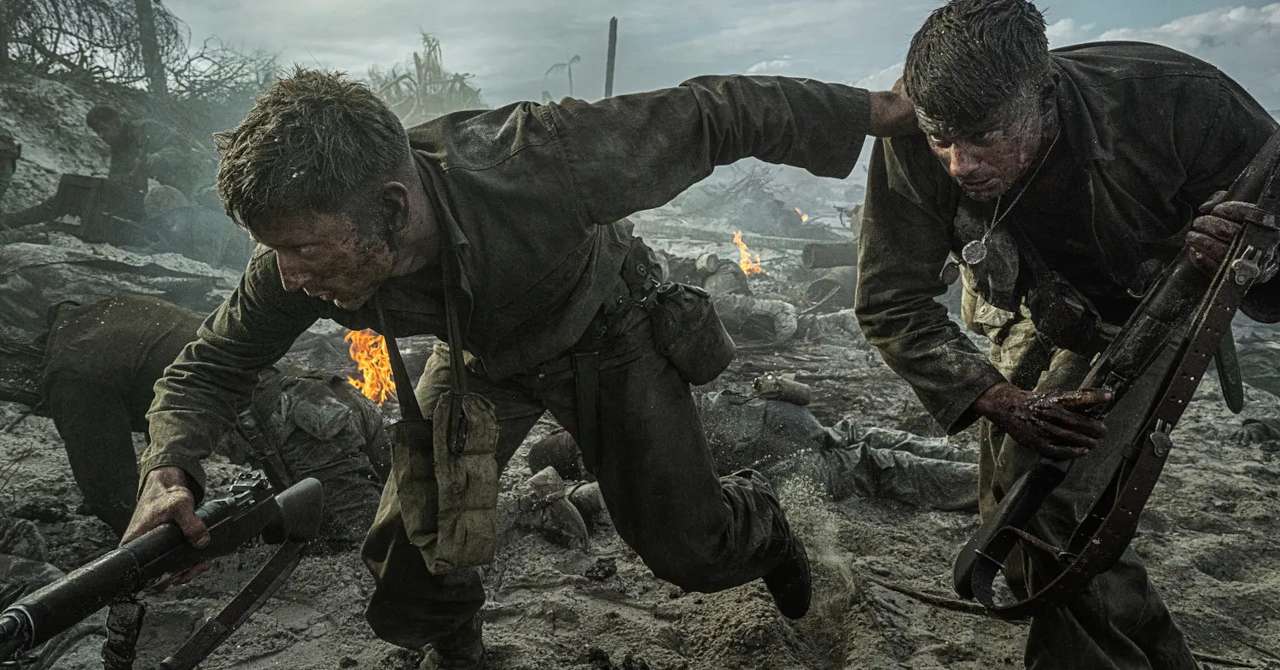
Released on Netflix this week, Peter Berg’s new film tells a little-known true story from World War II. After the attack on Pearl Harbor, four young American football stars join the Marines and find themselves sent to the front lines in the Pacific. Between sporting camaraderie and horror of combat, The Mosquito Bowl impresses with its staging, but struggles to convince the Anglo-Saxon press.
FOR
According to Empire, the casting constitutes one of the great successes of the film, as does its spectacular staging: “The cast is collectively captivating, navigating between the field and the trenches with a touching camaraderie. Their expressive faces carry everything The Mosquito Bowl seeks to tell. Berg’s film is fiercely anti-militarist. The fight scenes are relentless: bodies are thrown into the air by explosions or swallowed up by furious waves; a skull explodes before the eyes of the four men. The whole thing is filmed on an epic scale by cinematographer Jacques Jouffret, who had already given a similarly charred look to Berg’s Netflix series, American Primeval.“
According to Time Magazine, Berg sometimes overdoes it in the depiction of violence, but manages to give the football match a particularly touching dimension: “Berg throws so much violence at us that it ends up feeling like filler. Conversely, the depiction of the Mosquito Bowl itself, the heart of the film, is pure joy. War does not so much make a man of a boy as it brutally snatches away his childhood. Perhaps that’s why it’s both liberating and poignant to watch these young men escape, if only briefly, into versions of themselves that already no longer exist.“
Collider, for its part, highlights the work of the actors, who manage to give depth to characters insufficiently developed by the script. Ray Nicholson particularly stands out: “Despite its length, the writing does not grant much depth to the characters; it is the actors and their interpretations that carry the interest of the film. Nicholson clearly stands out from the rest of the cast, bringing nuance and introspection to each of his character’s decisions. Francis continues his transition from theater to the big screen, with a nice nod to his award-winning vocal abilities, resulting in one of his most memorable moments. Genuine camaraderie unites the soldiers, but it never quite reaches the level of a series like Masters of the Air.“
Radio Times praises a well-constructed war film, but regrets its lack of originality and performances that lack depth: “A well-crafted Second World War film, based on a true story, but quite conventional. Adapting Buzz Bissinger’s documented novel, published in 2022, director and co-writer Peter Berg contrasts the romance of the game with the grueling, bloody and brilliantly staged combat sequences surrounding the climactic Battle of Guadalcanal. Yet he finds nothing new to say about war or sport. The performances, like the film itself, are more solid than inspired, with Nicholson as the only particularly memorable actor.“
The Guardian points out that there are many other more stimulating war films and criticizes Peter Berg for not following through with his antimilitarist message: “As with every war film, there are a thousand other potentially better or more thought-provoking films circling on the periphery of this one. But this one, firmly on the Marines’ side, is the one we have. Berg sometimes cuts to a wide shot of Earth, the whistling of bullets giving way to the silence of space, in a rather heavy suggestion of the futility of war. This brings little comfort, when it is precisely the heat of the fighting that makes you want to watch the film.“
ScreenRant recognizes the director’s technical know-how, but believes that his concern for realism ends up working against the film: “This grueling war film for Netflix is undeniably well made, but pushes its concern for truth too far, to the point of violence that becomes gratuitous. (…) The film is clearly committed to realism and never backs away from it, even if, arguably, it sometimes should. In the end, perhaps it all depends on what viewers are looking for. Those who want blood, gore and nightmarish violence will be served beyond their expectations.“
AGAINST
The Los Angeles Times points out in particular the hasty treatment of the football match, yet at the heart of this story: “The real headache here is that when the match finally arrives, it seems to fly by, another victim of Berg’s feverish energy. An opportunity for catharsis is missed. Some of this emotion is present, but it seems touched upon rather than truly conquered, due to lack of sufficiently in-depth work on the characters or the dynamics of the scenes.“
Variety is much more severe and criticizes the film for never succeeding in giving a real existence to its four protagonists: “This Netflix production that pummels you with violence seeks to stir emotion amid the gunfire, telling the true story of four college football stars who join the Marines after Pearl Harbor. But not a single one of these noble warriors gives the impression of being a real person.“
The Wrap delivers one of the harshest critiques, denouncing in particular the blind patriotism and the very masculine vision of the film: “Berg’s film was designed, like many World War II films, for dads. Or perhaps it would be more accurate to say that it was made for grandfathers. But when films like Pressure, released this year, are made for lazy Sundays spent in an armchair, The Mosquito Bowl was designed to get parents out of their seats and screaming. Hooray for America, shame on non-whites, apparently, and what are all these troublesome women doing in this story?“
Finally, Decider summarizes its opinion with a particularly murderous formula: too much violence, not enough emotion: “Berg contrasts the gore with the enthusiasm of the match, a brief moment of joy for these men and for the film, before reducing this moment to a montage of the best passages that is far too short, then returning to the carnage. All this is accompanied by an insistence on making us care deeply for characters we barely know, despite spending two hours with them, a strangely sentimental tribute to the real men who died after this match, and an even stranger and more heavily supported critical reflection on the war. The Mosquito Bowl has too much blood and guts, and not enough heart and soul.“