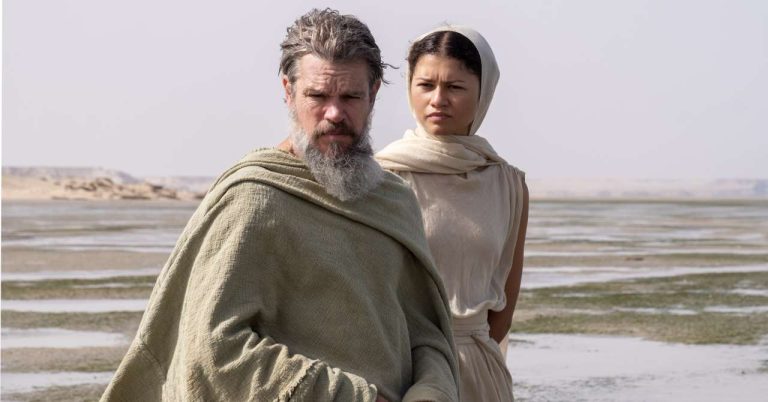

Angoulême 2026 – day 3: Gustave Kervern, Top of the pile, La Frappe, Cécile de France
Every day, a look back at the highlights of the 19th edition of the French-speaking film festival.
Film of the day: That’s it, it’s over by Gustave Kervern
That’s it, it’s over… but for Gustave Kervern it all begins. Because here is the one whose name has always been associated with that of Benoît Délépine at the head of his very first solo feature for the big screen. The tasty TV movie, I won’t let myself do this anymoreon Arte, had opened the way but That’s it, it’s over marks the time for the affirmation of things. The one where the skin-deep sensitivity of the Kervern director meets that of the Kervern actor (Cigarettes and chocolate, This music plays for no one…). Firstly because this film is eminently personal to him. He was born and spent part of his childhood in Mauritius where the action takes place. This unexpected love story between a young girl on vacation in a hotel and a young Mauritian who works there.
Awarded the Jean Vigo Prize, That’s it, it’s over is first of all a film of sensations where the space left for silences and extremely mastered staging between fixed shots and sequence shots allows each spectator to experience it differently. Kerven achieves here a perfect dialogue between poetics and politics. The poetic born from the beauty of its images, from its rhythm refusing to sacrifice any efficiency. Politics through what underlies its story: the ravages of freewheeling globalized capitalism which find a deadly echo in a Mauritian society that has been compartmentalized and therefore unequal for ages.
And if this film differs so much from those of the Kevern-Délépine duo, it is in no way because of a taste for rupture at all costs. Just out of consistency with the content and form of his remarks. But with in common this concern for his direction of actors symbolized by the way in which Suzanne Lindon (in her finest role to date) and the revelation Loïc Mandere burst onto the screen.
Released March 24
Director of the day: Louis-Julien Petit for Top of the pile
Since its beginnings, Louis-Julien Petit has had a desire for a cinema that questions society and more precisely the facts and gestures that, collectively, this society puts under the rug or struggles to put at the heart of a calm debate. Food waste from supermarkets Discountawarded the Public Prize in Angoulême, just before France became a pioneer in anti-waste legislation. Harassment and burnout at work in Carole Matthew. The daily life of homeless women in The Invisibles. The integration of unaccompanied foreign minors through cooking in The Brigade.
Here, nourished by his own experience, it is the abrasive subject of GPA that we find at the heart of his story. The one that a homosexual couple decided to call on to have a child. Louis-Julien Petit describes this journey with documentary precision, the daily consequences on the relationship of this couple, wonderfully embodied by Anthony Bajon and Aliocha Schneider, as well as the questions that this gives rise to in those around them. Louis-Julien Petit does not seek objectivity and his film is in no way a school exercise obsessed with a search for balance between all points of view. But the accuracy of what he shows opens the debate instead of closing it. And that’s what makes Top of the pile important.
Released January 6
The revelation of the day: Julien Gaspar-Oliveri with The Strike
This first feature, discovered during Cannes Critics’ Week, opens with a close-up of a skin without us knowing to whom it belongs. This sequence sets the tone for what will follow: the desire to leave uncertainty at the heart of the story. Because when Anthony (Bastien Bouillon, impressive) leaves prison and finds Enzo, his 19-year-old son, and Carla, his 20-year-old daughter, trying to rebuild their family, we know nothing of this man’s past. Nothing that landed him behind bars. Nothing about the details of his relationship with the children. Yet a disturbance and anguish reign over these first minutes, even behind the smiles and tender gestures.
Julien Gaspar-Oliveri does not manipulate the viewer: incest, the elephant in the middle of the room, will be clearly revealed. But by refusing to say everything right away, the filmmaker finds a relevant angle to tell it. The Strike does not show this incest, any more than it tells a journey of resilience. It plunges us into Enzo’s head, into his dissociated mind, into his impossibility of seeing his father as an executioner, into his inability not to love him and not to prove this love to him through behavior dictated by control. The result is chilling, undeniably trying but remarkable for its mastery of the story and its staging which reveals an author to follow.
Released September 2
Video of the day: Cécile de France for The Marie-Claire Affair
In this second feature film by Lauriane Escaffre and Yvo Muller, Cécile de France plays Michèle Chevalier, the mother of Marie-Claire, a 16-year-old teenager accused in 1972 of having illegally aborted after a rape. A case which their lawyer Gisèle Halimi (Charlotte Gainsbourg) would take up, contributing to the evolution towards the decriminalization of abortion established by the Veil law 3 years later. The actress explained to First the importance that this film requires in his eyes in a world where this hard-won freedom is still regularly contested by some.
Released November 4