Annecy 2026 – Duncan Jones: “In Rogue Troopers, there is not an image made with AI”
Moon, Source Code, Warcraft, Mute… and now Rogue Trooper, adapted from the 2000 AD comic that has haunted him since childhood. Duncan Jones goes back to indie mode, in animation, without AI. Meeting in Annecy.
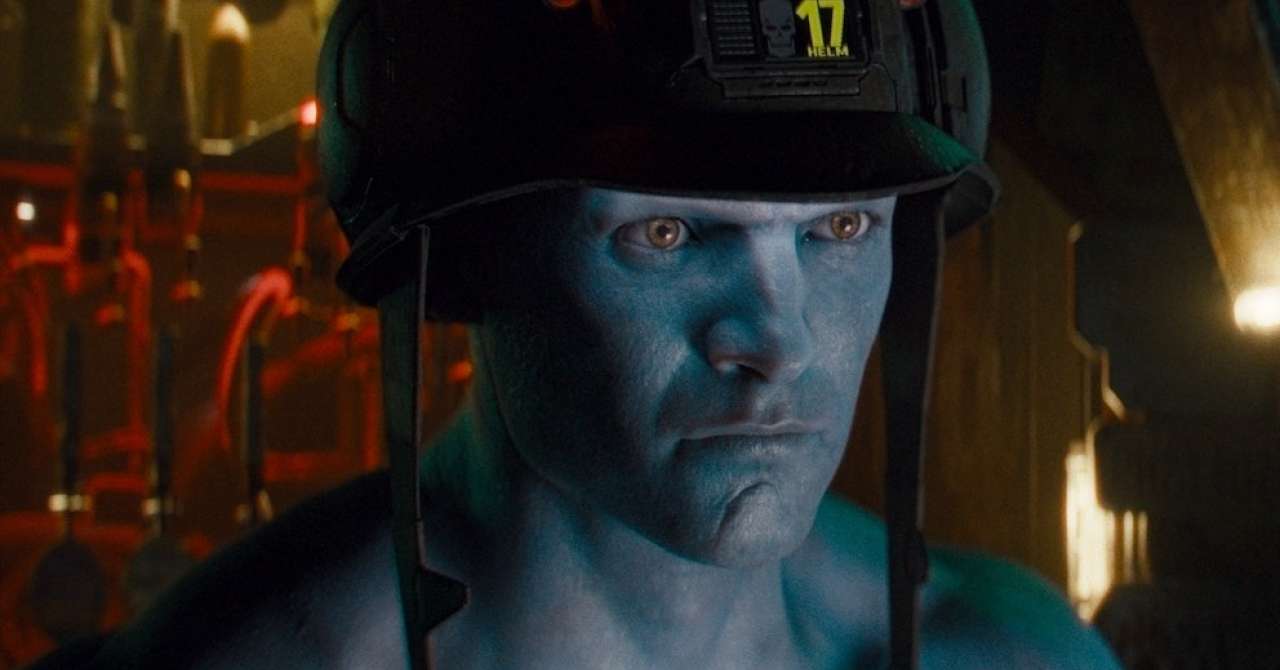
In 2001, Duncan Jones had not yet directed Moon. That didn’t stop him from going to knock on the new owners of 2000 AD to ask them, kindly, if he could adapt Rogue Trooper. We thanked him, telling him to come back when his track record was a little more complete. Twenty-five years later, Bowie’s son arrived in Annecy with his adaptation of Dave Gibbons’ comic strip (very cult in England but relatively confidential here). A pop and reverent satire, a very punk anti-Thatcherite manifesto. Jones made it an indie animated film, without an AI line, carried by the voices (and faces) of Sean Bean, Matt Berry and Jermaine Clement. With his long-time producer Stuart Fenegan, he looks back on the freest and craziest film he has made.
When was the project for this first animated film born?
Duncan Jones: I’m a fan of the comic magazine 2000 AD since childhood. When Jason and Chris Kingsley republished the magazine in the early 2000s, I went to them and told them I wanted to wear Rogue Trooper on screen. I had barely left school… They immediately asked me if I had ever directed a film. And when I said no, they kindly advised me to come back when I did (laughs). And… that’s what I did. I returned there years later. We hit it off, and the idea of adapting Gibbons’ comics together, with an indie budget, bypassing the studios, appealed to them as much as it did to me.
From the start, did you choose animation?
DJ: Not at all. Originally, I wrote the script to be live-action, but already cut for an indie budget. Except that as soon as we looked at the script closely…
Stuart Fenegan: …we realized that it would be impossible (laughs). Anyway, I’m used to it. Every time Duncan sends me a script, he says, “Don’t worry, it can be done cheaply,” and I immediately see that it’s going to be a headache.
DJ: The problem was scale. There weren’t many characters. Two here, two more in this scene… but the sets we needed were insane to build. And then there is the aesthetic 2000 AD itself: the characters are always a little grotesque, almost expressionist, it’s very comic book, bordering on caricature. With flesh and blood actors, even full of visual effects, we would have lost this madness. The animation unlocked everything. As soon as Stuart told me “live action won’t work, but animation, let’s try”, the ideas started to flow. The sets, the action scenes, everything opened up.
That said, we could read that technically, it had been complicated..
SF: We learned by doing it. We changed engines twice to end up with Unreal (the video game engine created by Epic Games and now used in cinema) wanting to do everything with Unreal (a video game engine widely used in cinema). That’s what cost us the extra year. It was complicated, yes, but now we know how to do it!
Jack Lowden, Jermaine Clement… You also used the faces of actors known for the mo-cap.
DJ: Yes and that was sport too! We knew we couldn’t mobilize the cast for very long, and we wanted to avoid getting bogged down in motion capture like on Warcraft. So we did everything in ten days. The core cast of actors was there all the time, and every two days we rotated the supporting roles: one day Jermaine and Matt Berry, the next day Sean Bean and Diane Morgan. The actors loved it: they showed up, rocked their scene, improvised, and we moved on to the next ones. Instead of being slowed down by technique, we focused solely on the faces. This is the key to human performance.
Ah yes, we had forgotten Sean Bean. Well… you obviously know his legend on the internet. He dies in all his films. Should viewers still be worried?
DJ: Yes. I would be in the audience’s place and I would worry a little about Sean (laughs!). There are even two legends hanging around him: that of the guy who dies all the time, and that of the guy who says “bastard” in each of his films. He only came on set for two days and I remember when he arrived on set, Stuart said to me, “He has to say it! Duncan, he ABSOLUTELY has to say it.” We had a lot of fun.
The film mixes war and comedy. We sometimes even think of Monty Python.
DJ: 2000 AD has always been both very political and very funny. It’s even his DNA. And it turns out that I grew up with Monty Python: my godfather is Eric Idle! I’m also an absolute fan of Terry Gilliam’s cinema. Building a world and infusing it with humor is something very natural for me. But until now, I had little opportunity to put it in my films. There, I let go.
You said it, the comic strip was very political, but marked by the English context of the early 80s. Is it still relevant today?
DJ: We started the film around the time of the famous “three-day special operation” (the start of the war in Ukraine Editor’s note). I immediately asked myself if, with a real war going on, it was my role to make a war film? And then I thought about the post-World War II period, at that moment when actors returned to war films almost immediately, to translate what they had experienced, what they had heard. In my opinion, Rogue Trooper is exactly the movie 2000 AD what had to be done now. And the humor that runs through it is the truth of how people cope with traumatic situations.
Moon was a very indie film, Warcraft a big studio blockbuster, Rogue Trooper marks your return to the indie side. Where are you most comfortable?
DJ: Ahaha. Guess! Indie, without hesitation. We did this by tinkering – and I’ll clarify straight away: we did not use an AI line on this film. Today’s technological tools allow anyone who loves world-building and fantasy to create universes that go beyond what the camera can film, at a reasonable budget. If you can find a way, indie offers you a freedom you don’t have anywhere else.
We were talking about influences, there is one we haven’t talked about, it’s Starship Troopers. I thought about it a lot while watching Rogue Trooper. Was it conscious?
DJ: I love the film, and I’m glad you mentioned it, but no, it’s not Verhoeven’s side that we went to draw on. I rather had in mind A bridge too far, When the eagles attack, The Twelve Bastards. That era, that cinema. We even have nostalgic music, very old school graphics. This is what I wanted to reinvent. That said, Verhoeven remains Verhoeven. Between Starship Troopers, RoboCop And Total Recallit’s unassailable.