Fjord, Oklahoma Honey, La Nirvana: what’s new at the cinema this week
What to see in theaters
THE EVENT
FJORD ★★★★☆
By Cristian Mungiu
The essentials
Already winner of a Palme d’Or in 2007, the Romanian Cristian Mungiu relocated to Norway and won the prize again. Thanks to a relentless drama with assumed moral ambiguity.
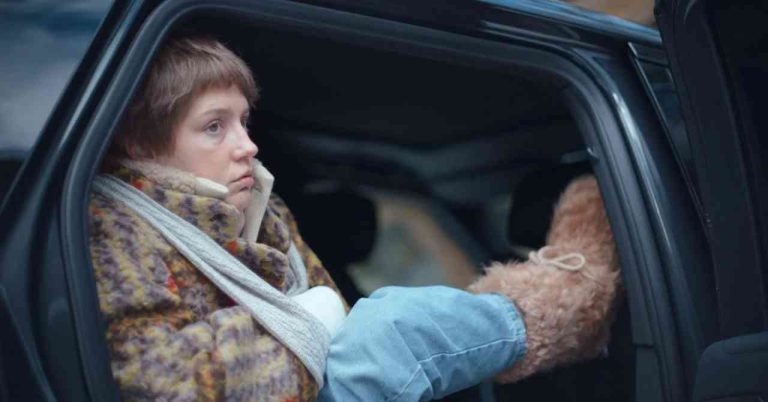
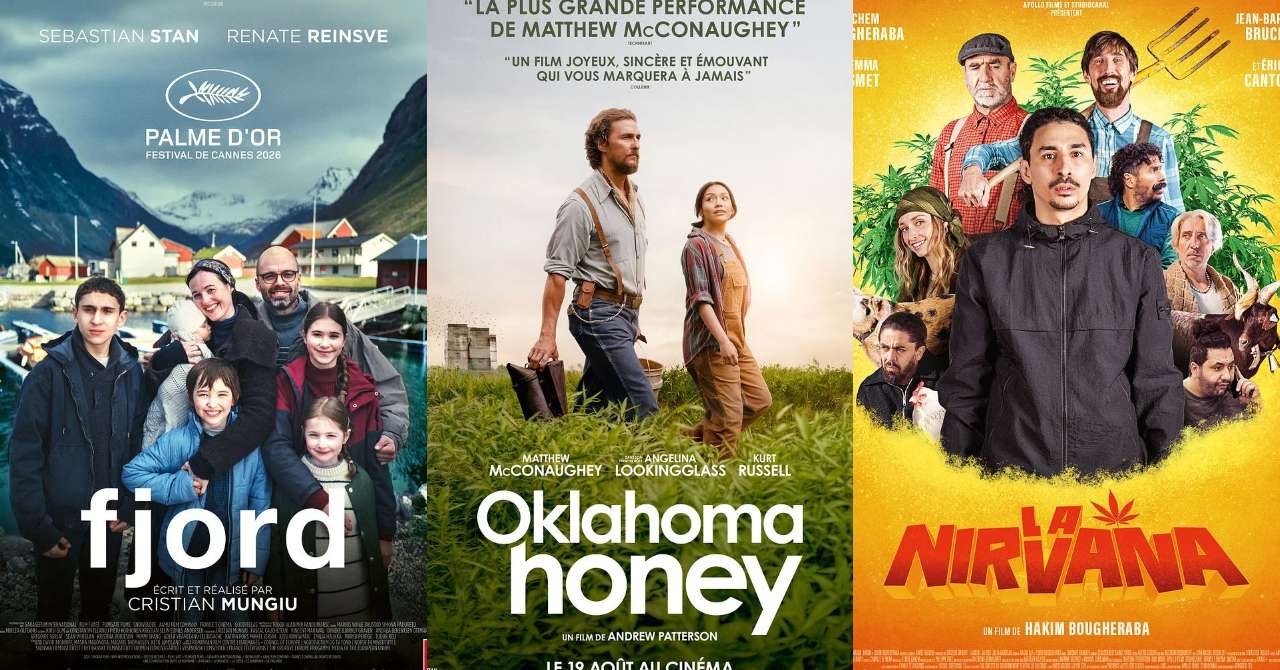
Cristian Mungiu makes a Norwegian fjord the epicenter of the contradictions of our increasingly divided era where we must be for or against and if possible take a position quickly. A family arrives from Romania with their evangelist principles on this little piece of ice. The rather progressive local society welcomes with a bit of skepticism this couple (Sebastian Stan and Renate Reinsve) who raise their toddlers in the love of God. An accusation of abuse against one of their children will ignite the flames and trigger an earthquake within this peaceful community. Everything seems to be decided in advance: the supposedly “good” people against the supposedly “bad” people. Except, not really. You have to know how to agree on words, your conception of education, your place in society… Mungiu puts his audience (only progressives of course!) on the defensive. This Fjord surrounded by sluggish waters will end with a cry of love leaving the spectator with his doubts, his anger, his principles but in no case, his certainties. We only want to land again to rethink what we think we saw. A Palm? Of course.
Thomas Baura
Read the full review
PREMIERE LIKED A LOT
OKLAHOMA HONEY ★★★★☆
By Andrew Patterson
Rustic musical comedy? Southern fable? Malickian thriller? The best way to approach this Oklahoma Honey is to forget the word “story” and look at it like you listen to a great country album. These records that float from one song to another, each piece spinning its own story without ever losing its overall tone. The first beaches are like a solar melodrama. When Kateri resurfaces, a young girl he took in as a child before losing sight of her, Amziah (to whom Matthew lends his magnificent redneck nonchalance) introduces her to honey and community, in a succession of scenes where Patterson films what almost no one knows how to film: the raw joy of being together, the intoxication of ordinary people. Then the album changes face. Hives are stolen, and the bucolic tale mutates into a revenge thriller, Kateri taking up the torch from her mentor and having to face a gallery of bastards. The feeling when faced with this totally incredible object is that of pure discovery. The sensation of seeing a filmmaker take insane risks without ever losing sight of the pleasure of pure cinema. Oklahoma Honey is not afraid of ridicule, emotion or scale. We come away a little groggy, with the heady air of a chorus that we can no longer get out of our heads.
Gaël Golhen
Read the full review
FIRST TO LIKE
THE CONDOR GIRL ★★★☆☆
By Alvaro Olmos Torrico
The voice of young Clara, a professional doula, accompanies the births of the women of her Quechua community. She and her mother witness the miracle of life every day – its drama, too. The weight of tradition is heavy to bear for those who, with their ears glued to their radio, aspire to perform on stage. And ends up, in a predictable teenage crisis, by going off to pursue his dream. Already in Wiñay (which saw two city women embark on an introspective journey into the Peruvian jungle), Alvaro Olmos Torrico questioned cultural frictions in an era of overwhelming globalization. Here, he observes under the microscope the painful agony of native traditions whose spirituality is “parasitized” by the arrival of Western practices, by the departure of the youngest. The Bolivian filmmaker superbly films generational clash and uprising of women refusing the archaism of certain customs.
Chloé Delos-Eray
Find these films near you thanks to Première Go
FIRST TO MODERATELY LIKED
NIRVANA ★★☆☆☆
By Hakim Bougheraba
Hakim Bougheraba leaves the SEGPA court for agricultural France, and the trip succeeds: he offers himself a new setting and a real subject in ambush. Jean, a ruined peasant on the edge of the abyss, sees Foued, a young man on the run, whose 4×4 loaded with grass ends up in his barn, arrive in his fields. From the debt a totally absurd association will be born: growing “organic” cannabis among herds of goats. The film assumes popular comedy – broad strokes and lilting accent – and this time the mechanism works in particular thanks to the duo between Ichem Bougheraba (Foued) and Jean-Baptiste Brucker (Jean). The real question remains: Bougheraba flirts with peasant despair without ever daring to tackle it completely. This is not really its point and we wonder several times whether La Nirvana is a satire of rural downgrading or a simple agricultural comedy. The film will never settle – too bad, there was undoubtedly something else to cultivate underneath. SO ? The guests are funny – Gad Elmaleh perfect in voice and Canadian accent; Cantona having fun in a tasty counter-use – certain situations too, and the Bougheraba reap the laughs without having thoroughly explored their subject
Peter Lunn
PARADISE ★★☆☆☆
By Jérémy Comte
Two characters lacking a father figure. On one side, a fatherless Ghanaian teenager who gets dangerously close to street gangs. On the other, a young Quebecer who wonders if the man his mother is in love with could be the father he never knew… Two parallel stories which will end up becoming one over the course of a story which plays with flashbacks and flashforwards with finesse and fluidity and retains an element of mystery for a long time. It’s when everything becomes clearer that the story is less convincing with a truly failed final stretch, completely contrary to everything that had been the strength of the narrative up to that point. And it is all the more a shame that, through a nuanced writing of his characters, Jérémy Comte avoids all the clichés of the representation in cinema of North/South differences in wealth and expresses all the complexity of situations too often treated in a Manichean manner.
Thierry Cheze
PREMIERE DID NOT LIKE
PROVIDENCE AND THE GUITAR ★☆☆☆☆
By Joao Nicolau
Free adaptation of a short story by Robert Louis Stevenson published in 1878, this new feature film by the Portuguese João Nicolau, thwarts the expectations of an adventure film with a deliberately static staging. It is through the force of dialogues and therefore of incarnation that this story seeks to lead us into a reflection (a wandering?) on the paths of love and art. In an undefined past, we follow a couple of acrobats seeking to perform in a small village. Unfortunately they run into the authorities and find refuge with a couple of artists in the middle of a marital crisis. At the same time, the film lurches into our present where a rock group not really celebrating, tries to defend their latest album with angry and desperate songs. Nicolau (The Sword and the Rose, John From…) creates a comedy or rather a “divertimento” with a light and falsely cheeky tone. However, it is difficult to be interested in this succession of redundant and, frankly, boring sequences.
Thomas Baura
And also
Insidious: Invasion from afar, by Jacob Chase
Marius and the Kingdom of the Seas, by Endre Skandfer
Mutiny, by Jean-François Richet
The covers
Come on, Dad! by Vincente Minnelli
Days and Nights in the Forest by Satyajit Ray
Wake in fright, by Ted Kotcheff