
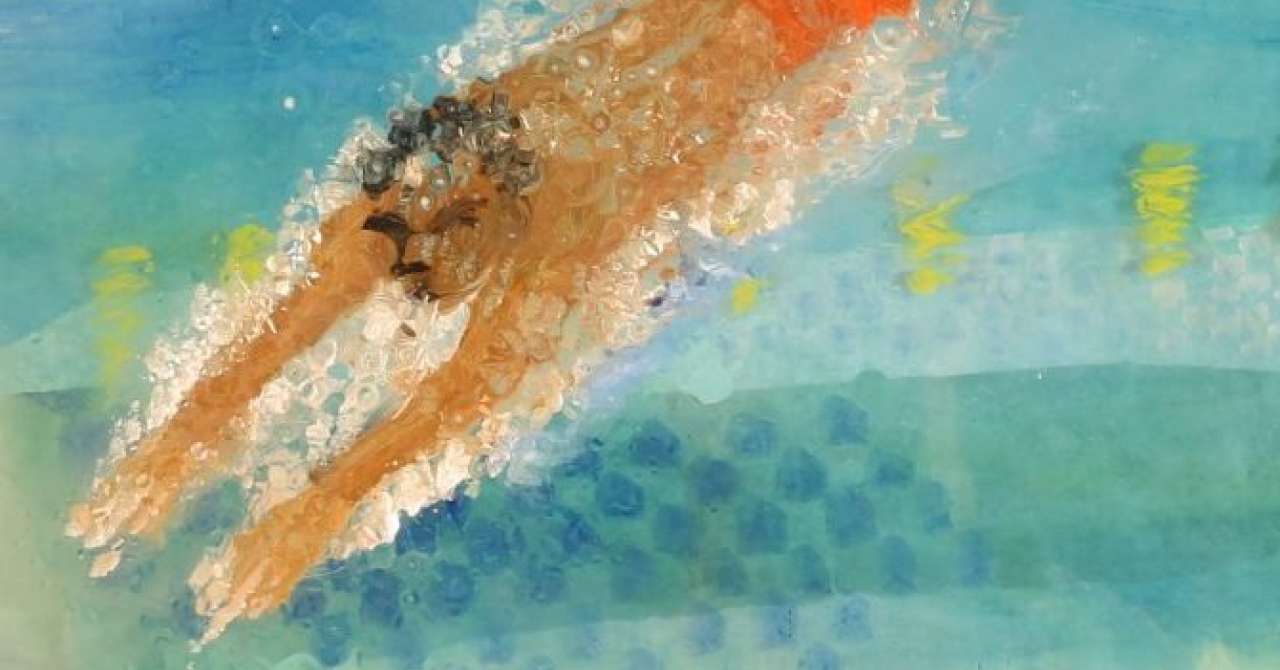
Papillon and the second American campaign of Ron Dyens
Campaigning for the Oscars, Florence Miailhe and Ron Dyens tell the story of Papillon, a hand-painted animated short, which became one of the five films nominated this year in Hollywood.
By Jean-Christian Agid
In the cozy lounges of the private screening room at Maison Barnes, on the corner of 63rd Street and Park Avenue, director Florence Miailhe and her producer Ron Dyens (Sacrebleu Productions) observe, with an eye both amused and conquering, this American audience, comfortably seated on large red sofas, glass of champagne in hand. A chosen, curious, influential audience, come to discover Butterflyanimated short film selected for the Oscars, and see Flow, crowned last year in Hollywood and César for best animated film in 2025.
Ron Dyens and Florence Miailhe know the value of these demanding spectators. If Butterfly is among the five films selected out of 113 candidates for the golden statuette on March 15 in the animated short film category, the battle has only just begun. Every vote counts. Convincing each member of the Academy then becomes a balancing act: talking about art without losing sight of strategy, defending an intimate work in the most competitive arena of world cinema.
This second American campaign (two nominations including an Oscar for Ron Dyens in 2025 with Flow) begins like that of 2025, in New York. She is once again taking part in Animation First, the coveted festival offered by L’Alliance New York, at Florence Gould Hall, and a showcase for the excellence of French animated film in the United States.
It was at the Bilboquet café, right next to L’Alliance New York, that we met Ron Dyens and Florence Miailhe. If the producer of Flow and the director of The Crossing have known each other for 25 years, Butterfly is their first collaboration. Between two screenings, two conversations and two continents, they talk about what it means, today, to take a French animated film to the Oscars and what this transatlantic trip says about the place of art, risk and freedom in contemporary cinema.
Here you are, Ron, on your way to the Oscars again. Two years in a row. Flow, Oscar for best animated film in 2025, was a work without dialogue. This year, Butterfly is a short film made of a succession of animated paintings. What was the adventure of this film, made two years ago, and which has therefore just found itself selected among the best?
Ron Dyens: The pre-nominations are the result of an administrative process put in place by the Academy. One hundred and thirteen films were eligible this year in animation, including Butterfly thanks to its award at the Trickfilm festival in Stuttgart. Then we entered a select group of 15 films before ending up in the club of five nominees.
What does this Oscar nomination, Florence, and this American campaign mean to you?
Florence Miailhe: The reward of seeing your work recognized. No matter the outcome, it’s recognition! I do animation in a particular way; it is an animated painting. To show this artistic technique is fantastic. And going to the Oscars, with my slightly middie side, is the pleasure of seeing Los Angeles and the beautiful dresses on the red carpet!
RD: And then what is beautiful, while Florence was recognized for all of her work with a Cristal d’Honneur at the Annecy festival, is to see this film have an exceptional journey. Butterfly is a counterweight in balance with Florence’s entire work.
The Oscars are ultimately the culmination of professional and global recognition.
RD: Papillon was screened in 140 festivals. He won around forty prizes including, above all, ten public prizes, including the Crystal Bear at the 2024 Berlinale. It was a young jury of amateurs and not professionals. And that is the greatest reward.
Here you are, two years later, in New York, at the start of the Oscar campaign, which will take you to a festival in Santa Barbara. Everything remains to be done!
RD: We are nominated, it reflects a nice path of recognition. We are going to increase the number of screenings and questions/answers with the American public.
To engage with and reach Oscar voters.
FM: To give them the opportunity to see the film. This is the first step.
What is the consequence of this nomination on the life of the film in the United States?
RD: As in previous years, all short films nominated for the Oscars benefit from a theatrical release thanks to a partnership with Roadside Attractions. It’s a real public conversation with the other films that is taking place.
What surprised you at last year’s Oscars?
RD: The adventure of Flow was totally different. From the start we agreed that Latvia and not France would be the majority producer. My Latvian colleague accompanied the director Gints Silbalodis, also Latvian. I played the role of a sounding board while this year, I am with Florence, on the front line.
So this is “your” campaign this year. It started with a private screening at Maison Barnes and continues with a selection for Animation First at L’Alliance New York, along with another French nominee in the best animated film category, Arco. Like in 2025.
RD: Animation First is a festival that is gaining recognition and becoming a counterpart to the animated film festival in Los Angeles. New York is also, after Los Angeles, the second city with the largest number of voters. We must go to meet them and defend with them Butterfly. It’s more difficult in a foreign country because we don’t necessarily have the codes and our presence is rare here. New York friends, take advantage of us, abuse us!
After New York, you leave for California, before returning to France, then Berlin; Florence, finally, will return to California at the end of February. What did your first experience at the Oscars teach you?
RD: That times are changing a little. The acceleration of technologies and a new way of structuring teams gives a chance to films from smaller territories. The fact that the Academy is opening up to women and countries other than the United States also leads to a change in the typology of choices and in the geographic origin of voters. This openness also benefits from different points of view, ideas, and techniques.
Butterfly is an eminently political film, a bit like Flow ultimately which evoked both a need for humanity and an understanding of climate change! A trend?
RD: Every film is political. Florence’s film is about what happened with the rise of Nazism.
FM: The story of Butterfly is inspired by that of Alfred Nakache, born in 1915 in Constantine in Algeria. He was Jewish, and very quickly he became a swimming champion in North Africa. He then accumulated awards in France, a bit like Léon Marchand today, and was selected in 1936 for the Berlin Olympics. The French team will finish fourth. But despite all his victories, Nakache will be a victim of anti-Jewish laws. His friends, his coach and other swimmers helped him take refuge in Toulouse, in the free zone, but he was finally deported to Auschwitz, from where he returned, but without his wife or daughter, who died in the camps.
Why did you decide to tell this story now?
FM: I had the opportunity to meet Alfred Nakache once, who was a friend of my father, a member of the resistance in Toulouse. Alfred Nakache’s younger brother also taught me how to swim and butterfly when I was ten. It was at this time that I met Alfred; I was proud to show him that I knew how to swim the butterfly but I didn’t know his story.
Your work, this painted animation film, now tells us this story. That of an unexpected champion, whose glory surprises the French in mainland France but does not resist the inhumanity of the Nazis, that of a man on the ground who loses almost everything and then rebuilds himself. This echo of the past thus resonates with our contemporary history.
FM: It’s a political film. I wanted to talk about anti-Semitism, discrimination in sport, and make a link with this story of a Sephardic Jew from the 1930s, world record holder in butterfly swimming and victim of the Nazi regime. His personal story meets that of fascism, which will turn his life and career upside down. I wanted to make this film because I realized that many young people did not know the history of the holocaust and the Shoah. Auschwitz! This word means nothing to them at all. And then Nakache was stripped of French nationality, like all Algerian Jews under Vichy laws, which I thought was good to remember. That said, Papillon is not a documentary film but an animated film, therefore poetic and metaphorical.
Is this not perhaps the reward of this nomination: Butterfly in France becomes Butterfly in the United States?
F. M: Bringing the story of Nakache to the other side of the Atlantic is for the memory of Alfred Nakache, for his family, unexpected!
>>> ANIMATION FILM IN THE HONOR IN NEW YORK
For its 9th edition, Animation First, the only French-speaking animated film festival in the United States, put Belgium in the spotlight and brings together the French-speaking nominees for the 2025 Oscars.
Presented by L’Alliance New York since 2018, Animation First received recognition from the New York Times from its inception. “ With Animation First, we have become the relay for excellence in French-speaking animated films in the United States. “, explains Tatyana Franck, President of L’Alliance New York. “ I hope that we will support this exceptional cinema in its quest for distribution and audiences, and prizes to reward completely original artistic expertise. “.
In 2025, Animation First welcomed Michel Hazanavicius with his film, The Most Precious of Goods and Ron Dyens with Flowthen on its way to the Oscar for best animated film of the year.
“This year, among the films presented, we are proud to show the New York public and Oscar voters the film Arco by Ugo Bienvenu, who also signs the poster for the 2026 edition of the festival and the short film Butterfly by Florence Miailhe” adds the President of the Alliance.
This edition is marked by a wish from the directors of “ tell stories that resonate with contemporary political and social issues », explains the co-director of Animation First, Delphine Selles, “ and also explore lighter topics about friendship and epic adventures “.
In total, Animation First offers six days of programming for more than 3,000 spectators, adults and children, two competitions, workshops and meetings with directors and producers.
More information: https://lallianceny.org/animation-first-festival/


