Series – The Shards: Paranoid Los Angeles (review)
This series by Ryan Murphy, adapted from the great novel by Bret Easton Ellis, immerses us in the very wealthy and falsely carefree Los Angeles of the 80s. A success.
The Shards is the adaptation of Bret Easton Ellis’ latest novel translated here, Les Éclats (2023), a great book which had all the makings of a last stand for the 62-year-old American novelist. Not that the cause was lost, but it was difficult to imagine that he would still be capable of republishing the feat of a text as powerful as Lunar Park (2005), an autofictional turn on the borders of the fantastic.
His Imperial Suite(s) (2010) was, in fact, lost in the swamps of repetition, as for his essay White (2019), he presented Ellis as a type who is always brilliant but disillusioned, even downright reactive. Les Éclats, going back to the very source of its creative juices, masterfully extended its Search for Lost Time, which emerged in the mid-eighties with Less than Zero and continued with The Laws of Attraction (1988), the hit American Psycho (1992) and Glamorama (2000).
The appearance of perfection
There we find young, beautiful, rich, white characters, of whom Ellis paints a portrait through his pen that is both loving and nauseating. These kids, splendid as Greek gods, dressed from head to toe in Armani, Ray-Ban, Gucci…, drug addicts to the tips of their nostrils, evolve in the very wealthy area (here the Hollywood Hills) that their parents granted them: prominent lawyers, Hollywood producers, surgeons to the stars… A world under a bell clinging to the tempestuous and arrogant 80s, Olympus that everyone would like to reach while sensing its slope infernal, the trap he closes. Where everything has the appearance of perfection, there are only mirages, as the hero of Less Than Zero observed, disillusioned: “The dance floor is covered with people, almost all of them are young, almost all of them are bored, almost all of them are trying to show that they are having fun. » Often at Ellis, they even end up killing each other.
The Shards, then. June 1980, cinema release of The Shining by Stanley Kubrick. Young Bret Ellis (Igby Rigney) rushes to discover it in a strangely empty downtown LA room. It is there that a young man appears to him whose beauty and aura immediately captivate him. He doesn’t know it yet but Robert Mallory (Homer Gere, son of Richard), a dark ephebe, will soon join his gang. It will even be the center of attraction. A Mephistophelian attraction because Bret Ellis is firmly convinced: the magnetic Mallory is in reality a dangerous criminal, perhaps even “the Trawler”, this serial killer who kidnaps and tortures, according to a sectarian satanic rite, kids from the valley.
Ryan Murphy’s touch
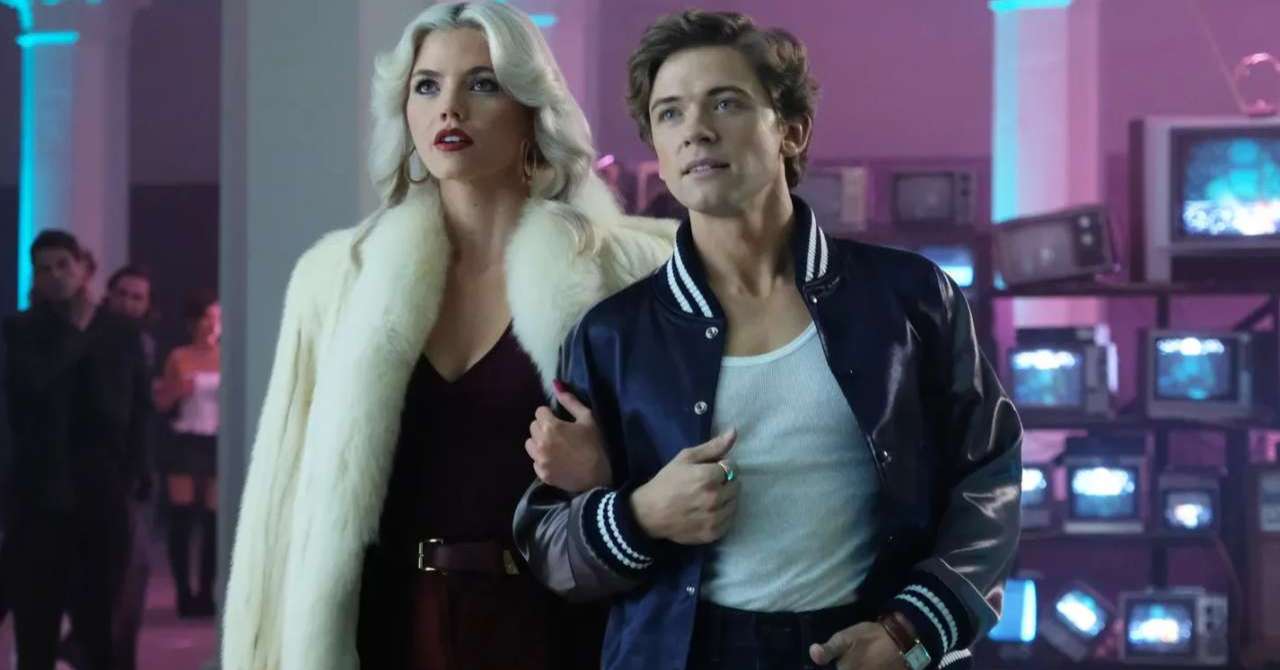
Around Bret, there is also his girlfriend, the superb Debbie with unreal blonde (Hayes Warner), the too perfect Susan (Kaia Gerber, daughter of the ex-top model Cindy Crawford and therefore half-sister of the aforementioned Homer Gere), in a relationship with the too perfect Thom (Graham Campbell). All of them are in their final year and sense the imminent end of this childhood that made them the kings and queens of the ball.
Produced, packaged, scripted and co-directed by star showrunner Ryan Murphy (Nip/Tuck, Glee, American Horror Story…), The Shards could at first glance give the impression of being like its protagonists, that is to say prototypes frozen in their own cliché whose shards reverberate on the straight rims of a Porsche 911 Carrera 4 launched at full speed on Mulholland Drive to the rhythm of “Rapture” by Blondie.
To restore Ellis’s precise and sharp prose, one must wallow in the stupor of his imagination and manage, as in a fifties melodrama by Douglas Sirk, to scratch the surface to see the darkness flowing through its cracks. Few companies have succeeded in this, with the notable exception of Laws of Attraction by the edgy Roger Avary (2002).
Black magic theater
This series in nine episodes, although uneven, achieves this by keeping its focus on the corrupted horizon of this narrow universe where reality responds to a strange logic. Apart from Bret Ellis, the piss-cold on duty aware that a tragedy will soon engulf them all, the others can’t seem to look beyond the next party they’re throwing. For them, it is a matter of not sinking into the abysmal void that surrounds them. Nothing is true, starting with the love that everyone is supposed to have for each other. The parents, of whom we only see a caricature couple – him, a tanned producer with visceral arrogance (Wes Bentley); she, a frustrated actress (Evan Rachel Wood) -, reflect the image of what everyone could become in this world.
A cruel tale, a theater of black magic, the protagonists of The Shards live as if removed from the world of the living. Nothing and no one exists outside of them. Signs from outside struggle to reach them, not even the repeated violence of a serial killer which we nevertheless pretend to frighten. The plot may replay The Silence of the Lambs or Zodiac for us in places, but it doesn’t work, for the simple reason that our young people are already dead. In these conditions, there is obviously nothing to expect from the final whodunit.
Happy chaos
The series takes into account this devitalization where beauty, never contradicted, becomes artificial and therefore incapable of producing anything other than its own annihilation. In its big moments (Episode 5, “Murder on the Dancefloor”), the series wields a jubilant sense of the absurd. The set of a game show in which our heroes participate reflects the never-misleading reflections of a grotesque world where the notion of representation, through its implacable mechanics, organizes joyous chaos.
In comparison, the “Shakespearean” episode (Episode 8, “Hamlet”), where the artifice of the theater is inserted into the continuity of the story, borders on the explanation of the text. What matters since all that matters is the logic of the narrator, Bret Ellis, this Proustian Swann, witness to a decaying society and held prisoner of his inspiration. Because The Shards is the story of an 18-year-old kid who is trying to write his first novel, which he would immediately like to convert into a film script. Its title? Less than zero. The circle is well closed.
The Shards. Nine episodes available from August 6 on Dinsey +