Cannes 2026 – day 5: the master Sorogoyen, the “AI” of Kore-eda, the performance of Marion Cotillard…
Every day, the hot spot live from the 79th Cannes Film Festival.
Film of the day: The loved one by Rodrigo Sorogoyen (in competition)
Funny echo from Cannes: one year later Sentimental value by Joachim Trier (Grand Prix 2025), where Stellan Skarsgård played a cynical filmmaker offering his daughter to be the star of his new film, Sorogoyen enters the competition with a similar pitch. Javier Bardem is a director who, to make up for his failings, casts his daughter whom he has not seen for years. A funny echo, it was said, coupled with a beautiful irony: Skarsgård sits this year on Park Chan-wook’s jury.
Especially since for the Spaniard, the stakes are high. It’s his first film, his first non-thriller film, and undoubtedly the best thing he’s done in his career (which is saying something).
The loved one opens with a delay. Five minutes. It’s nothing. Except that we can already sense a tension in Bardem’s neck. Father and daughter haven’t seen each other for a long time. They try to talk to each other. Can’t do it. Succeeds for a few seconds, before failing again. This intro, a true piece of bravura, stretches for twenty minutes, as if viewed through a window. And the entire film will be held on this line which is reminiscent of Bergman or Pialat. Sorogoyen films the melodrama and the duration as one tightens a rope: just enough for it to vibrate, never enough for it to break.
Bardem plays in a low voice and devours the screen with his raw charisma. Vicky Luengo, opposite, doesn’t give him an inch. We loved the dry Sorogoyen of the first thrillers; we discover him even more in control of his means in the family drama which he invests with the same sense of tension and suspense. We just have to hope that Skarsgård will not arrive late for the screening.
The true/false remake of the day: Sheep in the Box by Kore-eda (in competition)
In 2013, Steven Spielberg is president of the Cannes jury and Hirokazu Kore-eda already in competition with Like Father, Like Sona sort of rereading of Life is a long river quiet on a dramatic register. The film had a great effect on Spielberg, to the point that he acquired the rights shortly after to remake it (a project which never saw the light of day). A very strong candidate for the Palme d’Or, until The Life of Adèle does not silence the competition.
2026: Kore-eda is back on the Croisette and this time it’s his turn to tackle a true/false remake of the American. Does the story of a robot kid in search of identity and emancipation mean something to you? Sheep in the Box looks very much like a AI Artificial Intelligence pocket where a grieving couple offers themselves an android copy of their deceased son. The comparison ends there, Kore-eda preferring to deal with his favorite themes on filiation rather than plunging into existential dizziness. But we are firmly awaiting his rehabilitation from Jurassic Park or Ready Player One for 2027.
The performance of the day: Marion Cotillard in Karma (outside competition)
After the transparency Him and a Asterix which despite its 4.6 million admissions earned it a critical volley of green wood, Guillaume Canet necessarily played big with Karma. Not a double or double but almost. And, although this is not the case within Première where he clearly divides, the first reactions seem to show that he is on the verge of winning his bet for his return to the thriller (which earned him the Director’s César for Don’t tell anyone) with his darkest film, diving into the world of sectarian excesses.
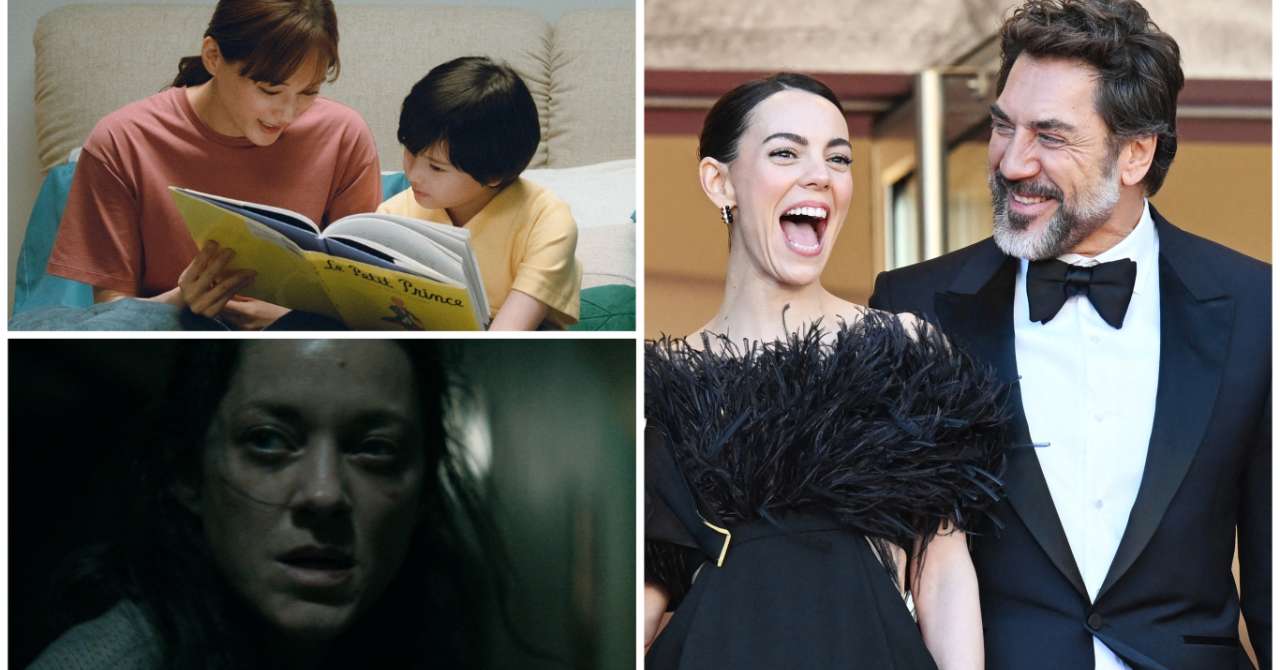
And in the enthusiasm of the reactions that we have heard since yesterday: one name keeps coming back. The one for whom he wrote this film: Marion Cotillard who plays a French woman exiled in Spain unable to expel from her memory a traumatic past which will very quickly catch up with her. Even though we are used to it, we remain captivated each time by his way of giving body and soul to a role. Whether in specialized projects (little girl blue, The Ice Tower where the new Mandico, Roma Elasticapresented here next week) or like here more mainstream. She embodies her characters in the first sense of the term, seems to play as if her life depended on it, without fear of going to extremes in screams, tears, rage.
A total letting go, without fear of ridicule, in a relationship of absolute trust with her partners (including the immense Denis Ménochet) and her director who says that she does not play any take like the previous one without ever asking which one will be kept during editing. After Léa Drucker, Léa Seydoux and Virginie Efira, the French actresses overturn everything in their path at the start of Cannes 2026.
The cramp of the day: Scarlett Johansson left James Gray in sight
Paper Tiger was presented this Saturday in competition in Cannes. The return of James Gray to the Croisette, a little “forced” by Thierry Frémaux while the great American filmmakers were absent (may Ira Sachs forgive us). We know that the author of The Night belongs to us was reluctant to return to a Festival where he has competed five times for zero prizes.
Will he leave empty-handed a sixth time? This film multiplies the references to his first works (Little Odessa, The Yards) has great arguments, and he was entitled to his traditional standing ovation at the Grand Théâtre Lumière. Adam Driver and Miles Teller were by his side, but not Scarlett Johansson. Gray tried to call him on Face Time to share the moment with him, without success. A pout from ScarJo? No, she’s in the middle of filming the remake of The Exorcist. But it results in a sequence that is unfortunately unflattering for the director, who spoiled the moment a bit instead of taking advantage of the audience’s cheers.
#ScarlettJohansson missed the #Cannes world premiere of “Paper Tiger,” so director James Gray tried to FaceTime her during the film’s 7-minute standing ovation. To her dismay, she didn’t answer.
Johansson, who stars alongside Adam Driver and Miles Teller, couldn’t make the… pic.twitter.com/ID4ZNJIEk5
— Variety (@Variety) May 16, 2026
The explosion of the day: La Gradiva by Marine Atlan (Critics Week)
In 1994, at the initiative of Chantal Poupaud, Melvil’s mother, Pierre Chevalier d’Arte and producer Georges Benayoun gave birth to All boys and girls their agecollection of nine TV films on the theme of adolescence, some of which (Cold water by Olivier Assayas, Wild Reeds by André Téchiné…) had been released in theaters after passing through the parallel selections at Cannes.
Thirty years later, we can see La Gradiva a child of All boys and girls their agea reference claimed by its director, Marine Atlan, a very talented cinematographer (The Rapture, The Queens of Drama…) who here signs her first feature film as a director. A film like an emergence. That of a group of young actors with no on-screen experience (accompanied by the brilliant Antonio Buresi) and astonishingly accurate, truthful and intense in the central roles: a group of high school students going on a school trip to Pompei.
And this new breath takes this teen movie far, very far, high, very high, which shifts into a Douglas Sirk-style melodrama. La Gradiva is a 2.5 hour fresco which masterfully brings together the sacred and the profane. One of the most beautiful cinematographic gestures since the start of Cannes 2026. A serious candidate for the Caméra d’Or.
The beautiful story of the day: Eva Huault and Lila Pinell for Shana (Critics Week)
At 10 years old, Eva Huault meets Lila Pinell at the summer camp where she has come to film a documentary. Eight years later, Pinell found her on the networks and entrusted her with Shana, the central role of his short film King David – who won the prizes before being nominated for the César. Eva Huault was then the waitress or the dishwasher. She returns to the kitchen before the cinema finally comes to get her. His poise, his naturalness and his accuracy quickly attract attention.
Teddy Lussi-Modest caste for No waveNoé Debré for The Last of the JewsAlice Douard for Proofs of love and recently Julien Royal for Fight. But it was Lina Pinell who offered him his first major role – an extension of Shana du King David. She plays a young woman who has a series of problems, money problems, toxic guy. The rhythm and thunderous energy of the story owe a lot to this irresistible actress who is as convincing in the cavalcades as in the intimate moments.
The revelation of the day: Julian Swiezewski in Fuel oil in the arteries (Critics Week)
Beautiful love story at the bottom of the truck, Fuel oil in the arteries tells the story of the thwarted love between two truck drivers who are addicted to each other, but whose incompatible itineraries prevent them from fully living their passion. Presented in a special screening at Critics’ Week, Pierre le Gall’s film is based almost entirely on the poetry he manages to infuse into their fleeting encounters in soulless parking lots, as well as the sensitive performances of Alexis Manenti and the Pole Julian Swiezewski. Completely unknown to us, the latter offers himself without shame to the camera, both very raw and perfectly luminous. A revelation and a real cinema sensation.
Bad idea of the day: AI in Soderbergh’s documentary on John Lennon
Two months without a documentary on the Beatles was starting to feel long. For addicts, Steven Soderbergh came to Cannes with a film on John Lennon’s very last interview, recorded for a Californian radio station with Yoko Ono, on December 8, 1980, just a few hours before his assassination. The film reveals this joyful, deep, peaceful interview, where the bespectacled Beatle brilliantly evokes a whole bunch of subjects – Yoko, Paul, feminism, junk food…
Soderbergh unfortunately saw fit to illustrate part of his remarks with AI-generated images, and the result is as ugly and inept as one might have feared. The spectator finds himself stuck in the middle of a paradox, listening to the voice of an artist (Lennon) who speaks in a luminous and visionary way, but at the same time suffering the hideous images prompted by another artist (Soderbergh) who has completely resigned. All produced by Meta, which would probably not have been entirely to the taste of the singer of Gimme Some Truth.
Today in Cannes
In Cannes, we are not idle on Sundays. Like Saturday, there are even three films in competition. And not least: Mill by Lazlo Nemes with Gilles Lellouche, Madder by Jeanne Herry with Adèle Exarchopoulos (on the cover of the new issue of First) And Hope by Na Hong-Jin, the great return of the director of The Strangers and undoubtedly the biggest expectation of the editor this year. Without forgetting The Third Night by Daniel Auteuil, who caused a sensation outside of competition two years ago on the Croisette with The Wire.