The Man Who Shot Liberty Valance, John Ford’s twilight masterpiece
One of the greatest films on staging, morality, politics and the contradictions inherent in US democracy. A classic long underestimated before a late canonization, to see or rewatch this evening on Arte and Arte.tv.
James Stewart arrives twice in the small town of Shinbone.
First by train, with his wife. He has gray hair and a white hat. When he arrives, he recognizes the old, cowardly sheriff (Andy Devine), his voice derailing, his big belly sticking out and his good-guy look overflowing with affection. Stewart is Ransom Stoddard, Senator, a role whose film will make us understand both the local dimension and the inevitable distance. Being the delegate of a town, going to township meetings, confronting the barons of Washington (superb histrionic act by John Carradine, the man who killed Jesse James in The Beloved Brigand of Henry King), obtain the nomination to become a state delegate, etc. : a political obstacle course with the challenge of going far away, over there, in Washington, to serve a purpose. It is from this perspective that we must look at the very beginning of the film, this palpable sensation that American democracy, in its version of conquest of the West, cannot be uncorrelated from its geographical dimension and the distances to be covered.
The first time, thirty years earlier but fifteen minutes later in the film, when the big flashback which constitutes the bulk of its footage opens, Ransom had come by stagecoach. Then, there was no railway, the country was therefore larger, the journey more exhausting, to transport one’s books and a few notions of law there, at the end of the end of a country which would only truly become a Nation on this condition alone. No easy feat. Maybe we need a gunshot to help. Or rather (spoiler?), a Winchester shot.
The route taken by the stagecoach is an old studio piece, filmed in tight shots. The western town in which almost the entire film takes place is that of Paramount Studios, a B-movie or TV series town in which Rick Dalton (aka Leonardo DiCaprio in Once Upon a Time… in Hollywood) could have played. We are talking about John Ford, however, the King filmmaker, the God of US directors. Still, Ford or no Ford, he has no choice: not a single corner, it will be a corner of the studio and a piece of scenery filmed a thousand times – and in black and white please. Six years after the doors opened as far as the eye could see on Monument Valley in Technicolor The Prisoner of the Desertthere is a scent of declassification there.
What doesn’t change, however, is the splendor of the cast, led by John Wayne in the role of the tough meat guy and James Stewart in the role of the young lead as tender as a marinated chicken breast. The two were 54 and 53, which always made some of the scenes comical (Stewart sometimes tries to pretend he was filming The Shop Around the Corner the week before), but that HD – and particularly 4K – reveals with a certain cruelty, wrinkles and crevices on faces filled with foundation.
Oddly, it’s almost better this way, as if the “meta” dimension of the film further gained from the real age of these two well-weathered actors to whom John Ford offers a kind of reflective flashback in a film cut in black and white, in the style of the cinema of the 30s which revealed them. They are therefore “themselves”, or rather a version of themselves (the John Wayne of the Republic westerns or The Fantastic Ridethe James Stewart of Lubitsch or Capra), their emotional maturity allowing them to fully embrace this return to the past, this return to themselves.
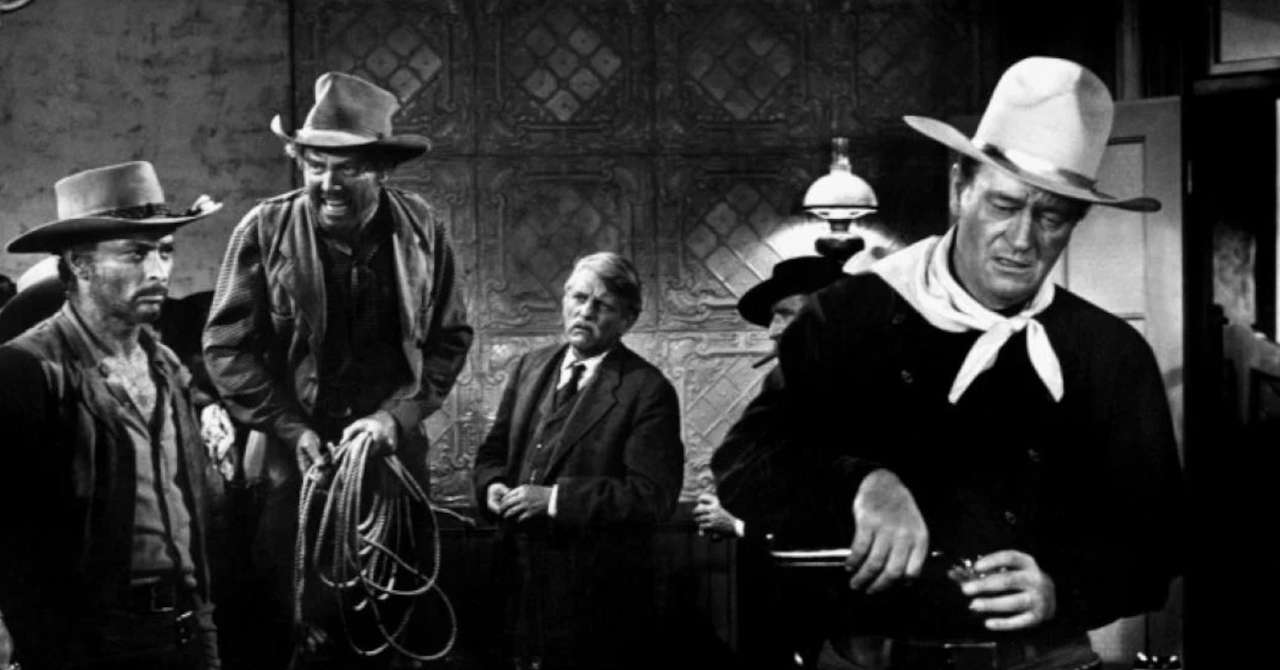
John Wayne in particular is astonishing as Tom Doniphon, arguably the most profound and mythological role of his life, and his last for Ford (aside from the mini-sketch of The Conquest of the West a few months later). There’s “That’s my steak, Valance” as you enter the frame, hip forward, there’s “Pilgrim!” » by bursting the cans of paint with a spinning gunshot, there is his way of opening and closing the two doors of the electoral convention, in Sergio Leone outfit, to come and pull up the straps of the man who stole his wife, his glory and his life.
A success upon its release, the film was for a long time only a semi-classic, crushed in the great order of Fordian westerns by The Fantastic Ride, The Infernal Pursuit, The Heroic Charge or (especially) The Prisoner of the Desert. It was considered a film from another time, almost has-been, cheap, theatrical, the opposite of the epic era (1962, the year of Lawrence of Arabiaof Longest day or the first Bond) which saw it born, an ostensibly outdated western, not even two years before the spaghetti revolution launched by For a handful of dollars (1964).
And then the parable began to take hold, to be taught in philosophy classes, the phrase “print the legend” becoming one of the great world cinematic totems, with a grammatical error which imprinted it in the collective unconscious on a misunderstanding, almost a misinterpretation. We have often seen it as an order in the imperative when it was a fatalistic observation: what do you want, my good sir, this is the USA, we print the legend…
This is perhaps the most beautiful moral paradox ever filmed. Ransom Stoddard only ends up being convinced to take the royal road that will make him Senator when he learns that the legend that surrounds him is only an illusion, an effect of staging, a question of camera axis and the result of the chivalrous gesture of his rival in love, a bad loser but a good player. However, it is indeed for the legend that people will vote by acclamation…
Today, the film is duly pantheonized, in the name of the mythological and philosophical clarity with which it organizes the opposition between the two Americas: east and west, north and south, elitist and profound. John Ford plays with genius this antagonism of incarnation: two types of force, two immense pasts of actors, two possible identifications for the spectator, ordered to dissociate his guts and his brain, his excitements as a little boy and his reflections as a man.
In the end, we are old, we light a cigar and we take the train in the other direction, to cross a country which, in the meantime, has undergone its industrial transformation. Is it far, Washington, darling? Oh, not so much. Less and less, anyway. Time to smoke a cigar while reading the newspaper then take a little nap, and we’ll be there.