
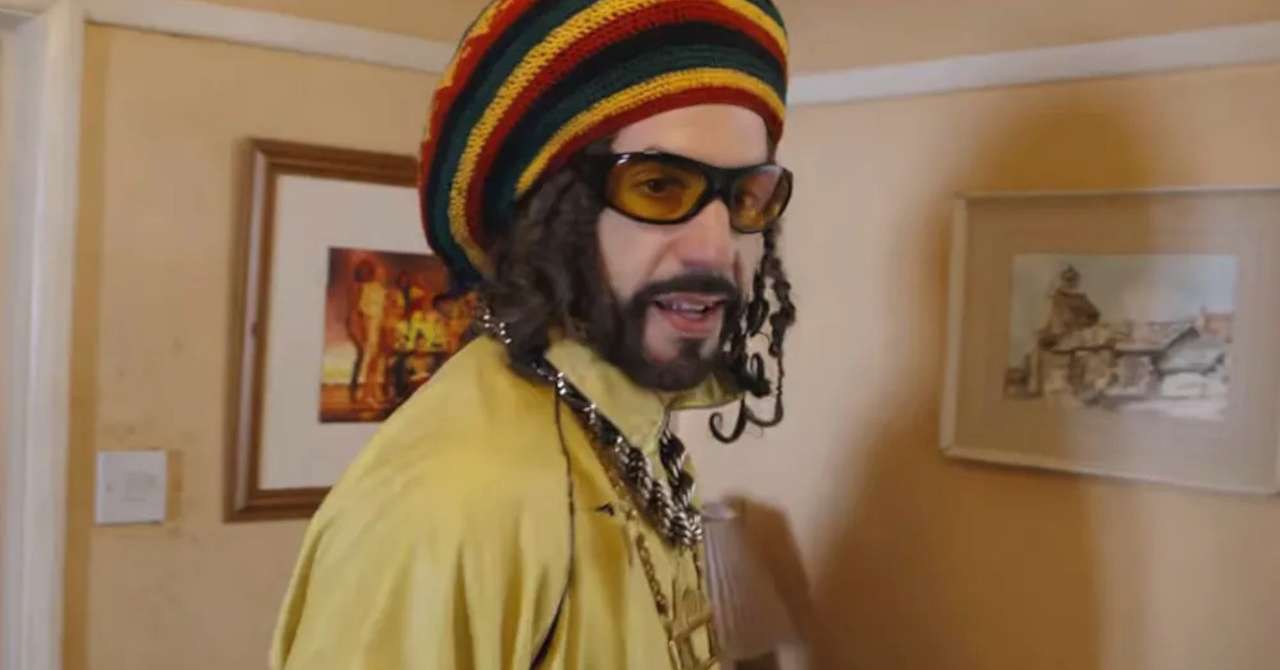
Does Ali G still have his place in 2026? The return of Sacha Baron Cohen is already controversial
More than twenty years after his last appearance, the return of the character is already controversial in the United Kingdom, accused of being “racist” and outdated. A campaign is even calling on cinemas not to show the film.
The great return ofAli G does not enchant everyone. Especially in the UK.
While the trailer for Ali G: Who Is I? was unveiled a few days ago, Sacha Baron Cohen’s new comedy, expected on October 23, is already facing significant controversy in its country of origin. In this new mockumentary devoted to his satirical character, Ali G appears in particular with his fake dreadlocks and his Rasta hat. He also talks about his desire to become an “absent” father. Images which quickly sparked reactions on social networks, with some Internet users denouncing a “racist” and “outdated” caricature.
The protest took on a new dimension with the launch of a campaign by NewsCord, a platform specializing in information comparison and media monitoring. Its objective is clear: to ask cinemas around the world to refuse to show the film. NewsCord claims to have already received requests to send more than 40,000 emails to major cinema chains.
The organizers accuse Sacha Baron Cohen of using satire as a “cover to perpetuate racist stereotypes“. To support their campaign, they notably brought out a press article published in 2000, just two years after Ali G’s debut on British television. Several black British comedians then described the character as a “alibi for racism“.
Ali G first appeared in 1998 in The 11 O’Clock Showon Channel 4. Sacha Baron Cohen played a particularly idiotic young white man, convinced that he was a representative of British and Jamaican hip-hop culture.
The principle of the character was based precisely on this ignorance: Ali G was intentionally offensive, and the joke consisted of making fun of his lack of culture, his prejudices and, more broadly, cultural appropriation. The character quickly became a phenomenon across the Channel. He got his own show, Da Ali G Showbefore arriving at the cinema in 2002 with Ali G. A success which largely contributed to making Sacha Baron Cohen an international star.
But his humor was already far from unanimous. In the article in question, published in 2000, the actor Felix Dexter thus considered that Ali G allowed “for the liberal middle classes to laugh at black street culture in a context where they can maintain their sense of political correctness”.
Criticisms which, 26 years later, are taken up by opponents of the new film.
The current controversy finds an echo in a text published by Afua Hirsch. In this publication on Substack, the British writer and journalist deplores this comeback and talks about how Ali G shocked her when she was a teenager: “I just knew he was making fun of us.”she writes, before explaining that the character seems to her today to be totally out of step with her times: “Black people don’t dress like that anymore. Even white people who imitate black people don’t talk like that anymore. Sexualizing black women and casually mocking working class women is no longer accepted today.“For her, Baron Cohen’s humor would now be “a coarse mixture” of all these stereotypes.
Faced with this campaign, however, British operators do not seem to want to play referee. Interviewed by Variety, Phil Clapp, head of the UK Cinema Association, points out that cinemas are not there to censor films or to decide for the public what can or cannot be considered acceptable:
“Cinemas are there to interest and entertain the widest possible audience. They are not there to act as censors or arbiters of public taste.“
Once a film receives its approval from the BBFC, theaters remain free to decide whether to program it or not, depending in particular on the reaction they anticipate from their audience. Ali G: Who Is I? must for the moment still be released in cinemas on October 23 (no French date has been announced at the moment, and the film is probably likely to be released directly in streaming on Prime Video here). But even before his arrival on the screens, the character of Sacha Baron Cohen already poses a question that his creator knows well: how far can we go in provocation when cultural codes have changed?