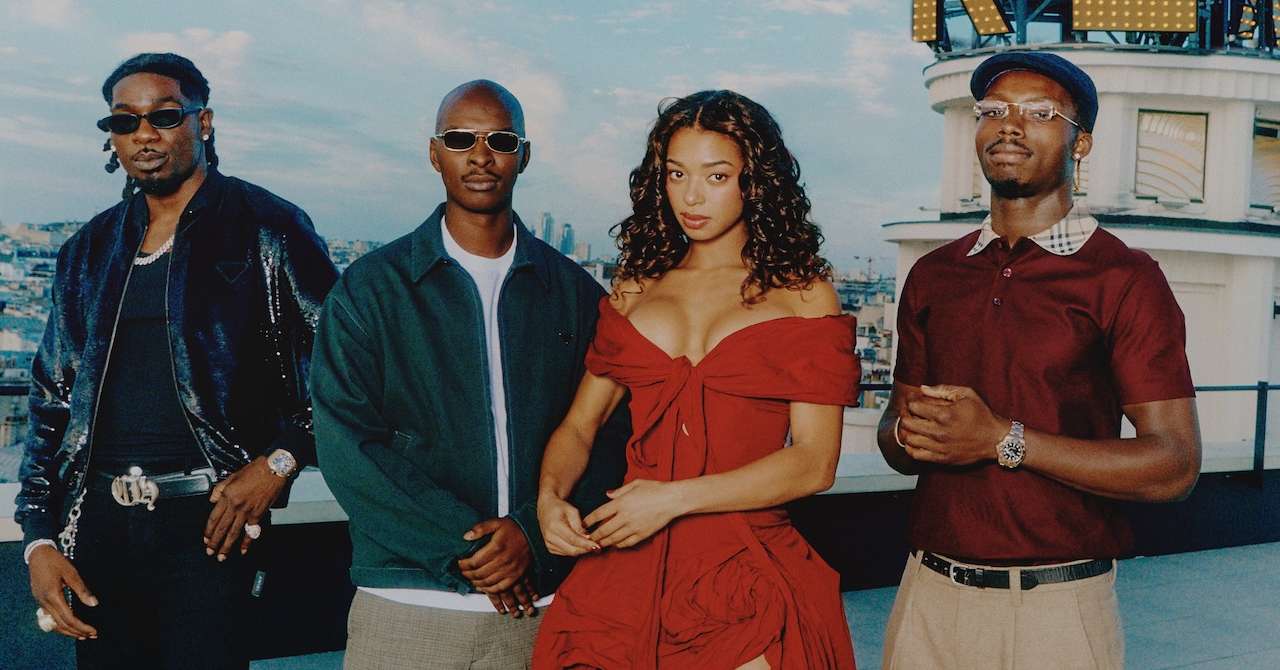
Kraken: Manon Bresch, Alassane Diong, Gazo and La Mano 1.9 herald the return of French horror
For their behind-closed-doors slasher, Mohamed Chabane and Théo Jourdain Rhodes brought together very different profiles: Manon Bresch and Alassane Diong, already seasoned actors, but also Gazo and La Mano 1.9, who are taking their first steps in cinema here. Coaching, stunts, choreographed fights and group life: on the set, everyone had to find their place in an adventure where the body counts as much as the dialogue.
For Krakendirectors Mohamed Chabane and Théo Jourdain Rhodes did not look for actors capable of wisely entering into already locked characters. The casting arrived early enough to directly influence the writing. The look and restraint of Alassane Diong, the physical commitment of Manon Bresch and the comic sense of Bilel Chegrani nourished their roles. And when Gazo and La Mano 1.9 join the adventure for their first film, the two filmmakers rely on what they could not produce: their presence and their credibility. A way of constructing this French slasher, thought somewhere between Top Boy And Screamstarting as much from its interpreters as from its genre codes.
WRITTEN FOR THEM
The screenplay may well lock its characters in a tower, but it never locks its actors into fixed roles. “We really wrote for them“, explains Mohamed Chabane. The directors use what their performers already give off to clarify the characters.
Alassane Diong is the most obvious example. Chabane describes him as a taciturn actor, capable of conveying a lot through his gaze. Idriss was therefore built in this economy. For Manon Bresch, it’s almost the opposite. The directors see in her an intensity and a physicality that calls for movement, action, raw emotions. Mélia is also written from this energy. Bilel Chegrani, who has already appeared in front of their camera in Successbenefits from the same treatment: Marvin’s jokes are written with his voice in mind.
With Bresch and Diong, the work goes even further. During our interview, the two actors say that the nature of their relationship has long been discussed. Mélia and Idriss could have been brother and sister. They could have been a couple. Several tracks coexisted before their link was fixed. What the two actors released together therefore ended up weighing on the writing itself.
This flexibility contrasts with the precision of the staging. Chabane and Jourdain Rhodes say they thought of certain sequences like the stages of a carousel, with the idea of constantly renewing the sensations. The device is very structured. The characters remain open enough to continue to evolve with those who play them.
PRESENCE BEFORE THE GAME
With Gazo and La Mano 1.9, the bet is different. Kraken marks their first steps in the cinema, but their inexperience is not a fault to hide. The directors are not looking for two actors capable of imitating a certain idea of the city: they want faces, a voice, a presence, a way of occupying the frame that they consider difficult to create. Théo Jourdain Rhodes sums up the ambition with a formula: to bring people together Top Boy And Scream.
Manon Bresch also insists on the counter-use of La Mano 1.9, whose role is quite far from what one might expect of a rapper who is starting out in the cinema. At Gazo, she especially retains accuracy.
It remains to transform this presence into a game. The directors speak of a real work of coaching, training and adaptation to filming. The two artists also prepare by taking lessons. On set, Alassane Diong is struck by their curiosity: they observe, ask questions, seek to understand each step. Bilel Chegrani especially remembers their ability to listen. He sometimes suggests another way of approaching a scene; they try, start again. Despite their status in music, they arrive with the awareness of entering a profession that they have not yet mastered.
GO THROUGH THE BODY
On Krakenthe game does not stop at dialogue. The film demands a lot from the bodies, and part of the preparation involves stunts. Manon Bresch and Alassane Diong produce a large part of their physical sequences themselves, under the direction of Emmanuel Lanzi, stunt adjuster.
Diong already knew Lanzi before the film. He says he prepared the fights with him like real choreographies. For him, the way of moving, of anticipating, of absorbing or of retaliating also tells something about the character. Bresch shares the same desire to go to the end of the scenes. She insists on performing her stunts herself as soon as conditions permit, with precise work upstream to master the movements safely.
The tower adds yet another constraint. Narrow corridors, verticality, small spaces: the action must remain legible without losing the feeling of confinement. The practical effects reinforce this physical dimension, notably in several sequences around Gazo, Bilel Chegrani and La Mano 1.9.
Gazo is not spared. Mohamed Chabane recounts a scene filmed on a roof, in the middle of winter, where the rapper is dragged to the ground by -2°C. “He never complained.”. An anecdote that sums up well the demands of filming: once in front of the camera, status matters less than what the scene requires.
MAKE BODY
Kraken is first and foremost a band film. On screen, not all the characters occupy exactly the same place in the group, but the filming had to bring together performers with very different experiences. On one side, Manon Bresch, Alassane Diong, Bilel Chegrani and Lucie Charles-Alfred, already accustomed to the sets. On the other, Gazo and La Mano 1.9, who are discovering cinema here.
This difference in experience, however, does not seem to have created a boundary. Lucie Charles-Alfred recounts a team where the barriers quickly fell: “We spoke the same language, we shared the same culture“. Manon Bresch goes in the same direction: “We made this film all together, without clans or subgroups, like a real team.”
On such a physical shoot, this cohesion also becomes a necessity for the game. Fights, stunts and movements in the narrow spaces of the tower require knowing the rhythm of the other, anticipating their movements and knowing how far each person can go. Even when their characters don’t belong to exactly the same core, the actors must learn to function together. Another way, to Krakento build his band.
Krakenby Mohamed Chabane and Théo Jourdain. With Alassane Diong, Manon Bresch, Guillaume Gouix, Bilel Chegrani, Lucie Charles-Alfred, Gazo, La Mano 1.9. In theaters September 30.