
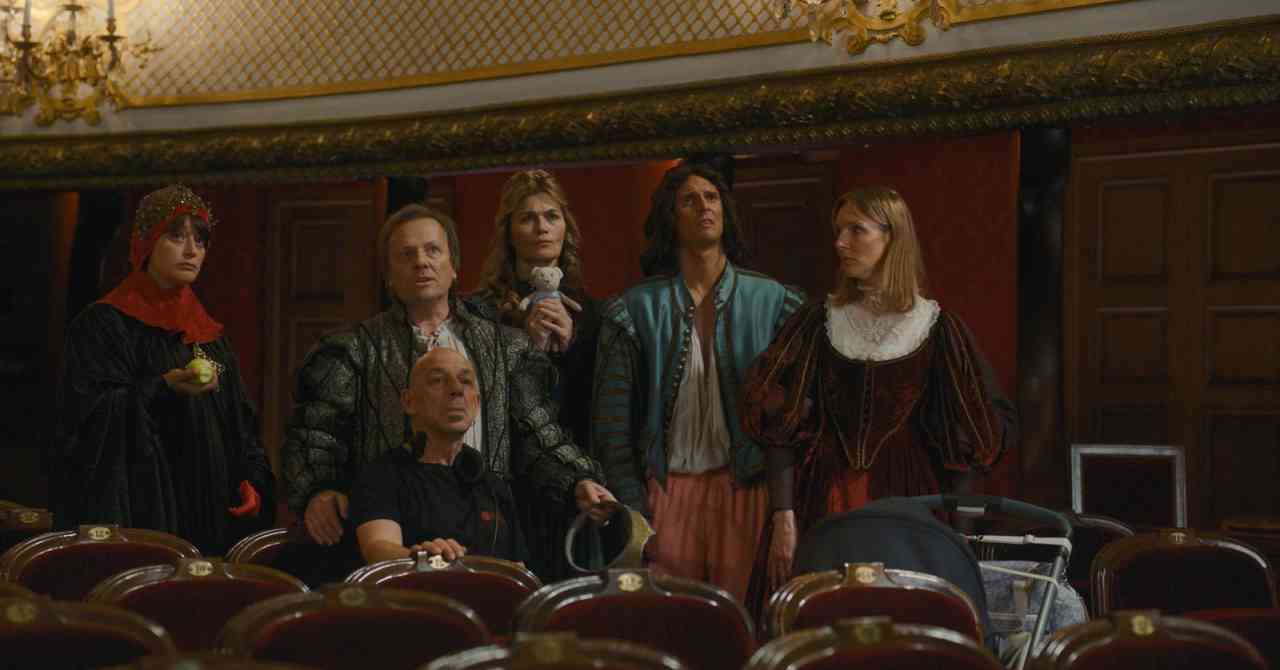
L’Alpe d’Huez Festival 2026: Pauline Clément sets fire to the Comédie Française
Behind the scenes of the Comédie-Française, a director has three hours to save her premiere. A feverish mockumentary worn by Pauline Clément.
From the opening, the film sets the tone. Nina (Pauline Clément) is an actress at the Comédie-Française and must join the troupe for a final rehearsal of her first production. Barely arrived, she comes across Guillaume Gallienne, who plays an inflexible reception agent. As she cannot find her badge, Gallienne – who knows her very well – refuses her entry. He is the clumsy sphinx of a broken universe, the overly scrupulous guardian of a closed world and, incidentally, for Nina, the first test of an evening that promises to be special.
The sequence is funny, even absurd. But less than what follows: after having managed to get back, Nina gets on her bike – baby seat and luggage rack rickety – and starts speeding through the Frenchman’s corridors. In apnea, in zigzags, in organized panic. She crosses the whole house with her oversized bike, takes the elevator, struggles on the stairs, turns back, paces around the institution in a hurry, as if she had to pass in front of each workshop, cross each floor to wake up the venerable house…
This opening is a manifesto and gives the rules of the game. First, this film will move quickly, very quickly – and nothing will stay still. Afterwards, From the Comédie-Française looks like a happy mess; poetic, but also strange and even a little disturbing. The real French actors play in the film but not their own roles – which confuses the issue. Finally: Pauline Clément will be our guide. In a kind of Ophulsian vertigo, it is she who will lead us through the corridors with contagious freedom. It is she who will guide a camera seeming to dance around the bodies, slide between doors and twirl around the actors.
This movement is never gratuitous: it embraces theater at its most feverish, its most unstable. From the Comédie-Française is a film that seems written in breathless speed, as if each scene had to be saved at the last minute. And this sense of urgency doesn’t come out of nowhere. It also relates to the origins of the project. First thought of as a series by Bertrand Usclat (creator of Graze) and Martin Darondeau, From the Comédie-Française could only exist when the troupe gave the green light for a film.
The project was then launched, written and shot at breakneck speed, almost hand-crafted, in a schedule as tight as the behind-the-scenes it films. This speed of execution, this need to invent everything in a constrained space – all this nourishes the energy of the film. We feel that each scene is stolen from the schedule, torn from reality. The film literally bears the trace of its own making: a lively gesture, a collective sprint, a joyful necessity.
We sometimes think of Birdman of Inarritu during the film – and not just because of the drums and percussive music that punctuates the film. It’s obviously the subject (behind the scenes of a theatrical creation), the choreographed chaos, and this energy that we were talking about. Except that here, everything doesn’t revolve around a single man on his way back. Quickly, beyond the initial frenzy, something shifts: the story refocuses and reveals what really matters. Nina is therefore preparing to put on her first production.
His version of Macbeth is scheduled to begin at 9 p.m. and at 6 p.m. the trouble begins. Her main actress is absent, her Macbeth (Fantastic Stocker) is a bore, one of the witches doesn’t understand anything of the text and her stage manager takes too long to explain things… Will she manage to present her play this evening? The countdown has begun. The more we follow Nina, the more we understand where the heart of this mockumentary lies. From the Comédie-Française is above all a film about actors, and above all a great film about actresses.
If the men are indeed present (and Stocker and Frison are magnificent), we only see them. From the Comédie-Française captures their trajectories, their fears, their outbursts, their bright spots – the way they carry the stage at arm’s length when everything threatens to collapse. We then no longer think of Iñárritu, but of Eve by Mankiewicz, for this way of exploring the power dynamics, the fragilities, the narcissistic wounds and the miraculous vigor of women in the theater.
This is where we need to talk about Pauline Clément. We were talking about a countdown, and the bomb ready to explode is her. As trouble rains down, it becomes the unstable material that sets off the chain reaction. Nina advances like a woman on a mission, aware that everything depends on her; she elegantly panics, smiles in the chaos, falls and gets up in the same movement.
Her performance seems written live, in the moment, with this electric precision and this nervous grace that we only see in great actresses capable of inhabiting urgency. She confided before the screening: this project is a bridge between her two worlds, classical theater and comedy, and we see her go in a second from a Shakespearean monologue to a vaudeville bullshit with the same ease.
Around her, the troupe sparkles: Marina Hands, Stocker and Gallienne, Lavernhe, Frison, Séphora Pondi and Danièle Lebrun, hilarious granny, a tornado of gentle anarchy which disrupts every scene in which she appears. Everyone finds their moment of truth, their sequence, their gag, their abyss. It functions as a succession of miniature sketches, comic variations, controlled slips which gradually compose a loving portrait of the Comédie-Française – not as an institution, but as a living organism.
From the Comédie-Française is not just a behind-the-scenes film: it is a declaration of love to the stage, to the fragile moment when everything can change, to the troupe and to those (but especially those) who carry it. A film that rushes like Nina through the corridors: at full speed, with fierce joy and a quite magnificent urgency.


