The Project: when memory becomes a living experience
A third grade class, a Buchenwald survivor, a year to learn to listen. With her documentary The Project, Margaux Chouraqui captures the fragile moment when History becomes a living experience.
On paper, the device Project could cause fear of the document stamped “National Education”. And for good reason: a third grade class, a history teacher and a Holocaust survivor. A school year dedicated to collecting his testimony then a trip to Buchenwald. Before launching the film, we feared the somewhat wise educational documentary, the “useful” film. But The Project manages to thwart this fear and goes beyond it. Because director Margaux Chouraqui does not film with good intentions. She films a passage. The precise moment when great History ceases to be an abstraction to confront reality, impacting faces, consciences, and above all small individual history.
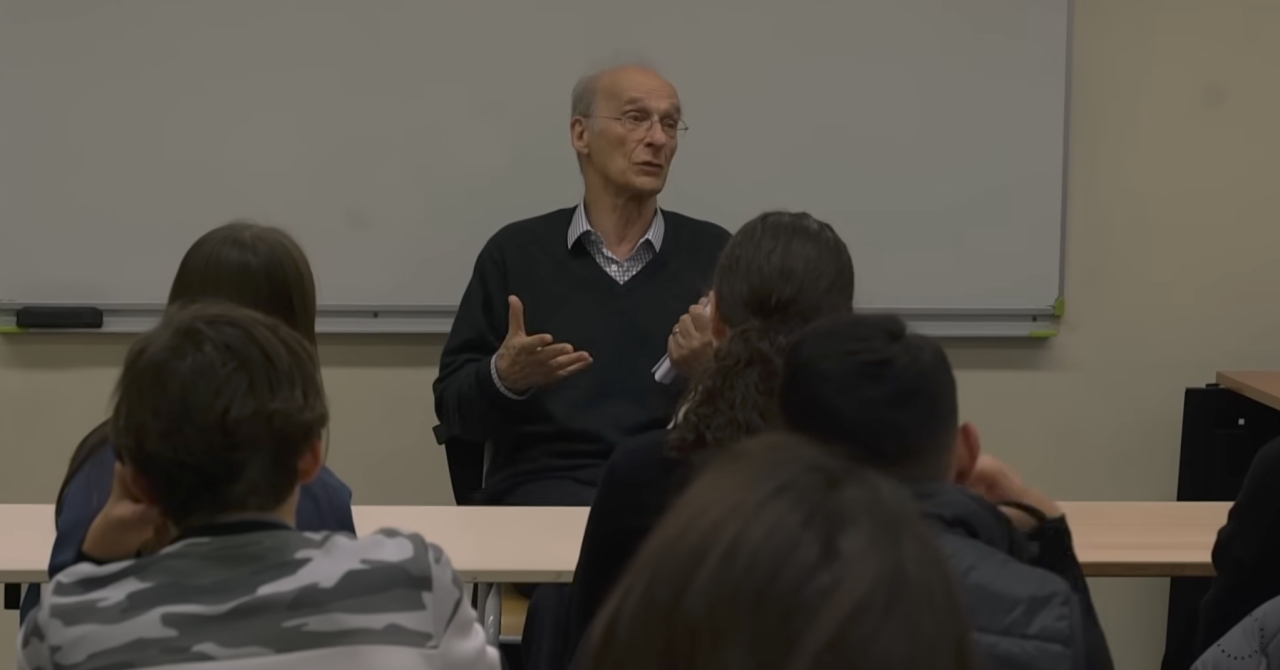
At the center of the film, Izio Rosenman. A child survivor of Buchenwald, he agrees to tell his story in front of middle school students from the Gustave Flaubert high school. This is the raw material of the film. Rosenman is not a sage figure or a monumental witness assigned to the rank of statutory sphinx. It’s a neighbor who walks in his neighborhood – the same as these students from the 13th arrondissement of Paris. The film opens with his perspective and his story. The photos scroll. These are those of life before, vestiges of the banal history of a Polish Jewish family, until the dispossession and deportation by the Nazis in 1939.
We first see his mischievous look, and then very quickly, his fears and his expectations regarding this proposal to tell his journey to college students. Rosenman, despite his extraordinary career (from concentration camps to the CNRS) is a man among others and this is where the dizziness comes from: History, this seems to say. Projectis never far away. She is not elsewhere, not locked away in books. She is there, at the corner of the street, on the other side of the window as shown in the first shots.
Margaux Chouraqui understood this and she will never crush her story under the weight of her subject. She doesn’t make anything sacred. She observes, listens and above all lets the word circulate. Because the film finds its accuracy in this attention paid to what happens between on the one hand this elderly man who has come to transmit his experience, his story, and on the other hand these students led by their history teacher Kamel Chabane. They have other fish to fry. Youssouf for example seems to be searching for himself, but thanks to his teacher, he will end up getting involved in this story. Solange reads Semprun or Anne Berest before going to interview Rosenman. And Chouraqui records the meeting between these two universes. It’s a look or a silence that thickens. A thought-provoking remark or an awkwardly asked question. Emotions that we feel arise before they find expression. “You shouldn’t be afraid,” explains Chabane. “That’s why we’re at school.”
The Project therefore moves forward in a simple, consistent manner, and we can thank the filmmaker for never trying to highlight what, in any case, naturally moves people.
The first interest of Project is there. If Rosenman is its living memory, the film therefore tells its story as much as those who receive its story. The teenagers filmed by Chouraqui are not illustrative. They are there, with their embarrassment, their curiosity, their erratic concentration, their growing involvement. It’s quite beautiful to see the film grasp this shift: at what point does a third-grade kid really listen to what he’s being told? At what point does he understand what is happening in this story? And above all, at what point will what we transmit to him become binding on him? This is where the film becomes broader. Because he doesn’t just talk about the Shoah: he questions what we should do with a word entrusted to us. Of the responsibility there is to collect a story, to reformulate it, to take it further. And the fact that the students themselves learn to film is not anecdotal: Chouraqui shows that transmitting is not simply receiving. It is, in turn, becoming a relay. Choose a shape, a frame, a shot value… In other words: make cinema. Because the “project” of the title is also this: getting the students to co-direct the film.
>>> VIEW THE PROJECT <<<
But there are other things. Because this documentary turns out to be more complex – from a historiographical point of view. The Project will also compare different memories. It is Rosenman who takes the first step, speaking from the start, in front of the students, about Fanon and his involvement in the Algerian War. But in this context, the essential character, about whom we have spoken little, is Kamel Chabane. This teacher who asks the right questions, forces students to get out of their comfort zone, encourages them, prods them. Halfway through the film, he begins to tell his story. Of Algerian origin, son of a father engaged in the French army, he seems to have “entered History” to answer his questions, and we understand that he has given himself the mission here of bringing the memory of the Shoah and that of other wars into dialogue. Of course, it is not a question of putting everything on the same level, nor of forcing an artificial equivalence, but of revealing a possible circulation between stories, injuries, incomplete transmissions. The Project then touches on something exciting and very contemporary: how to come to terms with multiple, painful memories, without dissolving them in a vague narrative? The film never provides an answer. It simply shows that a class, a testimony, an exchange can already constitute the beginning of a sharing and (re)recognition.
And then, of course, there is Buchenwald. The moment when the film accompanies the students and Rosenman to the scene of the deportation shifts the material of the documentary. What was of the order of words becomes a physical experience. We can always say that The Project assumes a form of frontality or refuses formal complexity at all costs. Let him search (himself), and oscillate between transmission, recording, and historiographical or aesthetic reflection. It’s true. But that’s also what makes it valuable. At a time when so many docs seek to impose a point of view, that of Chouraqui chooses to let it happen. Let a witness speak. Let teenagers listen. Let a teacher confide. Let time do its work.
This is undoubtedly where the film is most accurate. In this conviction that memory cannot be decreed. Let it be built, patiently and collectively. In modest gestures. By filming this fragile place where a legacy begins to take shape, Margaux Chouraqui creates a stimulating documentary. A film without emphasis, and from which we come away saying that all is not lost.


