
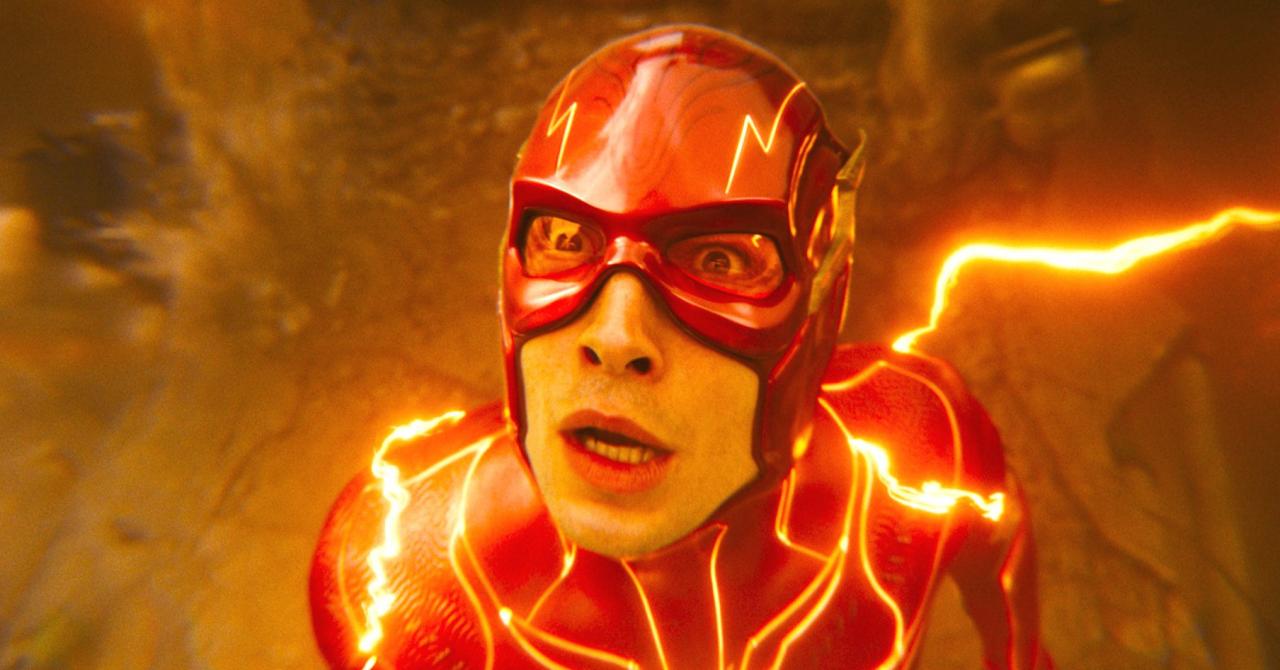
Why The Flash failed at the box office, according to its director
Broadcast unencrypted this evening on TF1, the DC film had only earned $270 million worldwide in 2023, and attracted only 800,000 curious people to French theaters. Andy Muschietti tries to explain the failure of his feature film.
The crash of Supergirl in theaters is being talked about a lot this summer.
But before Superman’s cousin, DC has already experienced other flops. Notably The Flashin 2023.
Andy Muschietti’s film, which will be broadcast this evening on TF1 free-to-air for the first time, has been disrupted by delays, reshoots and the mental health problems of its star, Ezra Miller. The mixed reviews sealed the fate of the film, which only grossed 270 million dollars at the worldwide box office, for a production budget exceeding 220 million… A blockbuster which caused Warner Bros to lose around 200 million dollars during its theatrical release.
Who is really responsible for this flop? Muschietti? Miller? The new studio boss, David Zaslav? The first has obviously not been reprimanded by the managers of the firm, since he is still supposed to stage The Brave and the Bold for the DCU of James Gunn and Peter Safran. The director, however, recognizes this failure, and he gives several reasons why he thinks that The Flash did not find its audience.
Interviewed in Spanish about this by Radio TUand relayed by Real Anarchyhe speaks openly “mental health problems” of its main actor, accused, on the sidelines of his production, of having attacked fans, consumed drugs in the presence of children, manipulated psychologically fragile young women…
Full translation. Thank you @ReelAnarchy working with me on this:
“It’s the result of a mental health situation, you know. It turned out the way it turned out, let’s say. I mean, they were dealing with a mental health situation, and well, when you make a movie, there are things…
— DC Film News (@DCFilmNews) January 12, 2025
Did DC’s new strategy cause The Flash to flop?
“This failure, it was the result of dealing with a mental health problem, you know, he begins. That’s how it happened, let’s say. I mean he (Miller) was dealing with a mental health issue, and when you make a movie, there are things you can’t control. One of them is the public relations crisis that the actors are going through. They had problems during this period, there was the arrest in Hawaii, etc. Personally, I had a very good experience with Ezra. He is a great actor, a great comedian, who surprised me a lot. And then, towards the end, I discovered all this…
Muschietti clarifies that it is not only Ezra Miller’s crises which are responsible for the failure of The Flash. He also places the blame on the character himself, saying he just wasn’t as popular with moviegoers, especially females, as Batman or Superman, for example.
“When you spend $200 million on a movie, Warner wants even your grandmother to go to the movies, he explains. And I found in private conversations that a lot of people just weren’t interested in Flash as a character. Particularly the female audience.”
The director does not mention the fact that he arrived on this project following the abandonment of five directors, and that the firm had to hire numerous screenwriters to rethink The Flash currently in production, but this inevitably weighed on its reception in theaters. The film was also released at a time when the DCEU was being completely redesigned by Warner Bros., the films of the “Snyderverse” having to leave the field open to those supervised by James Gunn.
A big superhero film to be released in 2023 had 45 screenwriters
At the writing of Firstwe quite liked it The Flash. Here’s an excerpt from our review, followed by the film’s trailer:
Paradox: The Flash, the fastest superhero in the DC universe, took his time to arrive on our screens. (…) First evidence, Ezra Miller is a perfect Flash! Until then, he had been confined to the role of the rookie and the comic element (in particular in Whedon’s Justice League). We discover here that the actor is capable of injecting real emotion into the character. This is due to its composition, but also to the most interesting trick of the scenario. The story very quickly pits two Barry Allens against each other. (…) There has been a lot of talk about superhero cameos, the appearance of Zod and figures from the past, or the return of Michael Keaton as Batman. But Muschietti – who after Mama and the two chapters of It moves away from flamboyant horror – remains riveted on his hero. The first 20 minutes of the film, very amusing (the saving of the babies, Barry’s complex within the Justice League, Wonder Woman’s lasso of truth) function as a sequel to Justice League, and serve to define the original Barry before launching the film when the latter will start to go back in time.
Nicolas Cage is even more afraid of AI since The Flash