
28 years later: The Temple of the Dead, Greenland: Migration, The Bojarski Affair: what’s new at the cinema this week
What to see in theaters
THE EVENT
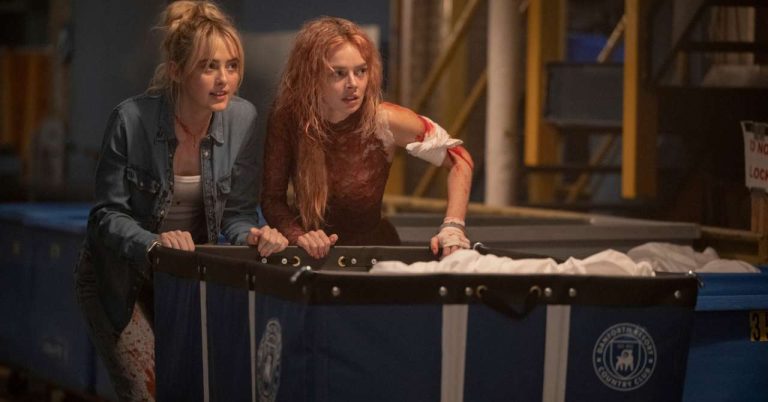
28 YEARS LATER: THE TEMPLE OF THE DEAD ★★★★☆
By Nia Da Costa
The essentials
With this second, darker and more ambitious part, Nia Da Costa confirms that she did not come to flatter nostalgia, but to completely reinvent the cult saga.
In this sequel to 28 Years Later released last year, the story picks up after Spike’s capture by the Jimmies, a degenerate survivalist sect who have transformed the end of the world into a nihilistic carnival. Very quickly, the film shifts its center of gravity: the infected are no longer the heart of the show, but its setting. Their blind rage becomes almost secondary to something more chilling – organized, ritualized violence, transformed into spectacle by those who have chosen to no longer fight against chaos, but to wallow in it. The real subject is humanity facing the moral void, and the way in which some fill it with violence, cult or myth. With 28 Years Later: Temple of the Dead Nia DaCosta blows it all up. The director does not take up the saga of Danny Boyle and Alex Garland to flatter nostalgia, but to dynamite what is still called, for convenience, a “franchise”. This second part acts like a dive into dark waters: more radical, more cruel, but also broader and more beautiful. More than a sequel, 28 years later: The Temple of the Dead is a great genre film, feverish and political and which confirms, if necessary, that this late trilogy is one of the most exciting projects in contemporary cinema.
Gaël Golhen
Read the full review
FIRST TO LIKE
GREENLAND: MIGRATION ★★★☆☆
By Ric Roman Waugh
As Donald Trump considers how to “acquire” Greenland, this Greenland Migration is timely. It is in fact in a bunker in the heart of the Arctic archipelago that the sequel to this apocalyptic B series released in the midst of COVID begins. The choice of Greenland as a pocket of survival in this sequel is quite ironic, especially since the air there is unbreathable and we will soon have to flee this hostile land for… France! Greenland continues to embrace its encore side – the big special effects lean more towards the Roland Emmerich of the beginning of the millennium than the James Cameron 2025 – and we don’t shy away from its pleasure. Gerard Butler as a sensitive protective father plays the race against time with his wife and son slung over his shoulder. The trio, like a Tex Avery character escaping repeated falling pianos, manages miraculously to avoid all the cataclysms and makes us forget the moments when everything inevitably runs out of steam somewhat.
Thomas Baura
Read the full review
THE BOJARSKI CASE ★★★☆☆
By Jean-Paul Salomé
He was nicknamed the “Cézanne of counterfeit money”. From the 1950s to the 1960s, Jan Bojarski, a Polish engineer who took refuge in France during the war, counterfeited a staggering number of banknotes which are still sold at auction. Jean-Paul Salomé (La Daronne) takes this figure from the relevant angle of the vertigo of creation. And his need for recognition not of himself but of the quality of his work which finds its source in the rejection he suffered due to his status as an emigrant without civil status (he was unable to file any patent for his inventions) and made him embark on this double life without fear of being caught. Just obsessed with the perfect gesture. The fascination we feel for this character and the general quality of the interpretation (starting with Reda Kateb in the title role) transcend the lack of roughness of the staging which nevertheless has the merit of never stifling a story that no screenwriter could have invented.
Thierry Cheze
FURCY, DO NOT FREE ★★★☆☆
By Abd Al Malik
Eleven after his first feature, May Allah bless France, Abd Al Malik is back behind the camera with this free adaptation of The Affair of the Slave Furcy by Mohammed Aïssaoui. A Reunionese slave who, after discovering documents on the death of his mother in 1817 supposed to make him a free man, initiated a trial against his owner which would last… 26 years! Abd Al Malik finds the right focus for this story. By focusing on his years there, without trying to tell Z about his life. By refusing to leave the violence of the beatings and humiliations off-screen without feasting on them. And by signing a work that pushes us to confront our collective history, as unbearable as it may be, without taking on the appearance of repentance but by seeking to move forward, to build things after having digested others. All carried by a Makita Samba (Les Olympiades), impressive from start to finish in the title role.
Thierry Cheze
ELEONORA DUSE ★★★☆☆
By Pietro Marcello
Nicknamed the Italian Sarah Bernhardt, Eleonora Duse (1858 – 1924) experienced the splendor of theatrical glory before seeing her star fade when emerging fascism made eyes at her. The actress with her unhealthy intensity was not driven by political convictions but an ego requiring her to go with the direction of the (bad) wind. Pietro Marcello (Martin Eden) here focuses on the last part of his life while the fire of the First World War distracts everyone from the scene. The magnificent opening session thus sees Eleonora Duse as if suspended above the montages, the basket which takes her to her hosts immediately establishes a precarious balance. In this majestic space, the staging will very quickly connect as close as possible to the face of the heroine, a real territory of a film which imposes full emotional energy. This is both the quality of the film (a maximalist Valeria Bruni Tedeschi) and its limit (a maximalist Valeria Bruni Tedeschi).
Thomas Baura
WITHOUT PITY ★★★☆☆
By Julien Hosmalin
Discovered in competition in Angoulême, the first feature by Julien Hosmalin which follows the return – following the death of his mother who ran a shooting gallery in a fairground – of Dario, a young man whose big brother never understood the reason for this distance of more than 20 years. Sans pity will reveal over the course of 90 tight and tight minutes, the why and how of this hasty departure. And the silence in which Dario continues to wall himself in at first, before he meets again one of those responsible for the tragedy which pushed him to flee so suddenly. Remarkably played by Adam Bessa (The Ghosts) and Tewfik Jallab (Leaving One Day), Without Pity also seduces with the thriller atmosphere created in image and sound by its director who knew how to perfectly adopt the references of the American summits of the genre which could have inspired him and create on screen a tension which never goes away.
Thierry Cheze
PALESTINE 36 ★★★☆☆
By Anne-Marie Jacir
1936, Palestine under British mandate saw the massive arrival of Jews leaving a Europe under tension. Faced with this immigration, a sharing of land was hastily organized by the English occupiers. A large part of the Arab population takes a dim view of this new workforce. A general strike that the authorities tried to put down was then declared. If an agreement with five Palestinian parties soon leads to a return to normal, tensions remain high and rebels are organizing in the underground. The Palestinian Annemarie Jacir (The Salt of the Sea) therefore sets out to go back to the source of all the ills of a region whose effects continue today. With the help of a slightly demonstrative staging, she nevertheless very intelligently constructs a polyphonic story with multiple ramifications. Colorized archive images introduce each new part to better authenticate the beauty of a vanished world which then seemed to be living its last moments of relative carelessness. Strong.
Thomas Baura
UNTIL DAWN ★★★☆☆
By Shô Miyake
Misa and Takatoshi are feeling sick. The first loses her temper over nothing, overwhelmed by the hormonal fluctuations of an impossible premenstrual syndrome – also known by the acronym PMS and still too taboo. The second, victim of chronic panic attacks, goes everywhere on foot, unable to get on public transport. So similar and yet so different, their paths cross and uncross thanks to the stars studied by the scientific company that employs them. If mental health has seen a resurgence of interest in global production in recent years, it is rarely deciphered with as much delicacy as that deployed by Sho Miyake. From the harshness of Misa and Takatoshi’s condition is born a poetry of which the Japanese director holds the secret. After La Beauté du geste (2022) around a deaf boxer, he signs a new solar, luminous film, full of nuances and kindness.
Chloé Delos- Eray
Find these films near you thanks to Première Go
FIRST TO MODERATELY LIKED
LAGUNA ★★☆☆☆
By Sharunas Bartas
In Mexico, Lithuanian filmmaker Sharunas Bartas (Few of us) undertakes an initiatory journey in memory of his daughter, actress Ina Marija Bartaité, who died accidentally at the age of 24. He is here accompanied by Una, his other daughter. The camera seeks to capture the purity and beauty of an awakening world. The father and his daughter, returned to the wild, seek consolation. An intimacy that one wonders if it needed to be documented. But what else could a filmmaker do if not immortalize moments destined to be erased?
Thomas Baura
RED FOREST ★★☆☆☆
By Laurie Lassalle
The ZAD of Notre-Dame-des-Landes designates this ecosystem, survivor of an airport project, as much as a utopian no-man’s land resisting the capitalist and state assaults denounced by activists. It is in this corner of greenery, nestled in the heart of Loire-Atlantique, that Laurie Lassalle’s camera landed after filming the Yellow Vests – and the romance she experienced with one of its members – in 2018 in Boum Boum. And the documentary filmmaker continues to establish her cinema as an armed arm of societal revolts, while dissecting the very concept of struggle: to create, to bathe naked in rivers, to form a community, is this not just as much resistance as standing up to police cordons? Halfway between a social film and a scientific documentary, studying biodiversity as much as the men who organize to defend it, here is a captivating gesture of sincerity, but formally too harsh – unlike Boum Boum, adored in these pages – to achieve unanimous approval.
Lucie Chiquer
ABEL ★★☆☆☆
By Elzat Eskendir
It begins with a long sequence shot on a deserted plateau in Kazakhstan where farmers do their little business on the hood of a car. The camera widens the frame with incessant comings and goings which reveal a space as much as it partitions it. We are in 1993, collective farms inherited from the Soviet era are being called into question, forcing a certain individualism. Abel, a breeder is just looking for his place. With the help of relentless, although redundant, staging, this film manages to capture the turpitudes of a man trapped.
Thomas Baura
FIRST DID NOT LIKE
THE COURAGEOUS ★☆☆☆☆
By Jasmine Gordon
This first feature features a borderline mother, playing with the truth to protect her children from its violence. A woman (Ophelia Kolb) who has had trouble with the law and has since been unable to get her head above water financially. But to arouse tension and empathy, such a story must be based on a tight scenario. Quite the opposite, unfortunately, of what we are witnessing here with twists and turns that are poorly executed and which prevent us from believing in what we see and what we hear (the words slipped into the mouths of children which ring terribly false).
Thierry Cheze
And also
Maximilian, by Donovan Cook
The recovery
The Meeting of the Quays, by Paul Carpita