Franck Dubosc: “I want to please myself, finally”
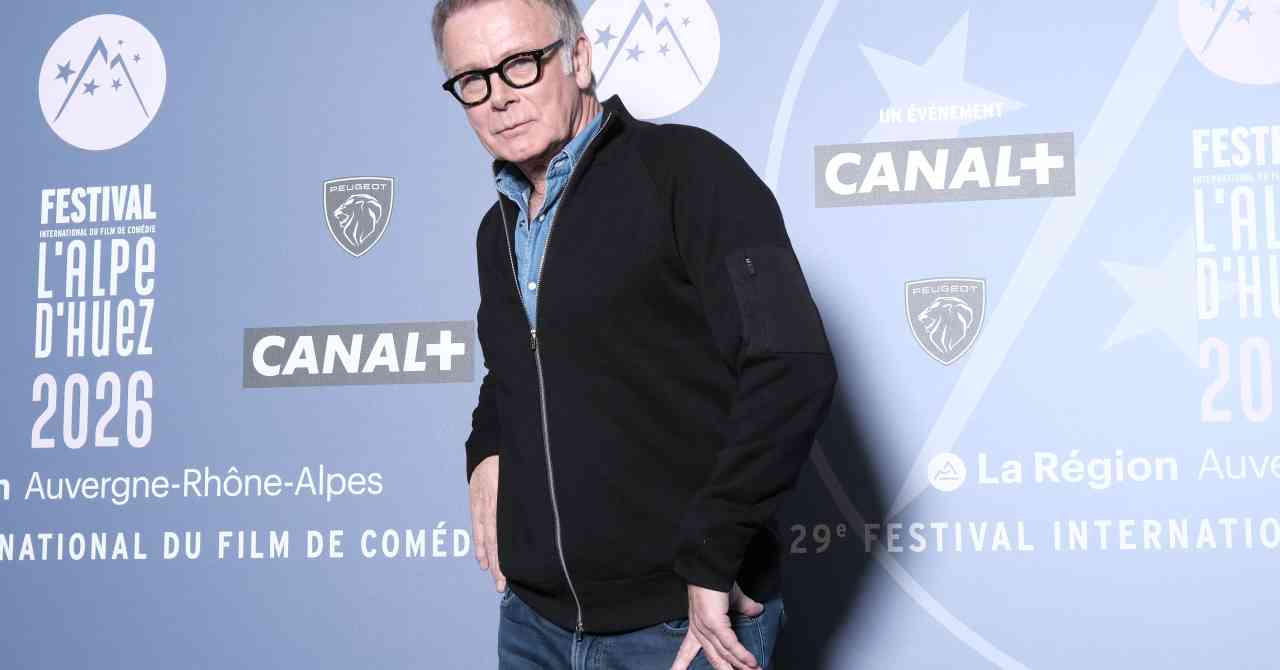
Franck Dubosc is at the L’Alpe d’Huez festival this week, just for fun. He still offered a hilarious happening before the Marsupilami screening and gave us an interview. The opportunity to talk about A Bear in the Jura, the Césars and his next film in Le Havre…
He had no film to promote this year at Alpe d’Huez, but Franck Dubosc was “at home” there. And as is often the case, he stole the show with incredible talent. In a happening calculated just before the session of Marsupilamihe went on stage with the entire film crew (Jamel, Alban Ivanov, Elodie Fontan…) before Lacheau told him that he had been cut during editing… A joke? Yes. But the funny thing is, it’s totally true. A little before, in the perfect atmosphere of the Chamois d’Or, we talked aboutA bear in the Jurathe Césars, and his next film, with a little exclusivity.
FIRST: Franck, the last time we spoke was a year ago, just before the release ofA bear in the Jura. Since then there has been the critical and public success of the film, your appearance at the Césars… How have you experienced this year?
Franck Dubosc: It’s been a great year. It’s true that the Caesars were crazy! I also had some great shoots, I was made some great offers, there were choices… Yes, really, a great year.
Will the success ofA bear in the jura represents a turning point in your career?
A turning point… no. That would be presumptuous. I have the impression that a single film cannot be a turning point. It’s a step. Let’s say that I didn’t steer the wheel, but just took a road that goes a little sideways. To speak of a turning point, it would take two or three films.
However, we feel thatA bear in the jura continues what you started with Everyone standingyour directorial debut.
It is true that with Everyone standingI was installing something. At that time, many spectators or critics were already saying: “Hey, what he’s doing is different.” I became a director, I made a comedy that wasn’t pure burlesque and it was surprising. Afterwards, there was Rumba lifewhich has gone a little under the radar. If we look for reasons, we can find plenty of them: the release date, post-Covid… but it’s not just that. I think this second film was less clear. As if I hadn’t really chosen… The film wavered between comedy and drama, and people wondered what I really wanted to do. Please note: I say this without regret. I adore Rumba. Let’s say, to use your metaphor, that I was starting to take a turn… but I took a turn without really taking responsibility. I stayed in between and… I slipped. Today, the film would find its place better, I think. At the time, it came too quickly as a “turning point”, without being fully embraced.
A Bear assume all this then?
The second film is the most difficult. We always say that, and it’s true. We put everything in the first and suddenly, in the second, we try to drive the nail in, but it’s extremely complicated. On A bear I was able to benefit from the experience acquired on the two previous ones. I no longer wanted to apologize, I wanted to take responsibility for everything I was going to do: the comedy, the dark, the drama. And it’s not a question of age or maturity. It’s the experience.
What is the critical and public success ofA bear in the Jura has changed?
I don’t want to disappoint anymore. Neither the public… nor myself. This clearly puts additional pressure. I’ve always had a good student side and I still want to get good grades (laughs), to please as many people as possible – while knowing that you can’t please everyone. But I want more and more to please myself. I have enough cinematic tastes to listen to myself more.
Wasn’t that the case before you started directing?
I spent my career for a long time without listening to myself, once again, wanting to please everyone. Sometimes by disowning myself a little. I don’t regret any film. But I wasn’t listening to myself completely. Today, I trust myself more. I will be wrong but at least it will be accepted, and it will be for me.
I listen to you and I remember that there is always a form of modesty in you. Do you think this is what made you successful? This fragility that we feel behind all your characters?
I’m not sure. At first, I think people liked to see me acting stupid. “He’s funny in a swimsuit, he dares to do things that we wouldn’t dare.” Patrick Chirac walks because we feel above him. This is very important: my comedy characters have often been guys whom the audience could feel superior to, they were often self-confessed simpletons. And at that moment, there was no question of fragility. But it’s true that people gradually saw that there was “something else behind it”. We always want to see the “front”, but I believe that those who stay also see what is “behind”. I like to put comedy into drama. No doubt out of modesty. To not take myself too seriously. To erase the overly serious moments.
We are one month away from the Césars and your film is eligible. Are you thinking about it?
A little. It is eligible, but like all films. When I looked at the list, I saw that there were a lot of really good films that checked all the boxes – and way better than mine. I think we would maybe be 7th or 8th with a Bear. Which is already good. Very honestly: even if I were nominated, I know that I would not make it to the end of the race. So that would be half reward. And I promise you: that’s not really my goal. If one day I have a Caesar, I will be happy… but five minutes. Time to go on stage.
This year, Jim Carrey will be honored. Is it an actor that touches you?
Yes, but paradoxically less in the comedy register. I really like him when he’s not being funny: Man on the Moon, Truman Show…I admit that Dumb & Dumber It’s not a humor that moves me. But I really admire his career. And above all I admire the directors who dared to take him elsewhere, who dared to make him do something other than what we know him for.
You are working on a new film as a director. Can you tell us a word about it?
Yes, it will be called 5:48 a.m. Martyrs Square. It will take place in Le Havre, and we will follow the story of an early morning bus driver who decides to take his passengers hostage… but by warning them, by asking their opinion: “I’m going to take you hostage. Do you accept? Not today, not tomorrow. We will choose together when and how.” 5:48 a.m. is the departure time of this bus which leaves Place des Martyrs every morning. He takes 7 or 8 passengers who are going to work and they are the ones he will take hostage.
Is it a comedy?
It’s a film (smiles). Not a black comedy this time, but rather a dramatic film into which I will inject a little comedy. And which, I hope, will make people laugh and cry. Once again, it will be a serious theme, with – a little – comedy.
And you play in it?
Yes. I am the bus driver.
Why Le Havre?
Because I wanted a cinematic city, with a real visual identity. Le Havre has magnificent architecture, very strong in the image. And then, I’m Normand. Of course I come from Rouen, but Rouen is a slightly more bourgeois city, a little less brutalist. For this film, I needed a more popular, harsher setting, more anchored in everyday life. Le Havre is more like me. We’re in location scouting, but I can’t wait to start filming.