
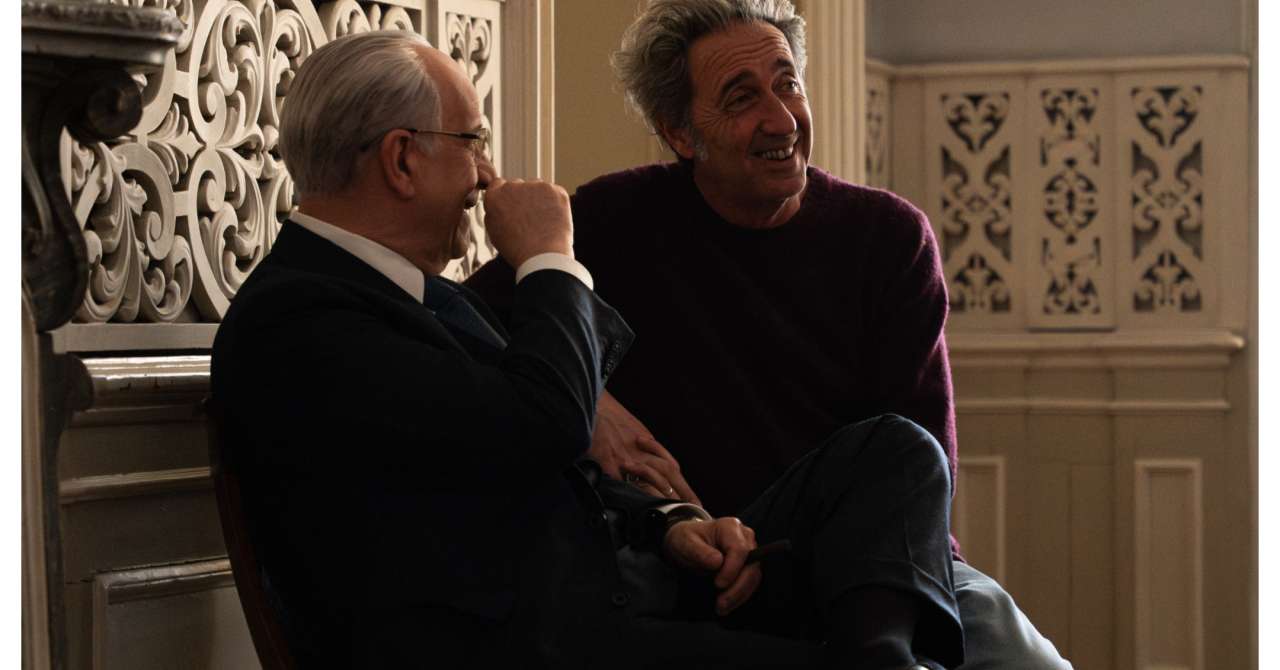
“The moral dilemma is an extraordinary driving force”: Paolo Sorrentino recounts La Grazia, his most intimate film
Best Actor Award in Venice, record start in Italy: Toni Servillo directs La Grazia, Paolo Sorrentino’s most intimate film, where a worn-out president faces doubt and the end. Interview with the filmmaker.
With Il DivoPaolo Sorrentino transformed power into a paranoid opera. With Silvio and the othershe made it into an obscene carnival.
With La Graziahe cuts everything: the light, the circus, the vanity – and leaves only a man who wavers. A president at the end of his mandate, the last guardian of forgiveness, who has nothing left to gain and almost nothing left to lose.
To embody this worn-out, twilight head of state, Sorrentino reunites with Toni Servillo, his cinema double for twenty years, who offers here one of his most stripped-down compositions. A performance which earned him the prize for best actor at the Venice Film Festival – and which accompanies a film which has become Sorrentino’s biggest debut at the Italian box office. La Grazia is a strange object. A threshold film with less baroque, but more silence; less power, and paradoxically more flesh. And underneath, as always with Sorrentino, love and death which intertwine without warning.
Paolo, this time, you start from an almost pure moral dilemma, whereas your films are often born from a character. Why this starting point?
Paolo Sorrentino: Because the moral dilemma is one of the most powerful narrative engines that exists. I had the revelation when I saw The Decalogue by Kieslowski. For a long time, I believed that a film had to move forward thanks to a spectacular event: a drama, a crime, a strong gesture. Then I understood that the real driving force could be moral. When a film is based on a dilemma, it becomes deeper and less spectacular. And even if The Great Bellezza also contained a dilemma – that of Jep, of having missed his married life – La Grazia assumes it in a more frontal way.
The president you film is consumed by doubt. It’s not a very common emotion among your heroes…
PS: Each film secretly reflects the moment in which it is made. And I’m getting old. I’m becoming an adult, for real. And adults, contrary to popular belief, are much more fragile than young people. He doubts more. This fragility crept into the writing. De Santis is older than me, he carries an immense weight. I imagined it with amplified intensity, like constant torment. It’s a very real, very contemporary doubt – and very personal too.
Many are talking about a softer, less flamboyant film. Do you share this idea of change, or even transition, in your staging?
PS: I don’t know if it’s a transition. There are simply films that allow you to be exuberant – and I have done some. And then there are stories where the characters forbid you that. La Graziaas The Hand of Godbelongs to these films. Emotion leaves no room for baroque. The character pulls the film towards a form of discretion.
In your previous political films, power was theater. Here, you totally refuse the political circus. Is this a comment on the times?
PS: I didn’t want to mention current politicians. But it is true that for forty years, politics has often been transformed into a spectacle. It’s an idea born in America: Reagan, the first president-actor, provided the model. And the Americans export their ideas well. But there are also rarer politicians, who experience politics as a silent vocation. This is the case of several Presidents of the Republic in Italy, who inhabit the institutions with seriousness and wisdom.
A vocation… almost a religious word?
PS: Yes. Vocation comes from religion. This character embodies the idea that politics can be a service of the common good. It’s idealistic, nostalgic – but still possible.
You have worked with Toni Servillo for a long time and La Grazia is even your seventh collaboration. Has your way of doing things evolved over time?
PS: Not really. I show him the script, we talk about it, and then we move forward day by day: a line, a scene, a feeling… It’s a very piecemeal work but ultimately hasn’t changed much.
And the physical incarnation, the approach, the postures: does that come from him or from you?
PS: I give references: a wig, a costume, a silhouette. Toni then moves through these cues with incredible grace. He composes from there.
Do you write with specific images in mind?
PS: Always. Hairstyles, ways of walking, gestures borrowed from people I knew. Characters are often born from visual fragments.
Your work seems haunted by grace. And this is the first time the word appears in a title. Is this a sign?
PS: I never had the feeling of looking for grace. I have too many doubts for that. I just did what amused me or interested me at the time I was doing it. But I always wanted to give harmony to the characters, even the toughest or darkest ones. And La Grazia tells the story of a man’s quest for harmony: jealousy towards his wife, the responsibility to decide on the lives of others, the retirement that frightens him… Bringing all of this together is perhaps what grace is: a gentleness towards life, despite the wounds.
Official synopsis: Mariano De Santis, President of the Italian Republic, is a man marked by the mourning of his wife and the solitude of power. As his term draws to a close, he faces crucial decisions that force him to confront his own moral dilemmas: two presidential pardons and a highly controversial bill.
La Grazia directed by Paolo Sorrentino and starring Toni Servillo hits the screens on Wednesday January 28.


