Daniel Chong: “In Jumpers, we took on the cartoon madness without any shame”
With Jumpers, Pixar has released its most cartoonish film in a long time. Its director Daniel Chong and its producer Nicole Paradis Grindle tell us about the genesis, the influences and the making of a cartoon not quite like the others.
Where did the very first idea of Jumpers ?
Daniel Chong: One of the triggers was my fascination with animal documentaries where we slip robots into nature to observe animals very closely. After seeing a particularly crazy one, I asked myself: “What if we took this technology further?” What if it became so sophisticated that animals no longer knew the difference? » Then the question became: but Who will guide us in this world? This is where Mabel, our heroine, was born. I remember a drawing I made very early on: she pinned a man to the ground who was about to crush an ant. This image said it all: Mabel would protect any living thing, no matter how tiny. She was our film.
Mabel is indeed a very empathetic heroine, a character that we love from the moment she appears. We cling to her in a wonderful prologue and we never leave her side… Was that the key to the film?
Nicole Paradis Grindle: Yes! from the beginning, we wanted to tell the story of a passionate young woman… sometimes to the point of being difficult to follow (laughs). The film had to lead us to understand what motivates her, to feel her emotions. We did not have a message “to deliver”. We had a character to follow in a specific world. And we followed her. Moreover, what is very interesting is that contrary to production habits, we did not start the film with a finalized script: Daniel launched a scene, the storyboarders drew it, and we edited things gradually. That’s where a lot of the humor comes from: the visuals, the rhythm, the assembly.
This is what gives the film a very cartoonish feel. We have the impression that Jumpers is one of the most slapstick films to come out of the studio in a long time.
DC: Totally. I grew up with the very comical Pixars of the great era: Toy Story, 1001 legs, Monsters & Co.. They had a real lightness, a pleasure in the gag for the sake of the gag that was insane – and liberating. And then, there is clearly my time on television: I did 140 episodes of a comedy series (Bear for one and one for you bear). When you produce so much, it gets crazier and crazier. We must push the dementia sliders further every day. Very quickly, you say to yourself: “Okay, today we’re doing an episode with aliens. “. In short, it’s difficult not to not bring back that energy. It gave me a taste for the absurd, for “zaniness”, for joyful madness. I think you can feel it. There is a dose of “unbridled cartoon” that I naturally wanted to inject into the film.
You go hard… Without revealing anything, you even do a sequence with a “jumping shark” (among screenwriters, “jump the shark” episodes designate those moments when a series, by dint of looking for the most absurd ideas, becomes totally out of control Editor’s note)
DC: (laughs) Yes! But we decided to go all out, without ever feeling the slightest shame. We knew exactly what we were doing.
NPG: Some people at the studio told us: “This shark thing completely takes me out of the film. » Others, often the youngest, exclaimed: “Don’t take it off, it’s great! »It created a real generational tension at the beginning. But the more we advanced, the more we felt that this madness was pleasing. Even if it didn’t always fit into traditional Pixar logic, we had to keep it. It was new, special, and it made people laugh.
Do you sense a change of times at Pixar?
NPG: I think so. Daniel’s tone really appealed to the younger generation of the studio. Some elders were a little shaken, but over time everyone understood that we were touching on something alive, something different. Daniel also has the advantage of coming from the outside. This is not nothing: Pixar bears an enormous artistic responsibility, a pressure. He came with the simplicity of someone who says: “This is how I work: in a room, with people who draw, and we make each other laugh. »
But that’s the story of Pixar; with the legendary Brain Trust where Andrew Stanton, John Lasseter, Pete Docter launched ideas that would become films….
NPG: Obviously, but things have changed a lot since then! During the pandemic, everyone was isolated. We worked on Zoom, we storyboarded separately. And I think that had an impact on the mood films that were produced during this period. This film, on the contrary, needed human warmth, a shared room. When we returned to the site, everything changed. Finding the rooms, drawing together, “making each other laugh”, it was crucial. The film started to work from the moment we found this collective energy. It brought back the gag, the madness, the movement. The studio let us continue like this because it produced “rich and fun” things. We had their blessing.
The film is also full of references to popular cinema.
DC: Yes. I’ll tell you a secret: at first the working title was “Penguin Avatar” – which gives you both a clue to the real matrix of Jumpers and on… the first animals I thought of for my film. It was totally assumed. But we knew that the film would quickly move away from Avatar to find your own way. There are also references to Mission: Impossiblea little Mad Max for action scenes, Men in Blackof Gremlinsof Back to the future…
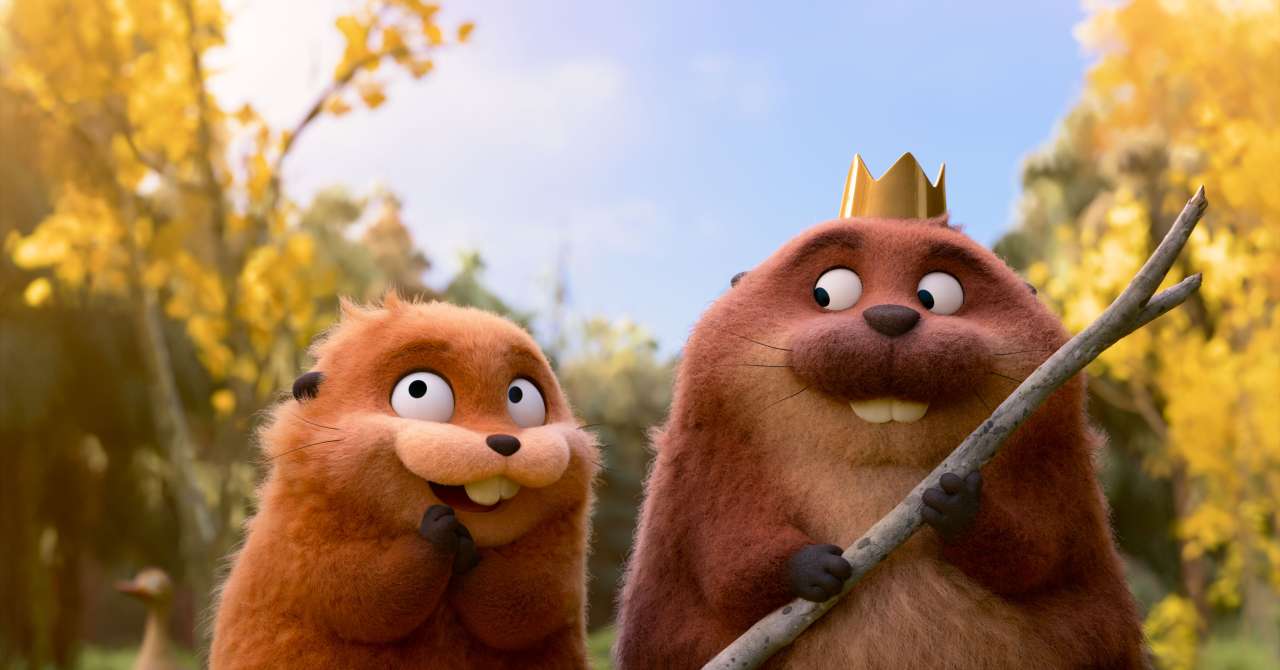
And from Pompoko for beavers who rebel against humans.
Obviously, for me, Takahata is a huge reference. In this film, I love the idea that depending on the point of view, the animals can be realistic or very cartoony. We use it differently – for us, it’s linked to “hop” technology – but the inspiration is there. and it is essential.
Pompoko had a very dark vision of the human/nature relationship. Jumpers seems more optimistic.
DC: Yes, it was important to us. How can we talk about these subjects without plunging young viewers into fatality? We wanted to show that there is hope: community, solidarity, the idea that nature can restore itself if we let it. We wanted young people to come out and say to themselves: “We can act.”
The film’s prologue is extremely neat, it’s almost a mini-film within the film.
DC: This is one of the parts that gave us the most trouble. The prologue was meant to make Mabel immediately loved, to show why she is willing to throw herself into any situation to save an animal. We hesitated a lot: should we start with that or go straight into action? Ultimately, we understood that the public needed this moment to understand what is at stake: the value of nature, its fragility. And visually, yes, we returned to a more classic, more pictorial form. I am delighted when people tell me about this moment which was a real challenge.
With all this, you think that Jumpers marks a turning point at Pixar?
DC: I don’t know if it’s a turning point, but it’s a possibility. Pixar can also be that: a place where “we make each other laugh”, where we experience a little madness.
The film is what it is because we followed this desire to the end.
NPG: And because the whole team believed in it. We liked the humor, we liked the message, and the studio supported us. We ended up saying: “Yes, we can go there.” And why not continue?