
Cannes 2026 – Moulin: a masterful duo-duel of actors (review)
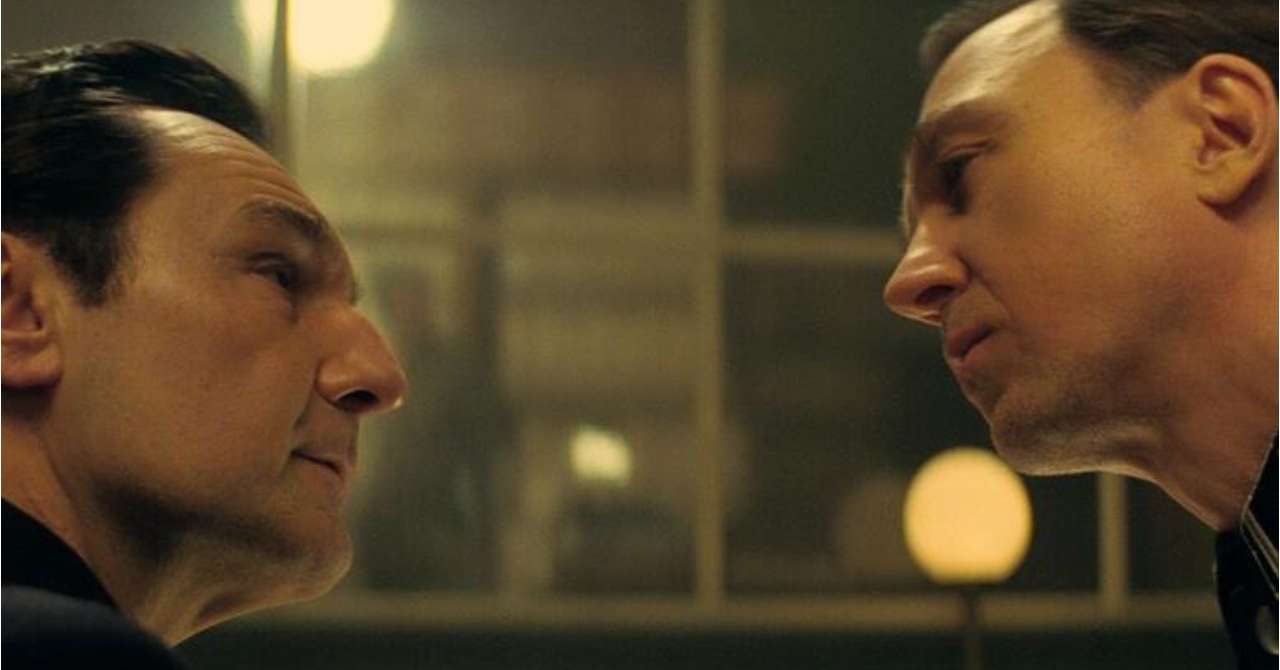
Gilles Lellouche and Lars Eidinger impress as Jean Moulin and Klaus Barbie in the new Laszlo Nemes which looks back on the last days – of interrogation and torture – of the hero of the Resistance.
Just before The Third Daythe remarkable film by Daniel Auteuil on the rescue of the Jewish children of Vénissieux and in the meantime Our salvation by Emmanuel Marre and the De Gaulle by Antonin Baudry, Laszlo Nemes therefore kicked off the French feature films at Cannes going back in time to the Second World War. And the first feature film on the big screen (after two TV films by Yves Boisset and Pierre Aknine in 2002 and 2003) devoted to the most symbolic figure of the Resistance directed by the director of Son of Saul was obviously not the least expected of the quartet. An understanding reinforced by the fact that instead of a biography from A to Z, from his birth to his death, Mill is based on a precise angle: the last days of his existence before succumbing on July 8, 1943 to the abuse administered by the Nazis, ready to do anything to know all the secrets of the French Resistance
Here we immediately find the “Nemes” signature – the one that makes its detractors bristle -: straight frames which imprison characters stifled by a vast off-camera in a carefully worked 35mm. But the trial for gratuitous ultra-stylization seems quite unfair here. Because this style perfectly matches what constitutes the epicenter of his new film: the face-to-face between Moulin and Klaus Barbie in a permanent camera which will pass from room to room: from the gilding of the Nazi criminal’s office to the sordid basement where Moulin will face the torture sessions. It is also at the moment of the meeting between the two men that the film instantly takes off. Because, before that, the set-up must necessarily deal with the whole period reconstruction aspect and it is then the same for the dialogues as for the decoration: a small propensity to overload things
But the essential thing obviously lies elsewhere. In what is said, is silent and played out when Barbie takes Moulin in her claws. A face-to-face of men which is also a face-to-face of actors. Which Nemes obviously took into account. Never before in his films have the actors been so much the driving force behind the device, whereas in The Son of Saul, Sunset and Orphan, the gesture of realization took precedence over everything else until it became a character in its own right. Here, it is Gilles Lellouche and Lars Eidinger who lead the dance. Without being able to separate their striking performances from start to finish.
Lellouche’s restrained performance implicitly allows us to see everything that his character, in his obligation of permanent concealment, cannot express: his fear. Or rather his fears: of suffering martyrdom and of ending up speaking. There is no trace here of the slightest demonstration. The way in which this role inhabits him avoids any counterproductive excess. And all the more so since Eidinger takes charge of the explosiveness of the bubbling rage which, unlike Moulin, must arise. To create astonishment, fear, chaos… and obtain confessions that will not come.
And despite this extraordinary act of courage, Mill never lapse into pure hagiography. It tells the story of a man worried about his own fallibility, giving this story whose disastrous outcome we nevertheless know this tension which never weakens. A tour de force.
By Laszlo Nemes. With Gilles Lellouche, Lars Eidinger, Louise Bourgoin… Duration: 2h10. Released October 28, 2026