Cannes 2026 – day 7: the disturbing “Fjord”, fantastic Léa Seydoux and Niels Schneider, Daniel Auteuil, great filmmaker…
Every day, the hot spot live from the 79th Cannes Film Festival.
Film of the day: Fjord by Cristian Mungiu (in competition)
The Romanian Cristian Mungiu (winnered for 4 months, 3 weeks, 2 dayss in 2007) arrives in Norway with his rogue’s suitcases to put the viewer’s morals to the test. A Romanian evangelist family settles on a fjord with their five children. At school, the eldest arrives with bruises on her body. Children’s Aid reacted immediately and placed the toddlers in foster families while waiting to see things more clearly. The judicial machine is racing. A trial soon opposes two visions of the world: ultra-rigorous religious conservatism vs. aggressive progressivism.
Mungiu first places his camera at the center of the debates before moving it to the side of the dispossessed parents (played by the American-Romanian Sebastian Stan and the Norwegian Renate Reinsve). His staging, a succession of shots with implacable precision, offers an overlooking vision while giving the spectator the illusion of moving forward in an open space. All around, characters are evolving, forced to position themselves for or against. The main stakeholders (the children) remain on the sidelines. Their voice will never really be taken seriously.
This war is above all that of adults and more generally of a Norwegian society which, by wanting to do good too much, would fall into a form of conformism of thought. A very “Cnews” moral that it would be wrong, however, to take at face value. Because this seemingly peremptory cinema constantly breaks the lines, blurs the perspectives, calls into play the contours of the drama with ellipses. Good and evil do not stand face to face. A look, a silence or a truth stated too quickly can cover up a truth that is unfathomable by nature. “I love you!” will say a young girl without being heard, except by the spectator. That is the essential thing.
The coupling of the day: The Unknown by Arthur Harari (in competition)
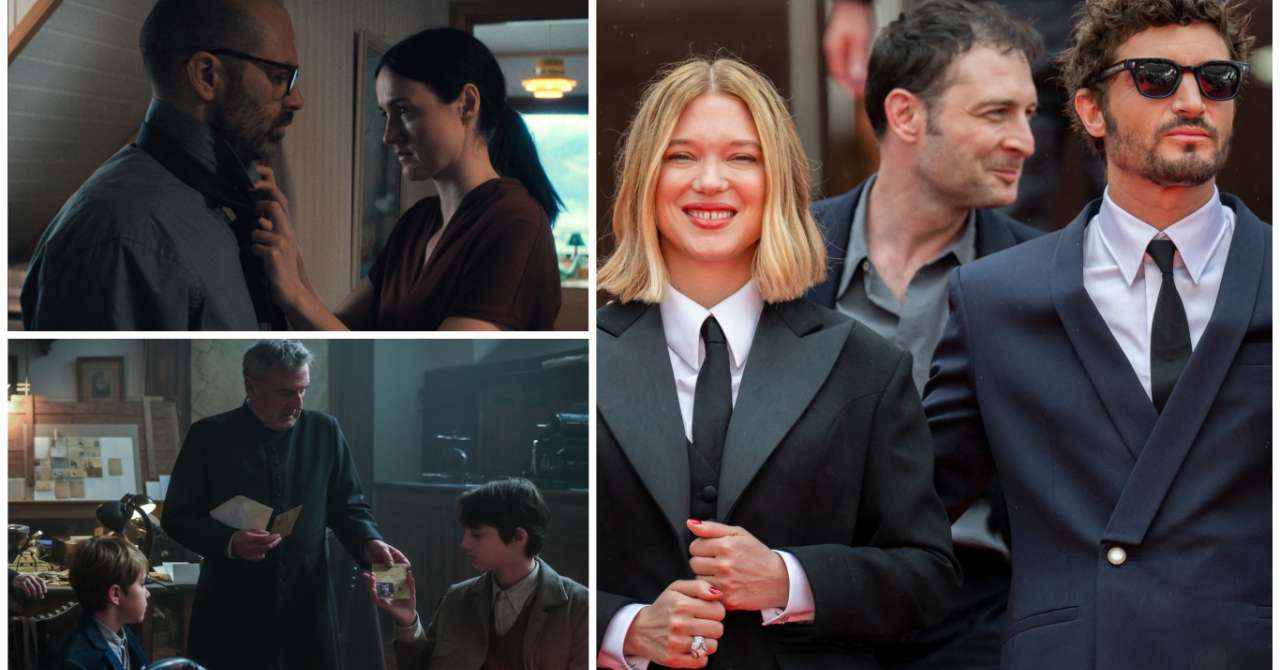
The first sex scene The Unknownbetween Léa Seydoux and Niels Schneider, is one of the strangest pieces of the film, and undoubtedly its secret heart. Bodies fit together, souls shift. Yet nothing here resembles the ecstasy of literature that launched the tradition of metempsychosis. Nothing romantic like in Avatar by Théophile Gautier, where Octave passed into the body of the husband to join the beloved. No desire, no transport, not even this erotic terror which irrigated The Dead in Love.
The exchange here takes place coldly, in a deaf, almost administrative mechanism. Skins rub without recognizing each other, souls slide without choosing themselves. And it hurts, a dull pain, with a worrying final rattle. As if the transfer should not have happened. Harari takes the tradition’s most loaded fantastical motif – transmigration through embrace – and empties it of its intoxication. What remains is the pure mechanics of counting. This scene is like the entire film: sad, sticky, melancholic. A fantasy without magic, where moving from one body to another is no longer a promise but a fatigue. A real illness.
Today’s performance: Daniel Auteuil “Melvillian” filmmaker
After taking oneself for Pagnol, we believed the Auteuil-filmmaker’s cause was definitively lost in the lavender fields. Then The Wire (2024) appeared, a very dark work, a trial film without too many concessions, where the great actor that he never ceased to be but who seemed to wander just about everywhere, found his full dimension. The opus was already in Cannes. So we were watching for Third nightpresented out of competition this year, to see if the fire was still sacred. The Third Night adds to the long list of films on the period of the Occupation. Lyon, 1942. While Moulin-Lellouche in the neighboring film of Némes is in the claws of the wolf, Father Glasberg-Auteuil in a barracks in the Vénissieux camp struggles to save Jewish children from the coming roundup.
Auteuil chooses austerity, dark grain, nocturnal atmospheres, silent shots… No more disguised “period” style decor with small trades and Traction Before leaving the flea market (there are some anyway), he chooses almost behind closed doors: a table, chairs. Anguished theater. For a bit, it looks like Melville resurrected. It’s barely straining when writing this. The game is of course his big business: Antoine Reinartz and Grégory Gadebois, respectively, the good guy and the bastard, are formidable in deceptive humor. Daniel Auteuil, it’s official, has become a very good filmmaker. Far from Provence, close to the heart.
Lesson of the day: Amine Bouhafa’s music lesson
You had to see Kaouther Ben Hania appear on video to greet his favorite composer – a strange and moving image, slipped into the heart of the lesson. Amine Bouhafa performed his score with virtuoso relaxation. The football scene Timbuktu first, dissected note by note: how Sissako films an invisible match, and how the music brings the ball into existence. Further away, The Summit of the Gods : melodies written for instruments of ice and glass, sounds from another world carved in the cold. Bouhafa tells and plays his scores without ever asking the master. After the Hollywood panzers who until now occupied the Buñuel Hall, Sacem has found its opposite: a young, political musician, who knows that the orchestra is also a way of looking at the world.
Good sleep of the day: Her Private Hell by Nicolas Winding Refn
We didn’t really realize it because he had produced three series in the meantime, but it had been ten years since Nicolas Winding Refn had last directed a feature film. Came to compete for The Neon Demon in 2016, NWR made its comeback through the back door, outside of competition, with Her Private Hell. A case of mist which engulfs a futuristic metropolis, with an actress in the middle nervous breakdown (Sophie Thatcher, very good), a GI (Charles Melton) looking for his daughter and a faceless killer. Funny little object, obsessed with neon lights (surprising, no?), leather clothes, daddy issues and the sapphic delusions between daughter-in-law and mother-in-law. Quite soporific in its first part, this delirium which will ogle at the side of Mario Bava and David Lynch gets a little restless afterwards, but the desire for a good nap is already too strong.
Today in Cannes
Casually, we enter the 8th day of the competition, and no film has yet emerged as favorite for the Palme d’Or. Minotaur by Andrei Zvyagintsev or Autofiction by Pedro Almodovar, presented this Tuesday, will they benefit from it? Also to be continued: the animated film The Corset from Louis Clichy to Un Certain Regard, Low Expectations in the Fortnight or The Criminal by Orson Welles at Cannes Classics. We will have an eye on the press conference of The unknown by Arthur Harari, one of the signatories of the anti-Bolloré forum (and not the least virulent) at the heart of all the discussions in Cannes…