De Gaulle freed! With The Battle of Gaulle, Baudry debunks the General
Antonin Baudry signs the opposite of a biopic: a funny, rebellious object, which crosses comics, thriller and epic to tear De Gaulle from his statue. Simon Abkarian gives him movement, panache and above all a lot of flesh.
This is not news: French historical film was dying. Above all, respect. For years, we had been filming big men standing at attention, in a wax light, with a devotion that looked a little too much like fear. Fear of the subject and fear of History. The biopics followed one another like ceremonies, and we left them like a museum closed for renovations. It’s finally moving: The Battle of Gaulle: The Iron Age offers the opposite of all this. Antonin Baudry does not sign a biopic but a funny, rebellious object, leaping like a comic book, tense like a Yankee thriller, shot through with flashes that owe as much to Tsui Hark as to Spielberg, to Goscinny as to Resnais. And it is in this permanent collision that the film finds its meaning – and its politics.
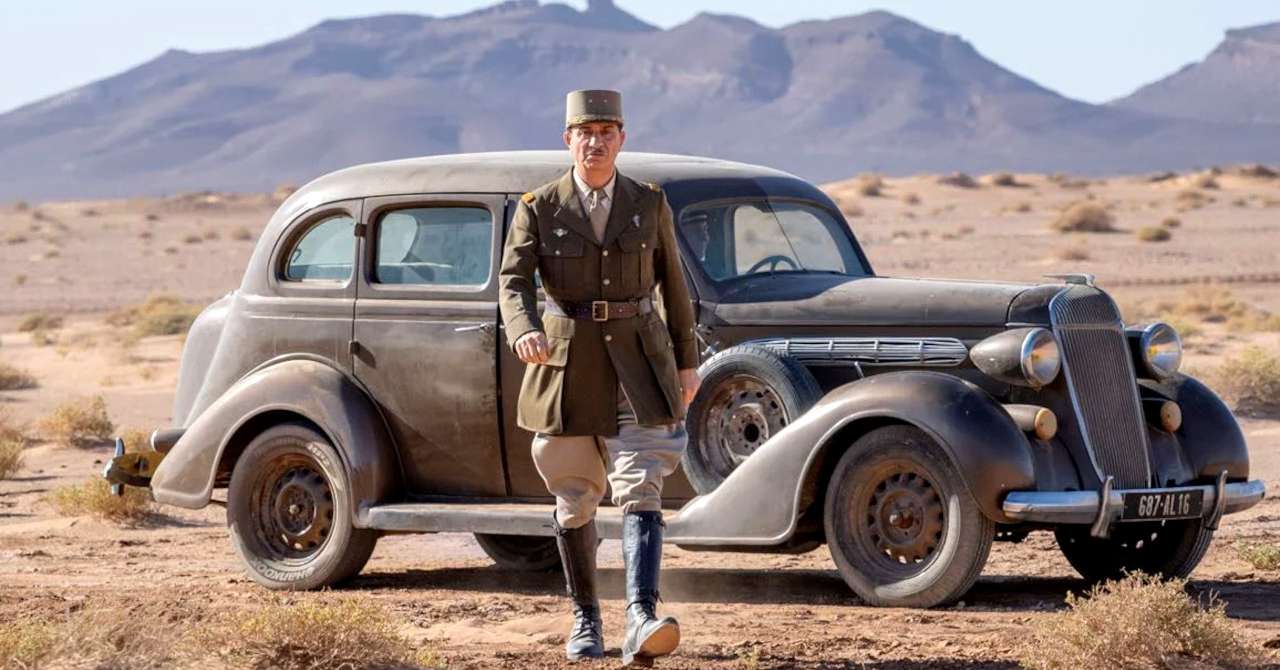
This first part is based on a simple intuition: to tell the story of De Gaulle, you have to start by forgetting… De Gaulle. We have to unbolt it. Give him back what was there before the statue: a body too big, a voice that is trying to find itself, an obstinacy that passes for madness. Enter here Simon Abkarian! The choice was as crazy as it was improbable, and the actor decided not to TO DO De Gaulle: he invents it before our eyes. As Baudry told us in the magazine, there is in his General something of a Don Quixote lost in a world that no longer believes in panache or great ideas. Above all, the filmmaker knows that an icon is built through voice and gaze above all else. Its executives therefore work on the actor as a material. Close shots on the back of the neck, on the eyes. A hand that trembles (barely), a tear that emerges… And if History makes its way, it is through small details that change the whole thing.
What is striking in the film is the way in which Baudry refuses unity of tone. A staff scene breathes like a thriller. A touch of humor cuts through a dramatic moment. A cowardly or funny dialogue arises in the middle of the action – and everything comes out intensified. He works his film by contagion: the epic infuses the everyday, the comedy explodes the tragedy and everything serves above all to undermine the solemn. We have seen this process a thousand times, but almost never here, and even less applied to the Republican pantheon. No doubt because it supposes something that French cinema no longer dared to do: believing that a serious subject can stand up without gravity, and thinking that the story can escape the Epinal image. This is the case here. His De Gaulle is filmed from below: like a B-movie hero from the 70s. Total paradox: this is undoubtedly how he becomes great again in the cinema.
Good. Everything is not perfect, and saying so does justice to the company’s ambition. The arc of the young resistance fighter – useful for the identification mechanism and essential for collective inspiration – does not quite match the dramatic intensity of the main story. This is the price of a film that wants to be both a fresco and an intimate novel. But this hesitation disappears as soon as Abkarian enters the frame, or the staging returns to its regime of pure kinetic energy.
The fact remains that we have only seen half of Quixote. The Iron Age is the first volume of a two-headed project, and we will have to wait I write your namein July, to measure the total scope of the project. But what Baudry achieves here, already, is what no one in France had dared for a long time: to prove that you can make a great popular film about a great man without solemnity, without reverence. And above all without giving up either the pleasure of cinema or the intelligence of the subject.