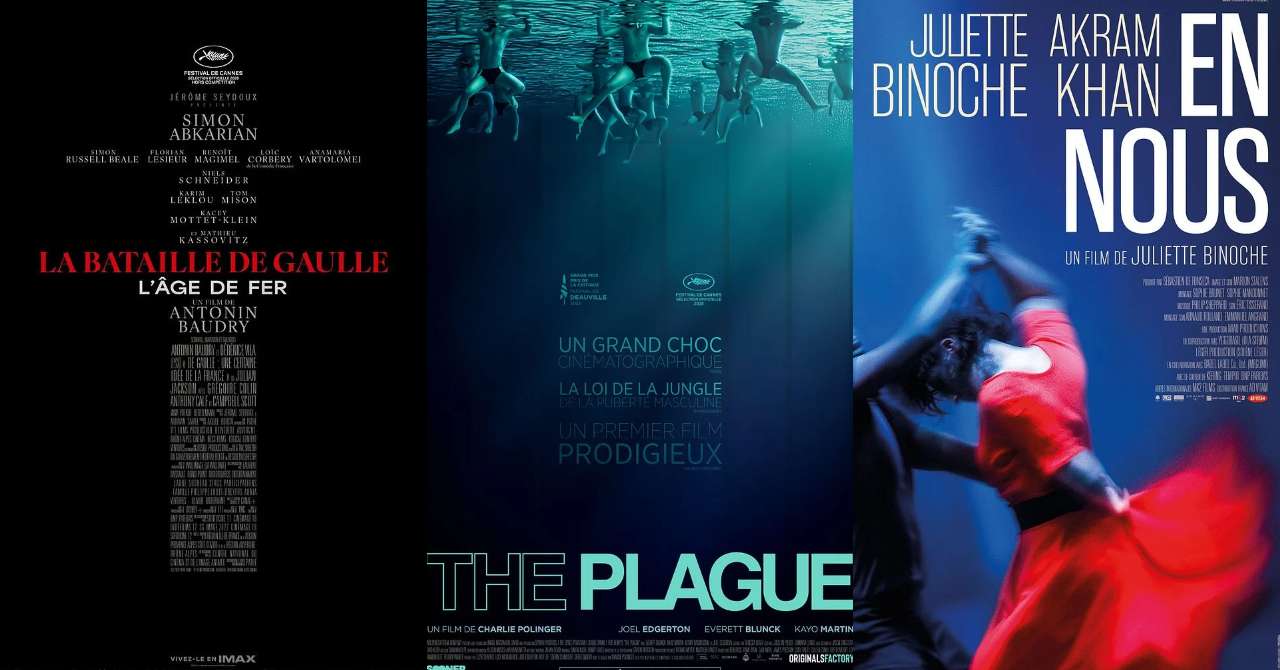
The Battle of De Gaulle: The Age of Iron, The Plague, In Us: what’s new at the cinema this week
What to see in theaters
THE EVENT
THE BATTLE OF GAULLE: THE IRON AGE ★★★☆☆
By Antonin Baudry
The essentials
Antonin Baudry signs the opposite of a biopic: a funny, rebellious object, which crosses comics, thriller and epic to tear De Gaulle from his statue. Simon Abkarian gives him movement, panache and above all a lot of flesh.
While the French historical film was dying, Antonin Baudry turned the tables. With The Battle of Gaulle: The Age of Iron he does not sign a biopic but a funny, rebellious object, leaping like a comic book, tense like a Yankee thriller, shot through with flashes which owe as much to Tsui Hark as to Spielberg, to Goscinny as to Resnais. And it is in this permanent collision that the film finds its meaning – and its politics. What is striking is the way in which Baudry therefore refuses unity of tone. A staff scene breathes like a thriller. A touch of humor cuts through a dramatic moment. A cowardly or funny dialogue arises in the middle of the action – and everything comes out intensified. Of course, everything is not perfect, and saying so allows us to do justice to the company’s ambition. The arc of the young resistance fighter – useful for the identification mechanism and essential for collective inspiration – does not quite match the dramatic intensity of the main story. This is the price of a film that wants to be both a fresco and an intimate novel. But this hesitation disappears as soon as Abkarian enters the frame, or the staging returns to its regime of pure kinetic energy.
Gaël Golhen
Read the full review
PREMIERE LIKED A LOT
THE PLAGUE ★★★★☆
By Charlie Polinger
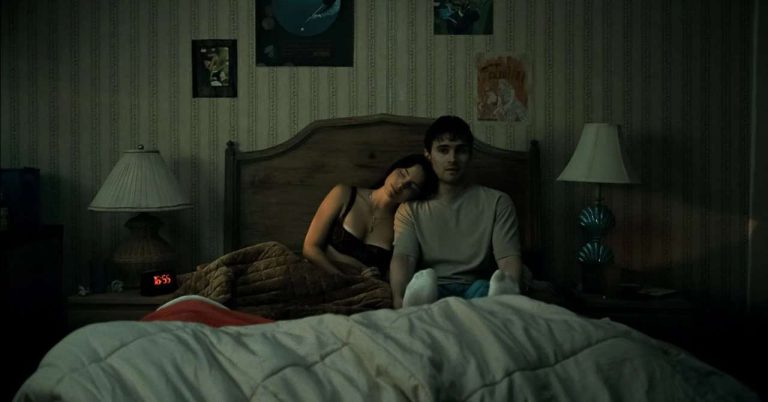
2003, San Diego, water polo summer camp. The dive of a group of boys into the water of the swimming pool draws ours into their little group. What follows – harassment induced by the group effect and violence as an initiation ritual – hits us head-on. Ben too: a new kid aged 12, his descent into hell begins with an insidious rumor. Eli, outcast of the gang, would have the plague. Faced with the cruelty of his comrades, Ben’s survival instinct kicks in. But taking part in the mockery will only protect him for a time since he will, in turn, become the beast of the fair. We could have seen all this coming if Charlie Polinger didn’t take great pleasure in disorienting us by playing with the sound and visual codes of three heterogeneous genres, which he shatters here. The camaraderie of the initiatory story disintegrates in favor of the paranoid scratchings of body horror, a tipping point towards the thriller, whose tension permeates each game of water polo. For his first feature, Polinger signs, without doubt, the most trying coming of age of the year.
Lucie Chiquer
Read the full review
FIRST TO LIKE
IN US ★★★☆☆
By Juliette Binoche
The year is 2005. Juliette Binoche then begins rehearsals for a dance show with choreographer Akram Khan. This In Us, the actress’s first directing, tells of the point of junction or even tension (never a break) between two artists who seek to train the other in their respective discipline. Khan “empties” herself emotionally “playing”, when Binoche tirelessly synchronizes her steps on her partner with flexibility and effort. This purely physical grace is beautiful to see in its very construction, made of constant questioning and analysis. Most of the documentary is, in fact, the story of a self-reflective work-in-progress. Therefore, the capture of the show in the last part appears both redundant and almost disappointing as it is impossible to restore its full extent over time. A frustration which does not prevent us from saluting the incredible performance at work.
Thomas Baura
Read the full review
BOUCHRA ★★★☆☆
By Orian Barki and Meriem Bennani
Bouchra is a wolf of Moroccan origin. Director, she lives in New York, where she is free to live her homosexuality as she sees fit. With her nose in writing a film, she continues introspective telephone exchanges with her mother. A nugget of adult animation, Bouchra is a cinematic UFO, of these radical proposals, joyful melting pots of aesthetic and narrative experiments, which relate to the random “it makes or breaks”. Here, from the pens of Orian Barki and Meriem Bennani, the anthropomorphism of traditional animated imaginations is bombarded by a transgressive autofiction; the documentary content of the quest for identity (with these dialogues, resulting from real conversations between Meriem Bennani and her mother) blurs the contours of the mise en abyme of the film within the film. It’s sometimes cacophonous, it’s often dense, it’s always great. And it happens.
Chloé Delos-Eray
THE BOY WHO MADE THE HILLS DANCE ★★★☆☆
By Georgi M. Unkovsky
This boy who makes the hills dance is called Ahmet. He is 15 years old, trekking in the Macedonian mountains accompanied by his sheep, standing up to his authoritarian father as best he can and listening to music when he receives 4G. And there is music to the point of imbuing the film with a romantic dimension, always epic, sometimes comic, but never laughable. In truth, Ahmet won’t make many people dance, except the one he falls under his spell with: Aya, a fierce young woman destined to marry. A springboard for their respective emancipation, their love story does not shake up the codes of coming of age. But we quickly forgive its cuteness, eclipsed by a sharp humor that emerges without warning – a flock of sheep at a rave; Windows shutdown sound on call to prayer speakers; a bowl in the middle of the forest – and makes us laugh a lot.
Lucie Chiquer
ALL MY SISTERS ★★★☆☆
By Massoud Bakshi
After a few forays into fiction, Iranian director Massoud Bakhshi (Yalda, the Night of Forgiveness) returns to documentary through a long-term project. Between 2007 and 2025, he filmed the daily lives of three sisters. Their childhood joys, their discovery of music and dance under the disapproving gaze of their grandmother, their entry into school and with it the introduction of a veil which will practically never leave them again. The camera never moves away from these lively kids who gradually transform into freedom-loving teenagers, endowed with a political conscience very far from that which traditional school sought to instill in them. However, it is also the entire Iranian society, its evolution, its struggles, which emerges in its complexity through their portraits. An exceptional, delicate work, with even greater resonance as the country finds itself more than ever in the spotlight.
Anne Lenoir
NEW FRIENDS AT PUFFIN ROCK ★★★☆☆
By Jeremy Purcell
It’s not always easy to find a nice film to show to little ones, so when you come across such a specimen, you don’t miss it. Adapted from the animated series by the very talented Tomm Moore (Song of the Sea, The Wolf People, etc.), New Friends at Puffin Rock extends the visual universe with watercolor-style textures and very successful landscapes. The adventure, simple but rhythmic, mixes storms, caves and misunderstandings around the disappearance of eggs, to better promote friendship and tolerance. A very cute and poetic film, quite ideal to watch with the family, although no one will blame adults for taking advantage of it to recover from a difficult night. All that matters is the joy of our dear little ones, right?
François Leger
BAIT ★★★☆☆
By Mark Jenkins
Are Mark Jenkin’s images haunted? Six years after winning a BAFTA in England, Bait finally arrives in France, two years after the release of Enys Men, which the director shot retrospectively… We find in Bait Jenkin’s meticulous work on cinematography, which immortalizes the settings of Cornwall in all their sticky and distressing aspects. In this film, the destiny of a fisherman that Martin Ward was to follow is disrupted by the abandonment of this activity by the community in favor of tourism. This is both the strength and the limits of Mark Jenkin’s style: films that tell more through the atmosphere shaped than by weak but persistent scenarios – we readily think of Hitchcock, minus the strength of the story. But there remains this visceral fear of seeing life as we have always known it disappear… and that’s already a lot.
Nicholas Moreno
THE GYPSY – ON THE ROAD WITH TAMERANTONG ★★★☆☆
By Sébastien Lefèbvre
At the origin of this feature-length documentary with social accents punctuated with humor and poetry, we find a Tamèrantong association! and one objective: to bring together young people from working-class neighborhoods around the theater. It is Lord Stanley’s La Tsigane that these children carried throughout France to Slovakia, passing through the Roma slums. In just one hour, Sébastien Lefèbvre’s film takes us from laughter to tears, from astonishment to hope. Through the portraits of these students and their teacher, he tells the story of the fight against racism and exclusion that takes place on stage. The theater becomes a political and social arena. The film accompanies with music and without judgment a small miracle: that of a company from Plaine Saint-Denis which, buoyed by its success, crossed borders.
Lou Valette
Find these films near you thanks to Première Go
FIRST TO MODERATELY LIKED
THE ZANETTI CASE ★★☆☆☆
By Leonardo Di Costanzo
Ten years after Elisa Zanetti was convicted of her sister’s crime, about which she says she remembers almost nothing, a renowned criminologist (Roschdy Zem) reopens her case and, through several face-to-face meetings with her, tries to bring back her memories and therefore the truth. Interesting on paper, this dive into the head of a criminal, with the idea of looking evil in the face, unfortunately suffers from a transparent staging, from a false rhythm which artificially keeps you at a distance and more generally from a scenario that is a little too laborious to convince.
Thierry Cheze
FAR FROM ME ANGER ★★☆☆☆
By Joël Akafou
In 2011, the civil war in Ivory Coast hit the village of Ziglo hard. Fifteen years later, a woman named Tchinmouegnan tries to heal hearts damaged by war. Filmmaker Joël Akafou films with precision and accuracy this everyday heroine who has given herself the mission of alleviating hatred between different communities. An abandoned widow, a woman burned alive in her hut, and an orphaned mother…: in 2026, the post-electoral crisis of 2011, engraved in the flesh or in the hearts, continues to consume the inhabitants. With Far from Me Anger, Akafou delivers a documentary with very raw photography whose assumed aridity (neither music nor voice-over) nevertheless ultimately remains a little too distant.
Lou Valette
And also
Anna and the children, by Diane Clavier
Francesca & Giovanni, by Simona Izzo and Ricky Tognazzi
Saccharin, by Natalie Erika James
Scary movie 6, by Keenan Ivory Wayans
The covers
Bye bye Brazil, by Carlos Diegues
When we were kings, by Leon Gast