
With The Odyssey, has Nolan finally resolved his problem with women?
Long relegated to the loom while Ulysses took to the sea, the women of the poem finally emerge from the shadows. In this, Nolan follows the historians and translators who reread The Odyssey from a woman’s perspective.
The criticism is old. For more than twenty years, women in Christopher Nolan have had the unfortunate habit of dying before the credits roll. Or just after. His female characters are often reduced to accessories. Think of Leonard’s wife in Memento or that of Christian Bale in The Prestige, Marion Cotillard in Inception or even the Rachel of Dark Knight : so many dead, missing women, whose function is to make males cry. Critics have a word for that: “fridging.” She also has a figure that sums up the problem: out of her twelve feature films, no leading female role and not a single one that passes the Bechdel test. Oppenheimer had made things worse, since the character of Florence Pugh only existed for the duration of an affair (and her suicide).
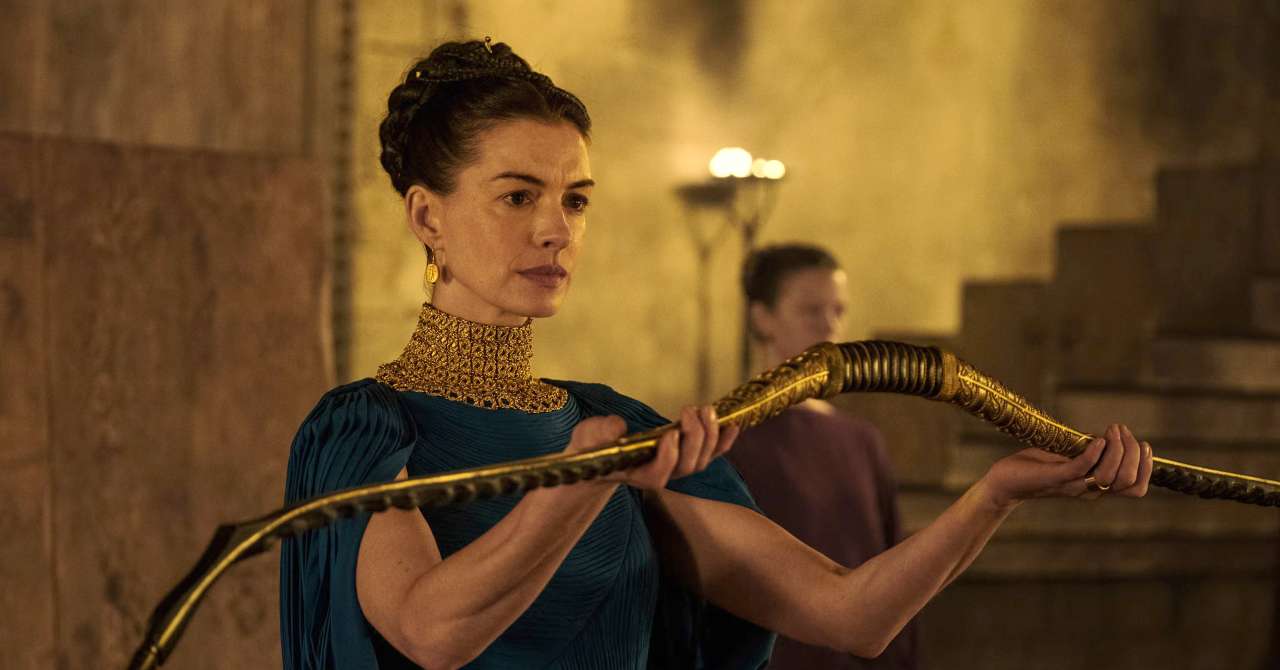
And there you have it The Odyssey. Here the wife is (and will remain) alive. Penelope is played by Anne Hathaway. In both the book and the film, she doesn’t just wait on the balcony, she rules. It is therefore not a simple wife who awaits the return of her husband; she is a queen who has held a kingdom for twenty years without ever being granted legitimacy. Even if she lives in a male society (in Canto I of the book, Telemachus asks her to shut up and return to her distaffs), she is a cunning woman, who plays a long game, and whose main attribute is anger. It is one of the most beautiful female roles in Western literature and therefore in Nolanian film.
And it’s anything but a coincidence. Nolan in fact built his film partly on the translation of Emily Wilson, the first woman to have translated Homer into English. Wilson writes a very beautiful text about this adventure (A translator puts the women of The Odyssey to the test) where she explains that she spent years giving back to the heroines what generations of male translators had confiscated from them: Calypso’s very political fury against the gods, female physical strength (she speaks of Penelope’s “muscular” hand where others wisely wrote “a firm hand”), or even the complex fate of the handmaids massacred at the end. His thesis is contained in one sentence: “The Odyssey depicts male fear of female power.”
Nolan followed these intuitions and it shows in many of his adaptation choices. Like the character of Melantho. In the poem, she is a servant from Ithaca raised by Penelope. She moves on to the suitors and mocks Ulysses who has returned in rags; she will end up hanged, with eleven other slaves, in the great final bloodbath. Until then, the translations dismissed her with a contemptuous word, and Wilson insisted on rehabilitating her by refusing to call her a “whore”. That this character (a slave and a collateral victim of the hero’s revenge) is played by Mia Goth, an actress who is not hired to act as an extra, says a lot about the film’s program. Nolan does not just dust off Penelope: he gives a face, and a weight, to those that the epic has until now crushed in silence. He brings justice to women.
In the process, Matt Damon’s Ulysses loses its splendor and gains flaws. But let’s not get too excited. The case is not entirely won. Because if Penelope shines, if Melantho gains prestige, the great feminine powers sometimes remain on the edge of the frame. We see Calypso (Charlize Theron) too little, Athena (Zendaya) is too evanescent (and we take away a lot of scenes from her). As for Hélène (Lupita Nyong’o), she is saved by a reply reminding us that the Trojan War was not fought in her name. A beautiful tirade offered to the Queen of Sparta, even if the goddesses and magicians pass by a little too quickly.
This is, ultimately, the real movement of the film. Nolan didn’t solve his problem, he moved it. He redeems the sacrificed wife, the one who has haunted him since Mementobut leaves the goddess and the witch in the dark. Desire and fantasy. Of what Wilson had restored to the text, he only takes up half: the marital part. The other, the magical and divine part, the dark part, the one that Pietro Citati called the “idyllic and funerary parenthesis” of Circe and Calypso, or of Nausica (totally absent) still awaits its great work.
So, cured, Nolan? Let’s just say he finally brought a living woman back to Ithaca. And that he understood, with Citati, that Penelope was not the wise wife of Ulysses, but “the guardian of secret signs”.


