Vaiana, Evil dead burn, The Heat: new releases at the cinema this week
What to see in theaters
THE EVENT
VAIANA, THE LEGEND AT THE END OF THE WORLD ★☆☆☆☆
By Thomas Kail
The essentials
Dwayne Johnson and Catherine Laga’aia tame the ocean in this adaptation sorely lacking in relief because it is too close to the original animated film
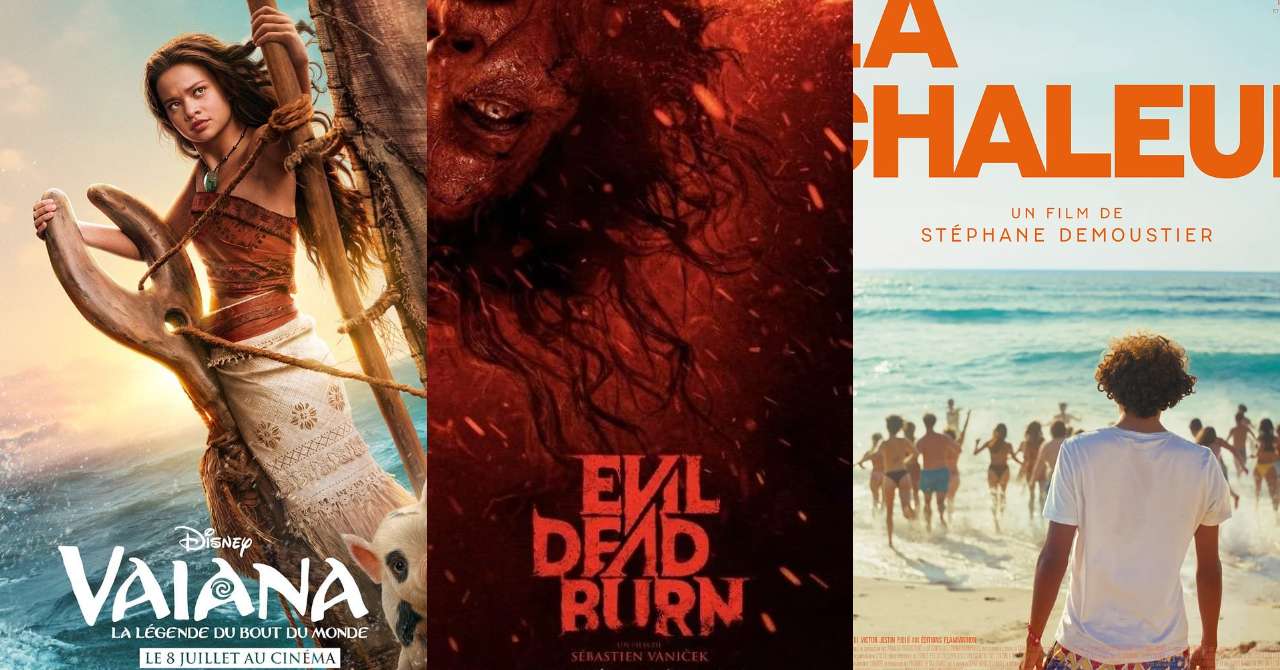
Thomas Kail tackles the story inspired by Polynesian mythology which had conquered the public ten years earlier in the animated film signed by the duo Ron Clements and John Musker. Vaiana, daughter of the chief of the island of Motunui, a young teenager, decides to brave the ocean alone, to cross the reef to save her people decimated by a curse, find the insolent demigod of the wind and the sea and his imposing tattoos, Maui, and restore the heart of Te Fiti. Ron Clements and John Musker had created an animated film on the surface of the water – faithful to the representation of Polynesian culture. Thomas Kail maintains this course by going to film on the Pacific islands but delivers a simple copy and paste without ever taking advantage of what live-action could bring or deepen. We therefore remain largely unsatisfied. This Vaiana, the legend of the end of the world, live action version, seeks to please fans of the first part without getting too wet…
Lou Valette
Read the full review
PREMIERE LIKED A LOT
DRY LEAF ★★★★☆
By Aleksandr Koberidze
The least we can say about Dry Leaf is that we have never seen anything like it in cinema. Starting from a minimal scenario (a sports photographer disappears, her father and a friend go looking for her), Alexandre Koberidze chose a strange device: the use of a very very low resolution camera and the desire to “trust the winds to take us where we could not imagine”. What emerges is a praise of pixelated material, a sublimation of the Georgian countryside. In Dry Leaf, we distinguish more than we see, and we are moved by the void left by the notes of a piano, the looks of stray cats, these sports fields where the journalist once passed, today deserted. It took three hours to unlearn how to watch in the cinema, then come out with a clean, new eye, and perhaps wet with tears from a letter finally received, against all expectations.
Nicholas Moreno
FIRST TO LIKE
EVIL DEAD BURN ★★★☆☆
By Sébastien Vaniček
Called to the helm by Sam Raim, Evil Dead Burn is the film in the saga that we had the right to expect from the director of Vermin: violent, gory, dry as a cudgel and filled with joyful horrific visions Sébastien Vaniček and his co-writer Florent Bernard imagined the story of Alice (Souheila Yacoub), a battered woman whose husband has just died. The widow goes to the isolated country house of her horrible in-laws, where the late grandfather recorded his research on demons… Spoiler: it goes wrong, and rather badly. There is no trace here of authorist fuss, Sébastien Vaniček is above all there to fight it out. This frontal approach allows him to fully fit into the mythology while breaking the toy. And if Evil Dead Burn slips a little more in terms of the psychology of its characters, it would nevertheless be stupid to deny pleasure in the face of the inventiveness of the staging and the talent of Souheila Yacoub, who effortlessly devours the rest of the cast.
François Leger
Read the full review
MICROSTAR ★★★☆☆
By Leopold Kraus
You shouldn’t believe everything you see on social networks: Gabriel Rose’s life is not, rosy. Squatting in a room at Crous, being diagnosed with a “median-sized penis”, having multiple mediocre partnerships in addition to romantic disappointments and risking hypothermia for a friend’s short film, that’s no dream. Welcome behind the scenes of Instagram stories, which the young filmmaker Léopold Kraus cheerfully dissects with an irony whose harshness is sometimes disconcerting. The plot of this UFO is going nowhere, and you have to get used to the idea. But the charm works, especially thanks to a cast that fully embraces the ambient absurdity: Abraham Wapler wears a blue flower bow-knot, Raïka Hazanavicius debates nepotism (the height of it!) and Félix Lefebvre wears gold gutters and other bling bling daddy’s boy accessories. Deliciously wacky.
Chloé Delos-Eray
ONLY LIFE ★★★☆☆
By Adrian Goiginger
The Austrian Adrian Goiginger has accustomed us to very personal films, for which he also wrote the screenplay, such as Brave New World released in 2017. For the first time, he chose to bring to the screen the story written by another, in this case Senad Halilbašić, an adaptation of a news item that shocked Austria. A clown sees her life explode when her husband then her two young children die in quick succession following a car accident. From this tragic starting point, Goiginger constructs a quite remarkable film, choosing, like the true protagonist, to cling to hope and life rather than dwell on her tragedy. He finds in Valerie Pachner, seen in A Hidden Life by Terrence Malick, an impeccable performer, both when it comes to exploring her comic side and when it comes to carrying the immeasurable weight of a terrible mourning by deciding to live it in her own way, even if it means upsetting those around her.
Anne Lenoir
HANAMI ★★★☆☆
By Denise Fernandes
Little Nana gets sick. Her mother is no longer there to pamper her, her grandmother sends her to a healer, at the foot of a volcano. A timeless journey begins on this island of Cape Verde that looks like an imaginary country, undoubtedly the most beautiful film set you will see this year. There we meet child climbers, a strange old man and a Japanese volcanologist. Hanami chooses simplicity: each shot is a painting designed to capture the magic of the place. Then Nana, now a teenager, navigates between a returning mother, a drawn-out family reunion, and hot, late evenings. Here again, the story is told less through words than through this atmosphere charged with wonder. For this, Denise Fernandes observes delicately and lets the image speak for itself. We come out of it like after a long feverish dream: stunned.
Lucie Chiquer
Find these films near you thanks to Première Go
FIRST TO MODERATELY LIKED
HEAT ★★☆☆☆
By Stéphane Demoustier
By freely adapting Victor Jestin’s novel, Stéphane Demoustier reconnects with the foundations of The Girl with the Bracelet, a disconcerting observation of the adolescent specimen. With the difference that everything happens here outside, in this campsite in the Landes that the protagonist relentlessly surveys, up and down and across – behind closed doors in the open air. This one, aged 17, is concerned. The end of summer is looming and with it, the departure of pretty Giulia. And then there is this lifeless body; the one he buried on the beach – a dull, asphyxiating threat. Almost as much as the humid atmosphere, as the white sun, whose rays are as overwhelming as the feverish guilt which, in waves, eats away at him. The aesthetic is sought after, full of meaning, and saves the film from the harshness of its own device. This is because we never quite know what to think of the adolescent and his (re)actions, as his apathy is unsympathetic, as the monotony of his wanderings is tedious, as his introversion is arid. Sometimes, languor rhymes a little too much with torpor.
Chloé Delos-Eray
THE PASSAGE ★★☆☆☆
By Brandt Andersen
In 2020, American producer Brandt Andersen moved into directing with the short Refugee, the title of which is enough to reveal its content. It is said that the man is very involved via associations in the fate of migrants around the world. Omar Sy was already part of the adventure. This Passage more or less takes up the starting point: a Syrian doctor flees Aleppo under the bombs accompanied by her daughter. As a feature film format requires, Andersen has authorized himself to deploy a complex narrative structure made up of spatio-temporal shifts and points of view. It is in the middle of this somewhat gimmicky dramatic canvas that we come across Omar Sy as an unsympathetic smuggler based in Türkiye. An antipathy, however, attenuated by sequences with the suffering son. Just another (clumsy) way of saying that no one here is inherently bad. It is indeed the tragic circumstances that distort men. If Andersen’s project is rather held by a sense of direction which combines documentary and melofictional momentum, the film disperses in the meanders of its scriptwriting tour de force.
Thomas Baura
THE END ★★☆☆☆
By Syeyoung Park
This dystopian story which is set in a reunified Korea but ravaged by a climatic catastrophe forcing the country to live cut off from the rest of the world is worth for its fascinating visual universe with minimalist special effects. His work on colors (from the dominant reddish hues to a black rainbow emerging in the sky), his mutant characters with deformed bodies and vocal cords tell this end-of-the-world atmosphere better than a thousand words. But the form takes so much precedence over everything else that it is difficult to become passionate about its heroine, an employee of an illegal fishing store who will end up rebelling by the established order. We understand the ambition – a parable around totalitarianism – but the demonstration of force of its staging diminishes its impact.
Thierry Cheze
PREMIERE DID NOT LIKE
THE ECOLOGY OF FEELINGS ★☆☆☆☆
By Alexandre Steiger
Unclassifiable, Alexandre Steiger is without context. Whether as an actor opting for often atypical projects like mini-series such as Aspergirl or The Spies of Terror or a film like The Beautiful Role. But also as a filmmaker, as evidenced by his two short films, Long Speeches in Your Hair and Why I Wrote the Bible, with worlds as explosive as their titles. For his first feature, for which he wrote the screenplay, he continues on this path. And offers the portrait of two misfits: Félix, who drags his discomfort and his lanky body in the rooms and corridors of his father’s old hotel, and Lola, an environmental activist determined to sabotage the Salon de la chasse, whom nothing predestined to bring together. But, for once, Steiger has little control over the cursor of the absurd, so much so that it is difficult to understand what he really intends to demonstrate or denounce and that The Ecology of Sentiments turns into boredom by dint of seeming to run on empty.
Anne Lenoir
And also
Between heaven and earth, short film program
The Leading Role, by Amor Akkar
The covers
Kill Bill – The Whole Bloody Affair by Quentin Tarantino
Sudden Fear by David Miller