
Alpha, sentimental value, orphans: new features at the cinema this week
What to see in theaters
The event
ALPHA ★★★★ ☆
By Julia Ducournau
Essential
After titanium, Ducournau returns with a horror body on a disease that transforms bodies into marble. Amazing, shock, and moving this time.
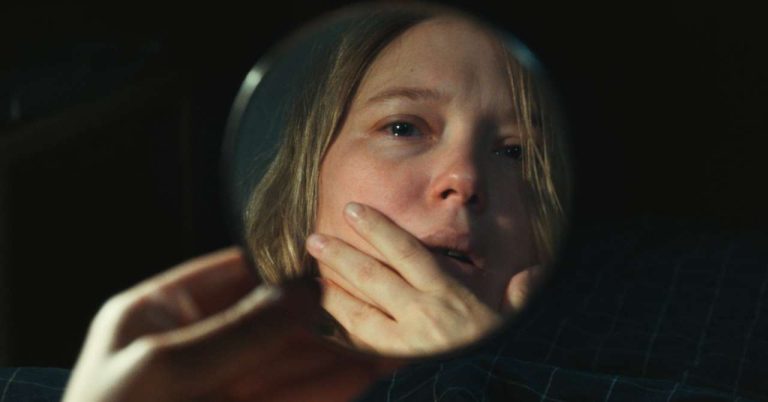
In the mid -1980s, in a provincial town, a mysterious disease gradually transformed bodies into marble statues. The teenager Alpha sees landing in her life his uncle adding amin (Tahar Rahim, masterful), while his mother doctor tries to save the sick in the face of general indifference … From these Cronenbergian premises, Julia Ducournau shoots her film towards an unexpected emotion, transfigures the horror in beauty and avoids the cinema traps, rather offering a dream -style descent in message, trauma pain. More than a film concept, Alpha is first of all a love story, multiple. That of a sister for her brother Junkie, that of a teenager for this uncle whom she discovers, or the more stealthy one of a teacher for her statuvity lover. Film on the fear of losing those we love, on the bodies that betray us, on the traumas that we transmit, Alpha resonates hard.
Gaël Golhen
Read the entire review
First a love
Under tension ★★★ ☆☆
By Penny Panayotopoulou
A brutally disappeared brother, his niece of which he will have to assume the charge, an inconsolable mother and the family laundering who is crumbling under increasingly abyssal debts … The daily life of Costas, security agent in a Greek hospital, has everything of an inevitable descent without hope of return to more joyful hours. Until the day when a stretcher bearer offers him a villainous combination that could get his head out of the water: watching the situations that could be easily transformed into possible medical errors and touching the lawyer’s wine that would be informed and would offer his services to the families concerned. Under tension is based on this moral dilemma and the collateral damage of the choice that Costa decides. And his title does not lie! The intimate drama experienced by the family of Costas is gradually putting on stifling thriller while turning naked the cogs of a breath of life that cracks from all sides and conducive to all drifts. All without pathos because refusing the ease of miserability and never depriving its characters at the bottom of the hole of the essential: their dignity.
Thierry Cheze
Salve Maria ★★★ ☆☆
Of Mar Coll
Woman on the verge of nerve crisis could be the sub-title of this Maria Coll film (whose previous ones are unpublished with us). This woman, Maria (Laura Weissmahr, a revelation), a writer, has just become a mother and appears incapable of being made to her new status, fascinating for a sordid news item: a Frenchwoman installed in Spain who murdered her 10 -month twins by drowning them in a bathtub. By adapting Mothers Don’t by Katixa Agirre, the Spanish filmmaker seizes the question of post -part -outing depression and the mental charge impossible to bear for certain mothers – even when as here the father is attentive – without ever softening the angles. Film everything except kind, Salve Maria marries as closely as possible the complex interior journey of a woman seeing in this child an obstacle to her fulfillment. Without being a lawyer or judge. Under the mental violence and the injunctions of the society it undergoes. Strong.
Thierry Cheze
Find these films near you thanks to First Go
First is shared
Sentimental value ★ ☆ding
Of Joachim Trier
AGAINST
This film opens onto an anxious actress who refuses to go on stage before freeing her text. Then Trier continues with a very beautiful sequence where an interior is the silent witness of a family life. From the outset, here we are taken in the nets of a double representation space which includes both pantomime and superego. Game and I. The noose tightens around a demiurgic paternal figure whose relationship with its two daughters is more or less broken. He is a filmmaker, one of he is an actress. The little narrative music of this sentimental value then deploys its melody of the sour orchestrated by the Norwegian filmmaker with his eyes riveted on his Bergmanian score. And we inevitably advance towards a programmed reconciliation. Until, in a final sequence of an implacable heaviness, the film finally reveals itself to itself is a theoretical and problematic object resounding from the self-scisting traumas.
Thomas Baurez
FOR
The Grand Prix received by Joachim Trier for sentimental value owes nothing to chance. And this welcome owes nothing to chance. He recounts the quiet power of an author who, since his first long new dive (2006), continues a coherent work without ever stinging. But also and above all the richness of a film that speaks at the same time and in a perfect complementarity of a father-girl relationship, an unwavering and protective link between two sisters and behind the scenes of cinema. His look at the seventh art and more precisely on the profession of actress, so often reduced to clichés, symbolizes the DNA of sentimental value. This refusal of any Manichaeism as of never trying to round the corners. All without hammering things, with elegance not devoid of humor which gives birth to an exciting reflection around art which can just as much destroy as to help to rebuild itself.
Thierry Cheze
Read the entire review
First a moderately love
The orphans ★★ ☆ From
By Olivier Schneider
Gab and Driss, former friends of an orphanage with diametrically opposed destinies, find themselves after years of scramble. One became a police officer at IGPN, square and methodical, the other fixer for thugs, more tactical and inspired by special forces. Their forced meeting? The suspicious death of Sofia, their first common love, in a mysterious car accident. Recognized stuntman chief, Olivier Schneider (GTMAX) masters his favorite field perfectly. The action sequences are millimeter: spectacular waterfalls, dantesque prosecution, choreographed shootings. Alban Lenoir is impeccable as a taciturn police officer and Dali Benssalah radiates in Hableur fixer. But the film is no exception to certain pitfalls: notable lengths in its first hour, a very agreed scenario, comic attempts that cannot always find their target. Hesed too much between the family thriller and the pure entertainment of action. The orphans still remain a calibrated, muscular and generous, even imperfect entertainment.
Pierre Lunn
Read the entire review
Tell me why these things are so beautiful ★★ ☆ From
By Lyne Charlebois
For her second long, Lyne Charlebois is interested in the singular friendship which was established in Quebec in the 1930s between a man of the Church, Brother Marie-Victorin and one of his students, the young Marcelle Gauvreau. And which has given rise to a long epistolary correspondence on many subjects then taboos around sexuality. The filmmaker therefore finds herself in the face of the challenge of bringing in the image what we imagine more spontaneously lying in a book. A challenge unfortunately retracted by the bias to want to dialogue the past and the present forced march, by building a parallel between these exchanges and those of the actress and the actor – which maintain an eventful adulterous link – chosen to embody them in a film. This abyss ends up serving the subject. Because it highlights what I say why things are so beautiful succeeds in suggesting as soon as it returns to the past: the avant-garde of what is said and is written between Marie-Victorin and Marcelle Gavreau, including in relation to today. Too much damaged didactism This film which was however prevalent in Angoulême in 2024 via her interpreter, Mylène Mackay.
Thierry Cheze
And also
Last show at First Light, by Nicole Midori Woodford
The night of the clowns, of Eli Craig
The Ritual- Emma Schmidt’s exorcism, by David Midell
The covers
The ace of the jungle, by David Alaux
The AS of the Jungle 2- Operation Tour du Monde, Laurent Bru, Yannick Moulin and Benoît Somville
Barry Lindon by Stanley Kubrick
Broken Mirrors, by Marleen Gorris
Princess Mononoké, by Hayao Miyazaki
Shocker, from Wes Craven
Silence around Christine M., by Marleen Gorris