
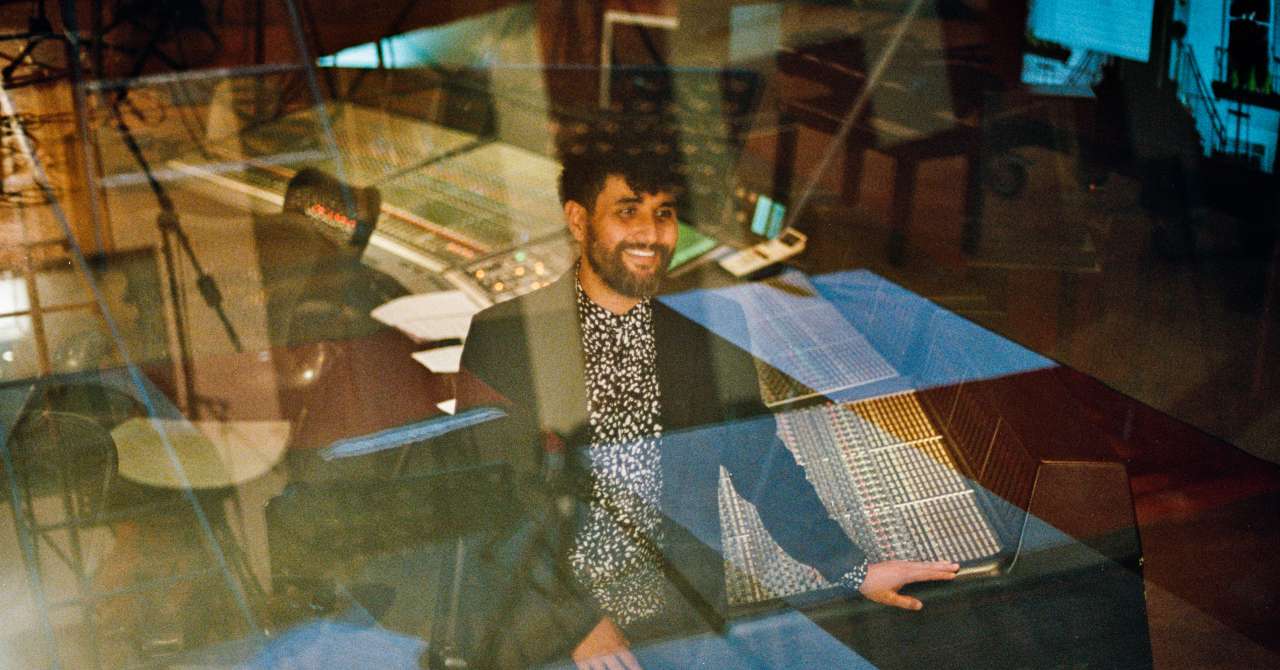
Amine Bouhafa: “the music of La Petite jeunesse had to dialogue with bodies and silences”
Nominated for a César for the music of La Petite Dernier, Amine Bouhafa returns to a deeply intimate score and his work with Hafsia Herzi, between buried emotions, human voices and organic writing.
A few days before the Caesars, where The Little Last is among the favorites – and where he is nominated for his original music -, Amine Bouhafa is experiencing an intense interlude. Hafsia Herzi’s film has also just been released on VOD, extending its successful run in theaters. It was the perfect opportunity to return to the work of a composer who is now among the singular voices of French-speaking cinema.
Bouhafa was revealed to the general public with his score for Timbuktuwhich earned him his first César. Since then, we owe him the music for films and series that have left their mark on people’s minds, Gagarin has Olfa’s Daughtersthrough more experimental or intimate works.
What distinguishes his work: an almost physical attention to bodies, breathing, light and off-camera. A way of composing which makes him a directing partner, almost an invisible playwright.
With The Little Lastit enters a new dimension: a carnal score, recorded as close as possible to the musicians, and where the voice becomes an instrument. We wanted to understand how such music is born, how it is woven with the image, and what is the alchemy that united the composer and Hafsia Herzi on one of the most sensitive films of the year.
How did your meeting with Hafsia Herzi take place?
Amine Bouhafa: By happy coincidence. I composed a song for Patricia Mazuy’s film The Prisoner of Bordeaux in which Hafsia played and that’s how she heard my work. That’s how she discovered my music. But our real meeting took place at the César. She was named for The Rapture and I accompanied Olfa’s daughters. We talked, and very naturally, we wanted to work together. And moreover, the producer who accompanied Hafsia on La Petite petite was Julie Billy, whom I had met on the set of Gagarin. So everything happened very naturally… In retrospect, it’s an alignment of planets.
It is also proof that your filmography follows a very clear guideline. Kaouther Ben Hania, Philippe Faucon, through Abderrahmane Sissako or Hafsia Herzi… There is a consistency in the sensitivity of the films you choose and in the filmmakers you come across.
AB: I do try to work with directors who have a unique voice. It goes beyond the simple aesthetic question. Each time, I want to participate in films that are in line with what I stand for in my life. This is essential. These are often intimate, sensitive stories. Films that allow music to exist in ways other than simple support. Then, I also look for projects that can take me elsewhere: a new sound palette, an instrument that I’ve never used, a different way of writing. I really care about this space for experimentation. The fact that you perceive this consistency touches me enormously.
In your scores, and this is particularly true in The Little Onewe feel an attention to reality.
AB: Yes, absolutely. It all starts there, with the reality that the film will describe or in which it will evolve. It’s the sound world obviously, but it can be the way the character breathes, speaks, evolves, moves. Everything inspires me. I am also very attentive to the voices of actors and actresses. For me, the music must almost play with them, dialogue with their diction, their frequency. When I compose, it’s as if I were an actor and I had to dialogue with the other actors. Each voice has its musicality – its timbre, its frequency, its vibration and the music must play with that.
And then there is of course the image. Its palette, its colors, the lights chosen by the cinematographer, the way the camera moves: all of this directly feeds the music. I really compose in dialogue with all that.
So, when you arrive at a project, what do you look at or look for first? A theme? A motive? A texture?
AB: Color. Always. I start with the sound palette: the instruments, the timbres, the sound universe in which I will work. Once this palette is found, I can start working on themes, harmony or patterns. But without color, nothing exists. It’s like the character in a screenplay: if you lose him, everything collapses.
With The Little One, Hafsia Herzi creates a free, sensual and moving film
The recording of The Little Last is very organic. You have chosen a close, very intimate production. For what ?
AB: Because with Hafsia, we talked about sensations before talking about music. Silence, interiority, restraint, sobriety: these were the words that came up all the time. I wanted this intimacy to be felt in the writing, but also in the way of capturing the sound. The way of producing film music is as important as its writing. For mo, the recording is totally part of the score. And I have sometimes recorded music in churches, to have a certain reverberation, a real breadth of sound. There, it was the opposite. I wanted proximity to the players and the instruments – I wanted it to feel like the musicians were in the room. We hear the friction of the ropes, the breathing. We must have had the impression that the singer was whispering the words or the music in our ear; that the cello accompanied the dance. Moreover, in this film, the human voice becomes an instrument, sometimes a rhythmic motif. This proximity creates a sensuality that the film called for.
Is there a scene that is particularly close to your heart?
AB: Yes, that of Pride. It begins with two voices, then three, then four… the lines come together and build to a crescendo. It is a very simple weave that rises gently. Then the instruments come, almost like extra breaths. Until the climax where the two characters dance together in the box: it’s an emotional moment that I’m quite proud of. On this scene, I really relied on the editing of Géraldine Mangenot, the head editor of the film – He was incredibly musical and he often guided me. This scene, for me, is a dialogue between editing and music.
Has this experience changed your way of composing? Or do you see it as a continuation of your work?
AB: Both. In form, yes, I remain faithful to something organic, fragmented, which evolves with the character. But musically, this film was a real opening. I have long had an apprehension with the human voice – it was in my mind too associated with song, even though I composed it often. There, I dared to make it an instrument in its own right, in a very minimalist style inspired by Steve Reich. I also chose a dry, modern acoustic treatment, unlike the larger partitions that I have done before. There is, I believe, a new balance, an intimate lyricism that I had not yet explored.
You are nominated for a César. What does this mean to you?
AB: Immense pride. Ten years later Timbuktuthis is my second nomination and I admit that when I learned about it, I was very moved. Whether for The Little Last matters even more: I deeply love this film, this score, and especially the human encounter with Afsia. This nomination is an encouragement to the profession, a symbolic validation, and a gesture of support that means a lot to me.


