
Cannes 2026: Fatherland, the winter journey of Thomas Mann
Eight years after Cold War, the Polish filmmaker returns to Cannes with a miniature film about the return of Thomas Mann to the torn Germany of 1949. With an immense Sandra Hüller.
We’ve been waiting for eight years. From Cold War In 2018, Pawel Pawlikowski seemed to have disappeared into the limbo of European cinema, busy with projects that were not released. Here he is returning to competition, at Cannes, with a film which, from the first shot, makes it obvious: we had missed his formal genius. Fatherland closes a trilogy of bruised Europe that he opened with Ida and extended with Cold War. Three films, in black and white and square format, to record the shift of the 40s and 50s and reflect on the long vibrations of the 20th century. But this time, the filmmaker is tackling a monument. Thomas Mann. And he does it through the eyes of someone who looked at him without illusion: his daughter Erika.
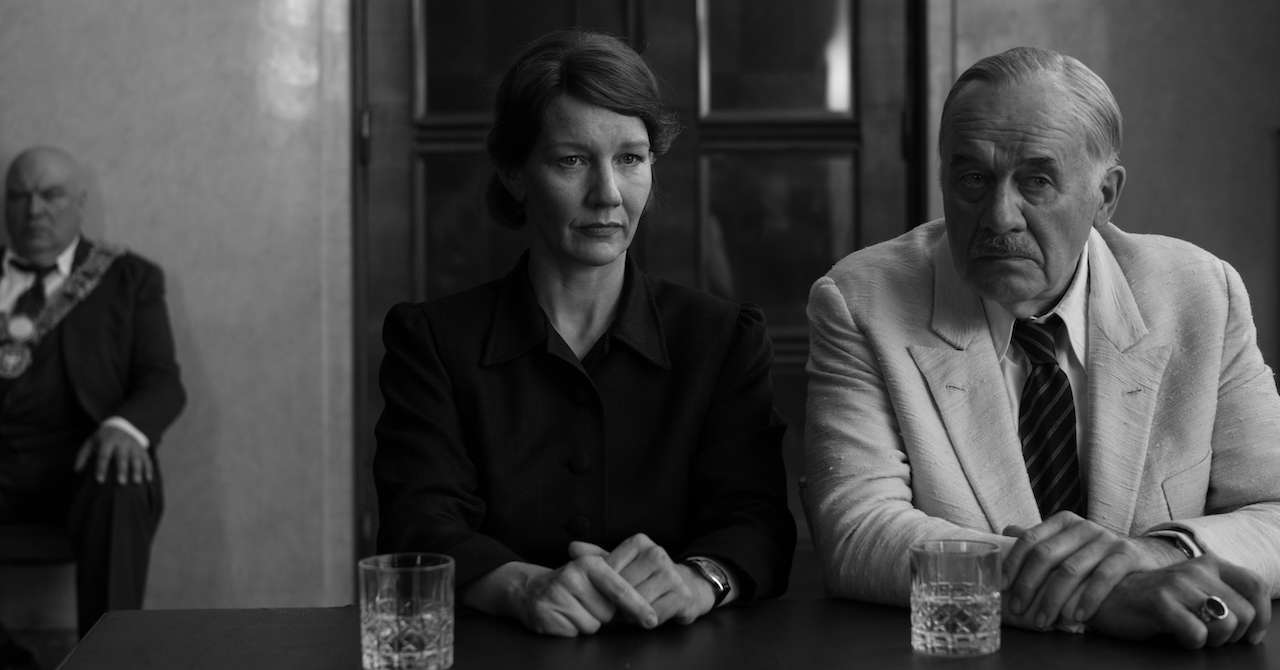
Summer 1949. The author of The Magic Mountain (Hanns Zischler, absolutely astonishing) returns to Germany for the first time in sixteen years, to receive two Goethe prizes: one in Frankfurt in the American zone, the other in Weimar in the Soviet zone. Erika (Sandra Hüller) accompanies him. One of his sons, Klaus (August Diehl), who we only see in a prologue as masterful as it is suffocating, did not want to come. So here are father and daughter embarked in a big black Buick, and crossing a Germany in ruins where everyone wants their share of the great man: the West German bourgeois who yesterday danced to Wagner and who today dance to jazz like the Stalinist apparatchiks who believe they can annex Goethe to dialectical materialism. Mickey Mouse or Stalin ? Mann refuses both. During his conferences, in vast, crowded rooms, he talks about cultural unity, literature or music. Outside, the concentration camps have only just been cleared and the gulags are already opening a few kilometers away, such as at Buchenwald, converted into a political prison.
There are many powerful things in Fatherland. But the most surprising thing here is the length of the film. 82 minutes, which makes it a radical gesture. Mann was the man of cathedrals, of behemoth books: The Magic Mountaina thousand pages; Joseph and his brothersfour volumes; her Doctor Faustusa paving stone. Pawlikowski responds with a thumbnail. The square format, the black and white of Lukasz Zal, the surgical conciseness are not coquetry or an authorial affectation. This is a critical response. Pawlikowski does to Mann what Erika does to him in the film by just looking at him: he reduces him, crushes him, and dismantles him. For two reasons: first, Fatherland is the portrait of a man who has come back from everything, broken down by the intimate tragedies and universal earthquakes he has gone through. Then because it involves knocking this giant of letters off its pedestal and placing it, fragile and bloodless, on the back seat of a Buick. But it is a radical gesture especially because, where Mann symphonized, Pawlikowski composed a song. A brief song, in a bare voice, which does not raise a monument but engraves an epitaph. The only way to put his finger on what he really wants to record: not the greatness of Germany regained after exile, but the observation of its disintegration.
Because beyond its compact side, Fatherland is also a film that crumbles. Like a sandcastle. Everything at first appears stable, composed: Germanic. The official speeches, the processions, the protocols, the dignity of Mann reciting Goethe to Soviet generals… And then something starts to slip away. There is the terrible news learned over the phone. Erika’s slap, the muffled cry of a man being taken away for talking about the Russian camps. The wind passes over the building, and grain by grain it is the century that collapses. Conciseness is basically an act of mourning. And in 82 minutes, through the journey of this duo, what we understand is: the fall of the Reich, the birth of the Cold War, the betrayal of a father, the death of a son, the end of the very idea of great German culture.
This gesture of staging would be nothing without the power of the performers. Hüller first who carries the look of the film. Huller whose every role since Tony Erdmann constructs a work parallel to that of the filmmakers who employ it, here composes a bloodless, ironic, devoted and bruised Erika. She looks at her father and, through him, at Germany, and through Germany, the very idea that an Artist can continue to speak when the world is falling apart. Fed up with “your Olympian phrases”, she throws at him at one point, and the entire film is based on this reproach. Facing her, Zischler – the face of young German cinema at Wenders – responds with a silence that barely breaks. He has the frozen beauty of a marble statue and at the same time his body, his posture, his gestures betray the exhaustion of a man who has come to make a last, somewhat vain, pilgrimage. Both of them embody the question that Pawlikowski had never asked so directly: what remains of culture when it has failed to prevent barbarism?
And the most beautiful? It all culminates in a stunning final scene. A church in ruins, two men repairing an organ, a Bach cantata (and not just any cantata, “Jesus May My Joy Remain”, at first a little rusty, sloppy, then more and more assertive) which springs into the void. And suddenly everything collapses. The mourning of a son, a brother, a country, a language. At that moment we understand that the control – the stiffness of Mann, the austerity of black and white – of everything that led us to this ruined church was not an affectation. It was a dike. And when she gives in, it’s immense. Where is home now?


