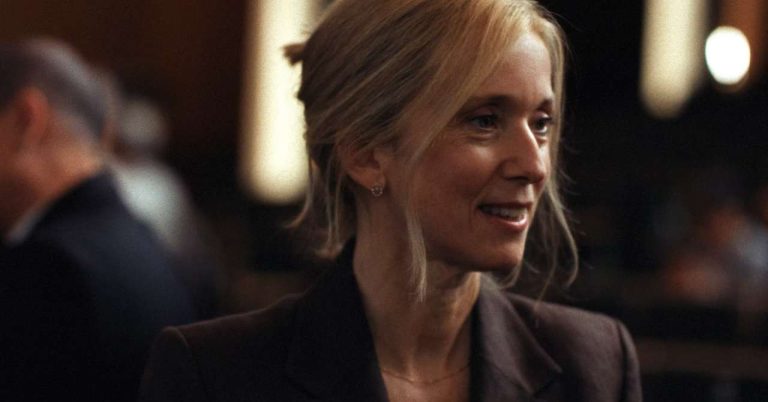

Cannes 2026: Virginie Efira illuminates the astonishing Suddenly
In competition, the Japanese filmmaker of Drive My Car installs Virginie Efira at the head of a Parisian nursing home and signs an anti-capitalist pamphlet mixed with senior hedonism. A surprising gesture.
It is an understatement to say that elderly people are invisible in the cinema. Place its plot almost exclusively in a Parisian EHPAD as the relocated Japanese Ryūsuke Hamaguchi does here (Senses, Drive My Car…) is in this a strong gesture. Even stronger is to make it a utopian place where taking care of others would be a way of re-enchanting a world scarred by our selfishness. Virginie Efira, who we discover sleeping next to a patient, is the director of an establishment with experimental methods. She sets up the “Humanitude” program around the philosophical concept advocating “ the capacity of a human being to become aware of his or her belonging to the human species as a full member. » Faced with the skepticism of her management or certain colleagues (one in particular), she holds on, praising the four pillars of this wisdom: gaze, speech, touch and verticality.
Through the gentleness of its staging, ultra-precise without being overbearing, Hamaguchi appropriates the space without falling into blissful exoticism. Parisian roofs quickly give way to a red brick wall before revealing a garden as if removed from the world. Even a walk on the banks of the Ourcq canal or at the foot of the François Mitterrand Library will not be a tourist postcard. Hamaguchi is riveted to his performers, embraces their rhythm, their heartbeat, listens to their thoughts against the test of their own speech. Virginie Efira goes from French to Japanese with disconcerting ease without ever making a tour de force. Forte. Very strong.
Interview with Ryūsuke Hamaguchi about Drive My Car
We will think what we will of the new feature by the Japanese author, know that after two hours he manages to captivate us with a “foot” orgy in the garden of the EPHAD where mostly senile elderly people find peace by rubbing their neighbor’s toes. To achieve this absolutely invigorating senior hedonism, it was necessary to integrate the logic of a film straddling Lelouch and Bourdieu where good feelings are coiled in an acute political awareness of the world. Because if capitalism segments forces by nature, the humanism praised by the director of the EHPAD in question intends on the contrary to abolish this gap which separates caregivers from patients.
This path will be possible in particular thanks to the meeting with a Japanese director (Tao Okamoto) in the terminal phase of cancer. As in Drive My Cartheater serves as a catharsis and it is first and foremost through representation that the awareness of the story is developed and constructed. This Suddenly is certainly haunted by death, he clings to life to the end with disarming sincerity. The film is indeed a response to our warlike and deadly era, a cry launched in the face of defeatism. This praise of benevolence can be exhausting or even make us smile; it especially reminds us of our cynicism as a Cannes spectator. There is no doubt in any case that the experience will be more profitable than that of the last Lelouch (Eventually) or Costa Gravas (The last breath) who on an almost identical theme sought in vain to stupidly sacralize the supposed solemnity of the last moments.
Carried by a rather fascinating sense of direction and an overly marked and redundant scenario, Hamaguchi’s film digs, loses, searches and finally brings together the scattered pieces of doomed existences. Nothing like an outdoor foot orgy to re-enchant it all! And just when we wanted to make fun of this candor, a pigeon dropping landed on Virgine Efira’s forehead. Did we dream this film? Did we suffer it? Is it ridiculous or brilliant? All at once perhaps. This is what makes it invaluable.
Japan. By Ryūsuke Hamaguchi. With ; Virginie Efira, Tao Okamoto… Duration: 3h15. Released August 12.