François Hollande tells us about Life After: “This film is a never-ending story”
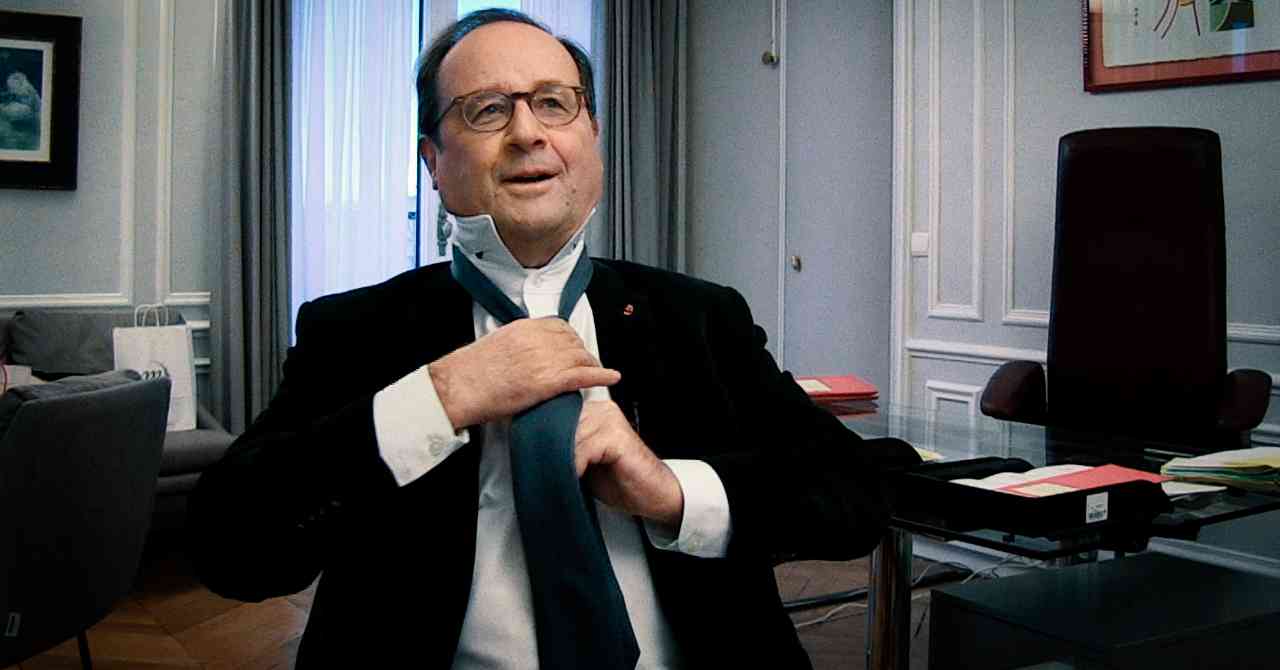
While the documentary La Vie d’après, which followed him after his departure from the Elysée, was presented at the Pessac historical film festival, the former President of the Republic answered questions from Première.
After the Presidency, do we become a “normal” man again? And what becomes of his daily life when his diary, overflowing with appointments and problems to be resolved urgently under the gold of the Elysée, looks like an almost blank page from one day to the next? Here are some of the questions that made journalist Béatrice Vallaeys want to ask François Hollande to follow him on a daily basis in 2017 to scrutinize and recount this famous Life after which gives its title to this documentary co-signed by director Olivier Lamour, long-time collaborator of the cult show Striptease.
And while most documentaries dedicated to politicians talk about conquest, this one tells, in reverse, the deceleration and its corollary, the essential strategy for not leaving the game and continuing to keep one’s convictions alive (here social democracy) when they appear to be totally demonetized by the rise in power of parties more radical than yours (formidable scenes of confrontation on the markets with LFI supporters), and this while no mandate invites you to this table.
Without voice-over commentary but punctuated by exchanges as tasty as they are relevant between the former President and the journalist fooled by nothing and curious about everything, Life after finds the right tone in these times of easy denigration of politics, whatever their position on the chessboard. So backwards again and again because funny and witty but never to the detriment of those they film – François Hollande like the French people he meets during his wanderings across the country. And this before a tragedy hits this filming: the sudden death of Béatrice Vallaeys which puts an end to the adventure in 2022. The three years that elapsed between the end of filming and the discovery today of Life after allow us to make this documentary a document but also necessarily to find resonance with the current situation of the Former President who has become a deputy again. A few hours before his presentation this Saturday in Pessac, François Hollande told us how he experienced this adventure and the discovery of the finished film.
Which political documentaries have had the greatest impact on you as a simple spectator?
Major political documentaries are often linked to electoral campaigns. I am obviously thinking of 1974, a campaign gameDepardon’s film on Giscard, long prevented from being broadcast and then shown in cinemas. But if I go back even further in time, the first one that had an impact on me was a film that I discovered when I was in high school: Citizens at the polls by Edouard Brobowski where we followed the municipal campaign which opposed the socialist mayor Guy Mollet in Arras in 1971 and his main opponent, Francis Jacquemont the UDR candidate. Without doubt the first film of a campaign experienced from the inside with unusual confidences and the irruption of political marketing. I could also cite the films of Serge Moati on François Mitterrand, the Paris at all costs by Yves Jeuland who also made a film on the Elysée, A time as Presidentduring my mandate.
In Life afteryou evoke the betrayal that you may have felt in the face of the Davet-Lhomme duo at the time of the publication ofA President shouldn’t say that. Did this not make you hesitate to accept the offer made to you for this documentary?
I always operate on trust. Today I am no longer in the exercise of responsibility so my word does not have the same consequence. It is therefore easier to follow a former President than to regularly question a head of state throughout his mandate. For Béatrice Vallaeys’ film it was all the more interesting as her work took place over a long period of time, without even setting a time limit. There were no secrets to reveal, no images to hide. Over time, it could be interesting – sometimes joyful, sometimes more intriguing – to know what a former President does, how he organizes his life, his travels, what political ambition he still harbors. And then the unthinkable happens. It turns out that during this period, there was a health crisis, the Yellow Vests, numerous other demonstrations… The team that followed me was able to capture my reactions directly, whereas today, with this prism, they are viewed with the distance of wise people.
Can you forget the camera and the microphones? Or is there a restraint and therefore a self-censorship in your words?
I am less wary of cameras than of microphones. There may be a questioning of an interlocutor, an awkward sentence, an inappropriate joke. But I accepted that this would be the case during a several-hour signing session for my book with the freedom to record all of the exchanges. To restore the meetings that I had and the words that were addressed to me. Because this film is not about me: it is about the relationship between a former President and the French. Everything that we cannot see with a President in office, because security and travel conditions make exchanges like those in the film impossible and because there is not enough time on a daily basis to engage in such a long dialogue with citizens.
Is that also why you accept this documentary? Because it is not just a portrait of François Hollande but the portrait of the French…
Yes, it is the portrait of the French, of those who come to me, of what they tell me, of what they experience. And then, it’s also a journey through France: sometimes in Moselle, sometimes in Tarn, in Corrèze of course, in Brittany, in the North… It’s a road movie, in a way…
Did you know Brigitte Valleys, the journalist who initiated this documentary, before she came to offer it to you?
I knew her because she had in her time had an important place in the writing of Release. She did not follow politics, but social issues, particularly questions of police and justice. I knew she was without prejudice. It was his curiosity that convinced me to accept his proposal. The deal we made was that I let her film everything I did and ask any questions she wanted. And her falsely innocent side, which we see throughout our discussions, means that she freely and brazenly asks questions that many of her colleagues, who follow politics on a daily basis, do not imagine asking.
What surprised you the most when you saw the finished film?
I found the film both funny because there are tasty and serious moments, with regard to the international situation and in particular the war in Ukraine, which arises; demonstrations against pension reform; presidential or national elections. We also see in the documentary why a campaign works or does not work. The documentary quite well recreates this gap between the will of politicians and the reality on the ground. I also like the long running time of the film and its never cynical or mocking tone with anyone. Respectful towards the people and situations encountered. This film is a never-ending story, that of politics, which we could have been filming if Béatrice had not left. Because “my life after” continues. But everything ended tragically as Brigitte died suddenly. The production asked me what it could and should do with this document which ends with the death of the woman who had become one of its main figures. And it is precisely this ending which gives meaning to what was filmed, to what was recorded.
Life after. By Olivier Lamour, Béatrice Valleys and Félix Stefanaggi… Duration: 1h31