
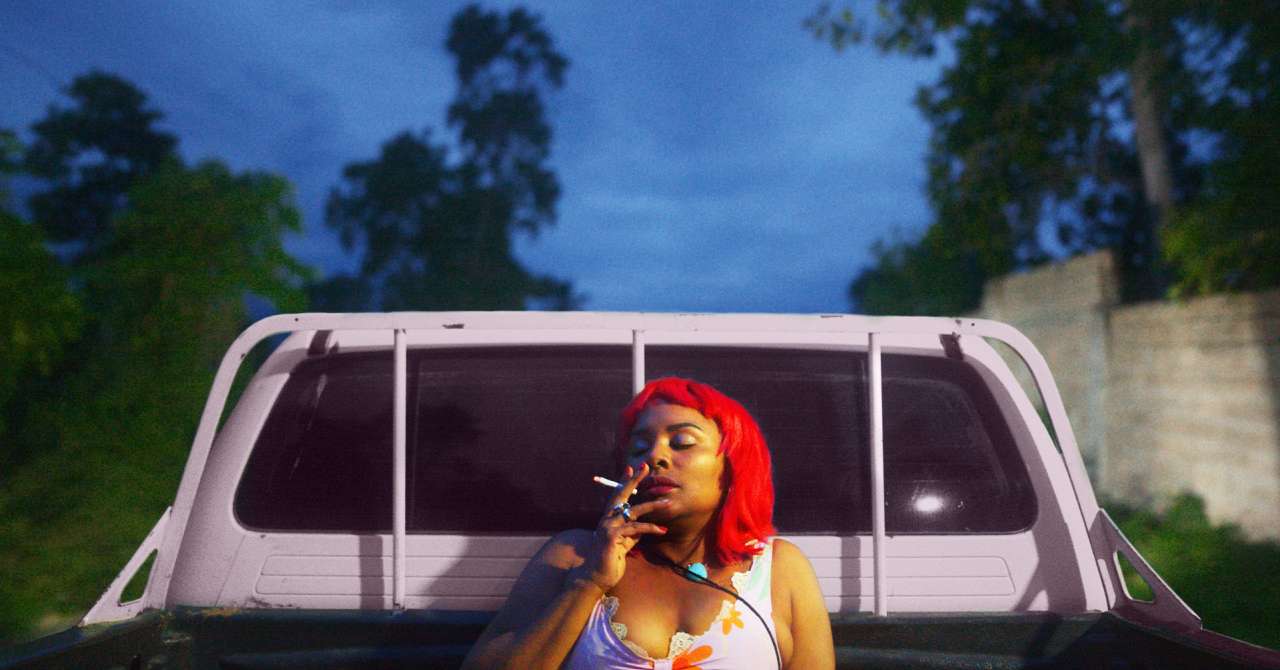
Gessica Généus: “Mary Magdalene is both a goddess and a representation of Haiti.”
Paris, 10th arrondissement, in this particularly hot month of October. In the Pyramide premises, Première met director Gessica Généus for her new film, Marie-Madeleine.
Gessica Généus, Haitian director, talks to us about her second fiction film, Mary Magdalenewhich depicts the meeting between a woman, a sex worker named Marie-Madeleine, and an evangelist, Joseph, in the middle of a Haiti confronted with violence and precariousness.
Hello Gessica, are you well? Do you keep doing interviews?
Gessica Généus: Yes but it’s great to talk with people who saw the film and loved it!
My first question is a bit technical… Why did you choose to switch to fiction for your last two films, Freda And Mary Magdaleneafter having made documentaries while these feature films have a very raw realism? What does fiction achieve that documentary cannot?
Gessica Généus: What I like about fiction is that you can put it all on a script and give it a structure and then organize a shoot. Whereas for the documentary, you really have to be patient. All the sequences that I present in my films are realistic and very raw, but filming them in real life would be ten times more tragic and harder. I will take the most extreme case in the film which is lynching. How do you film this? Fiction is really a protective screen. On many subjects, I find this to be the best option. And then the documentary is cinema, but it is very complicated to finance. Also, because we tend not to really perceive the documentary as cinema, but rather as a report.
Your film looks a lot like a tale: each character has their personal mythology, Joseph with his mother, Mary Magdalene with her grandmother, and when it is told, there is a very strong visual universe that is brought to life.
Gessica Généus: This is the first time I’ve been asked this question! I am very happy that you perceived this dimension. In the film, as in Haiti, orality is very important. The advantage, when something is told orally, is that you can magnify it as you wish, you don’t have to stick to texts. The story makes it possible to stage grandiose situations that keep the spectator in suspense.
Want to read more?
Access all articles and reviews for €1.99/month
No obligation, cancellable at any time
Subscribe
Already subscribed? Log in