
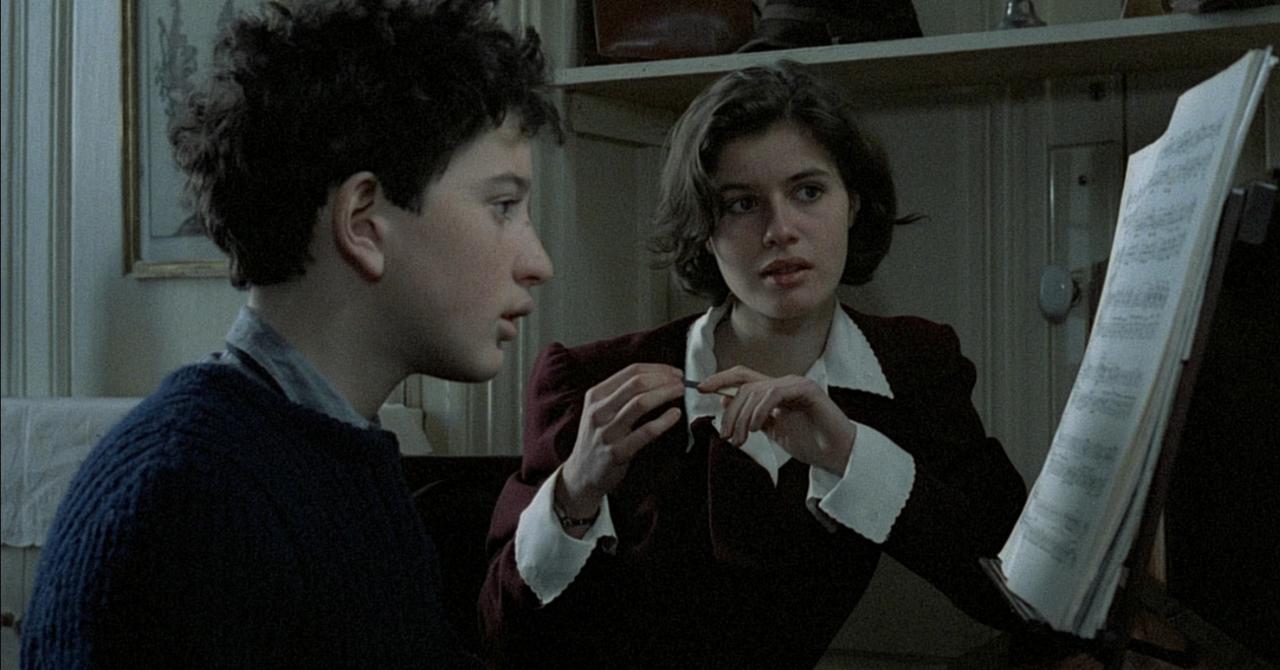
Goodbye children on France 5: when Gilles Jacob’s past inspires Louis Malle
In its autobiographical aspects, Goodbye Children also evokes the past of another great man of cinema, the former president of the Cannes Festival Gilles Jacob.
Goodbye childrenby Louis Malle, is rebroadcast this Friday evening on France 5, followed by a documentary dedicated to the director. They will be visible in streaming the next day on the France Télévisions website.
After Lacombe Lucienin which he adopted the polemical point of view of a French collaborator in 1974, Louis Malle returned to the theme of the Second World War with Goodbye children in 1987. Two films which frame the American period of the filmmaker, who left France at the end of the 1970s following the controversy sparked by the first and who returned to his country of birth with the second.
On this occasion, Louis Malle was interested in the war seen by children through the destiny of two young boys who become friends before one of them, Julien Quentin (Gaspard Manesse), discovers that the other, Jean Bonnet (Raphaël Fetjö), was hiding his true identity, that of Jean Kippelstein.
Released in 1987, Goodbye children is inspired by a true story, that of Father Lucien Louis Bunel, known as Jacques de Jésus, a Carne priest and religious who engaged in the Resistance while teaching at the Petit Collège Sainte-Thérèse de l’Enfant-Jésus in the village of Avon in Seine-Maritime. Arrested on January 15, 1944 and deported by the Gestapo to the Mathausen camp, he died in Linz on June 2, 1944 at the age of 45. Named Righteous Among the Nations in 1985, his beatification process in Rome began in 1997.
As for the two young children in the film, they refer directly to Louis Malle’s youth, since he represents himself on screen in the skin of young Julien Quentin. Bonnet/Kippelstein is inspired by a young Jewish boy born in Frankfurt, Hans-Helmut Michel, who was also arrested by the Gestapo before dying in deportation on February 6, 1944. In an article in the New York Times in 1988, Louis Malle explained his relationship with the young Hans-Helmut, who gave him the idea of making this film: “We were both very shy, and he resisted any deep relationships because he didn’t want to reveal who he was, but I felt like he was someone who could have become my best friend. In this case, it didn’t happen, and it was so brutal and unacceptable, because it was taken away from me“.
But behind the true story of Louis Malle, Jacques de Jésus and Hans-Helmut Michel (as well as his two deported comrades, Jacques Halpern and Maurice Schlosser), Goodbye Children also takes on a particularly intimate dimension for another name in French cinema: Gilles Jacob, emblematic figure of the Cannes Festival of which he was the general delegate from 1978 and of which he became president from 2001 to 2014.
Work of fiction reconstructing the past of Louis Malle, Goodbye children also incorporates memories of the youth of Gilles Jacob, himself a young Jewish boy who took refuge in a Catholic school during the Second World War. The scene where the young children take refuge behind the church harmonium is particularly directly inspired by the childhood of Gilles Jacob, who also lived through this traumatic experience. “I told this memory to Louis Malle, who had experienced the same situation in a college where students had been rounded up. Our two stories overlapped“, confided Gilles Jacob to Le Monde in 2011.
From, Goodbye children holds a special place in the personal history of Gilles Jacob. However, it is on the side of a competing festival, at the Venice Film Festival, that the great story ofGoodbye children begins with the Golden Lion awarded by the jury chaired that year by Sabine Azéma. Louis Malle’s most personal film will also become the one that received the most awards: winner of the Louis-Delluc Prize, it won seven Césars including those for best film and best director, but also for best design, which gave rise to a famous and confusing speech of thanks from production designer Willy Holt. Despite his return to France, America did not forget Louis Malle either by nominating him for the Oscar for best foreign film.
Having become a classic in the filmmaker’s filmography, Goodbye children also remained a separate work in the life of Gilles Jacob. When the latter was celebrated in 2014 for his last Cannes Film Festival as president, he left the stage in the form of a tribute in front of the screen of the Palais des Festivals on which was written… “Goodbye children” (photo above).
The story ofGoodbye children : 1944, Julien is a boarder at a Catholic college. He discovers Jean, a new arrival, proud and secretive. Julien and Jean gradually become friends. However, this bond can never flourish. The Gestapo arrived at the school one day and arrested Father Jean and the three Jewish children he had hidden among his Catholic children.


