In the Lost Lands, after the end of the world (critic)
Clumsy and badly damn, the new Paul WS Anderson is not however devoid of a certain (and pretty) Nanarde poetry.
In 1975, George RR Martin27, who had not yet written a line of Throneor even no novel, published in a collection “… to relive for a moment”. Very nice news where, in a post-apocalyptic world, the survivors of a vaguely hippie community fueled to a drug allowing them to relive moments of the past. Their new chef decides to use the substance to learn useful skills (medicine, mechanics), while the group’s troubadour prefers to get rid of things before. Utilitarianism against Romanticism, in short: Martin managed in a few pages to stick to us and vertigo, and the Bourdon, from its original title, “… for a single yesterday”drawn from the words of Me and Bobby McGee by Kris Kristofferson: “I’d trade all of my tomorrows for one single Yesterdy”. Fifty years later, The Iron Throne has become a worldwide IP. The name of George RR Martin is as known as that of JK Rowling or that Tolkien. Rereading “… to relive for a moment”we think of the state of the American entertainment, of the same franchises eternally continued and remake by the giants of the industry, where we return to the past only to take advantage of it. Yes, the bad days, it would be said that we would actually exchange all our tomorrows for only one yesterday.
What relationship with In The Lost Lands ? It is written basically on the poster: the film is adapted from a short story by George, published in an anthology of SF in 1982 (and available in the collection Ice dragon at Actusf in 2011). It is not a question here of judging the gap between this little -known text and this film, which would surely interest only the most picky compleists, but to see the new film of Paul WS Anderson. And In The Lost Lands is indeed a film by Paul WS Anderson. Impossible to go aside. On his blog, George RR Martin was promoting the film by calling it “Dark and twisted and atmospheric, and a lot of fun.” It may be very true, but honestly, George, it lacks words to your description.
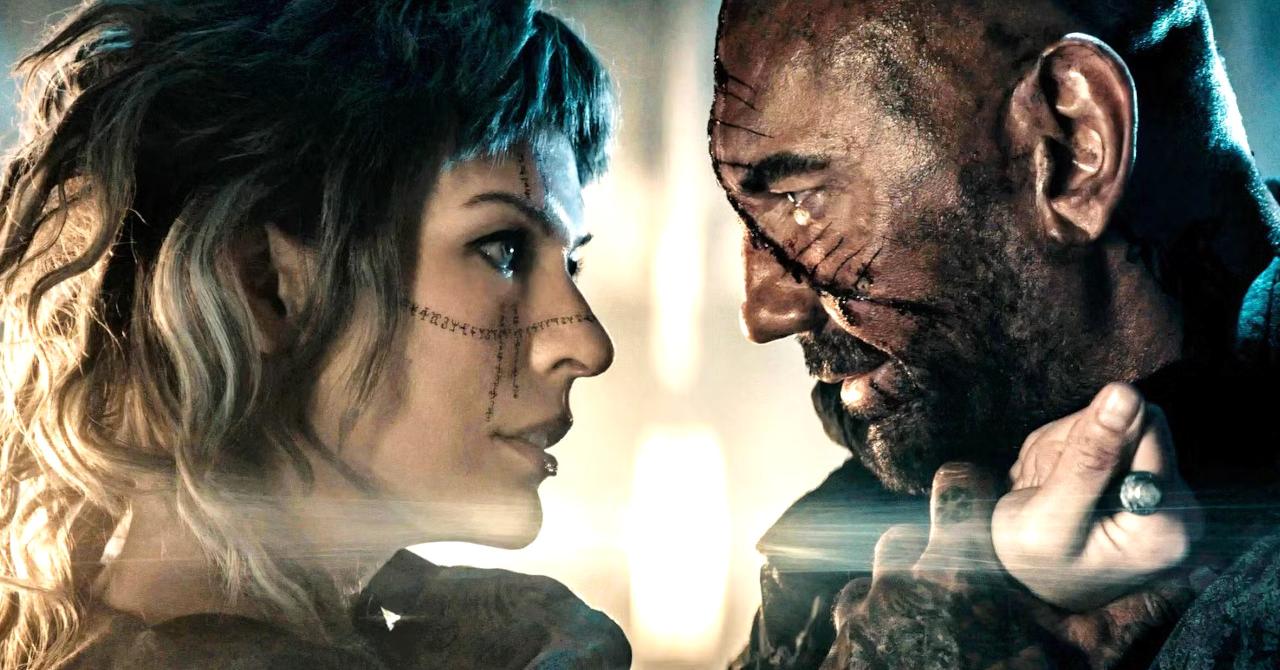
We are on a post-apocalyptic land, the proof by its large sets projected on a green background with ruined buildings and container racks stranded in the sand. The queen of a community dominated by Templars (therefore religious and fanatics) charges a witch to bring her the skin of a werewolf. Accompanied by the Queen’s lover, a Ranger-Pistolero (Dave Bautistasquare but under-exploited), it will cross the lost lands in search of the beast while the patriarch sends its troops to research. As it is Anderson, there are slow motion, close -ups of the face of Milla Jovovich (yes, Anderson continues to film his wife as he has done since resident Evil In 2002: Beautiful and Bastroar), impossible scenes which send waltz the notions of all stupid fittings and coherence -like this fight of heroes on a carcass of bus suspended above the void, facing dozens of fighters arose where. Or this scene where the nasty Templar carries a pair of Ray-Ban with pride to protect himself from the magical gaze of the witch. Or this badly damn script, with a werewolf and radioactive zombies, which investigates bizarre twists, sacrifices characters from one instant to the other, repeats Ad Nauseam the same cavalcade scenes on sunset, and aligns the WTF replicas (“This slut killed my snake!”instantly cult).
Inevitably, In The Lost Lands ends up making a strange girl’s poetry. It is Trivial of Mamoru Oshii bombed with Lens flares like a JJ Abrams from the 2010s. It is a Fallout first degree that lasts 1h41. It is a DTV on the big screen with a tiny ambition and that is all that causes its loss and makes its charm. While we have doubly (even quadrupling, since we saw the two films and the Unrared version) hated the Rebel Moon of Zack Snyder On Netflix, it might seem hypocritical to you. But there is a big difference between the Space Opera of Snyder and the post-apo of Anderson, it is the one that separates the pompous from sincerity, and the turnip of the nanar. The libertarian subject and that of the omnipotence of the image irrigated and crushed everything in Rebel Moon. Anderson does not seek to sell any vision of society. He simply wants to paint a love story against and against everything -the green funds, the writing, the management of actors. In The Lost Lands is not a useful film, no, but no one asked him to be. We come back to it: in “… to relive for a moment”Faced with the end of the world, the utilitarian accepts that we return to the past only if it has a usefulness, while the idealist prefers to relive his love stories again -which to commit suicide at nostalgia. Who is right, who is wrong? We do not force anyone, but definitely, when the world collapses, we would not exchange all our tomorrows for the girl’s poetry of yesterday.