Is The Odyssey Nolan’s masterpiece? (critical)
Three hours, 250 million dollars, an all-star cast: everything came together for the portentous fresco. On the contrary, Nolan delivers a nervous, haunted film, a huge film about war disguised as a peplum.
A moment ago, in The Odysseywhere the Nolan that we know seems to disappear completely. The filmmaker of mental equations and architectural arabesques steps aside to make way for someone else: a true storyteller, a sculptor of phantasmagorical, embodied images. A guy who saw The Seventh Voyage of Sinbad as a kid and never quite came back from it. This is the Cyclops sequence. For a few minutes, the British filmmaker dabbles in pure fantasy, haunted by the monsters that take shape in the darkness of our unconscious. And it’s quite magical…
But (like Homer), let us start again. After Oppenheimer and the Oscars, we feared that Nolan would rest on his laurels. A budget of 250 million dollars, filming on 70mm film, wooden ships, and an all-star cast… We were going to see what we were going to see! Above all, we could fear that the crowned filmmaker would repeat on a larger scale what he had already achieved. Some were already imagining a best-of of his favorite themes (kneading time, returning home) draped in the toga of the peplum. This is false.
If it maintains a powerful (and deep) link with his entire filmography, The Odyssey above all extends Oppenheimer on a single line: the guilt of the winner. The physicist carried the bomb he had invented like a burden. The king of Ithaca has cunning. It is this wooden horse which flouted the law of Zeus and plunged humanity into four centuries of darkness. The gods are going to punish him for twenty years and that is the real subject of Nolan’s Odyssey. The story of remorse.
A remorse and a return.
It must be clarified right away: with this kind of subject, it is very easy to stand still. Even more so when you follow a hero who wanders for years. But on the contrary, the film moves very quickly. He even runs. The exact opposite of the grandiloquent peplum that we feared. And in the middle of this cavalcade, therefore, the scene of the Cyclops, concentrated in childish terror. From the start of this passage, Nolan plays with scales like an old master: the very small men against the stone, Ulysses who enters the cave and suddenly becomes Lilliputian. And then, the immense creature of which we only glimpse a fragment for a long time. Ray Harryhausen is not far. And yet it is something other than a tribute: the sensation of being physically there, in the dark, pressed against the rock with Ulysses. And the first real attempt at fantasy made in Nolan.
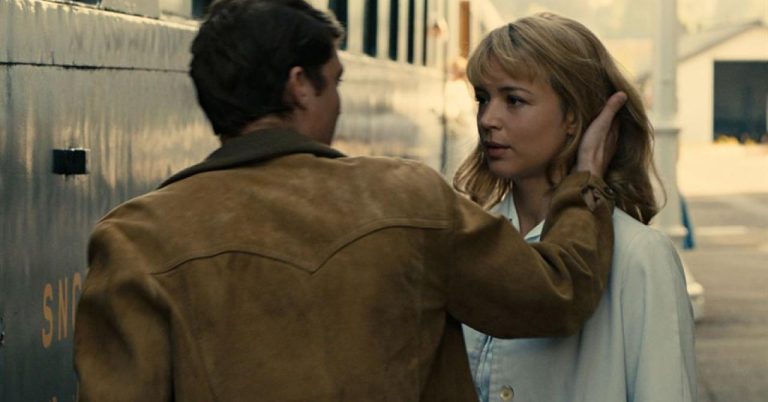
We could multiply the examples of these moments of pure staging which splash the canvas. In bulk: the sack of Troy is a marvel; Circe who transforms Odysseus’ companions into a hair-raising moment of anguish; the passage to hell is fantastic. However, the climax of the film is not in Ulysses’ wanderings. He’s in Ithaca. Nolan deploys a staging idea that takes the film by surprise. he films Anne Hathaway almost always alone, in a setting that is more theater than cinema – an actress on a stage whose fourth wall will only give way at the very end, when Ulysses finally crosses the threshold of his palace.
Recluse behind a fenced wall, she holds each shot without raising her voice, letting mourning settle into the frame without ever naming it. Then something comes up, more disturbing: what if the mastermind of the family wasn’t Ulysses? The famous pattern of the web that we weave by day only to unravel it at night would then become the apparent thread of a much larger tactical intelligence, to which Ulysses ultimately owes his return. Hathaway composes her Penelope as a patient and silent strategist, the true cunning (polymètis) of the family. The real heroine of the film? And a powerful woman, finally, in Nolan!
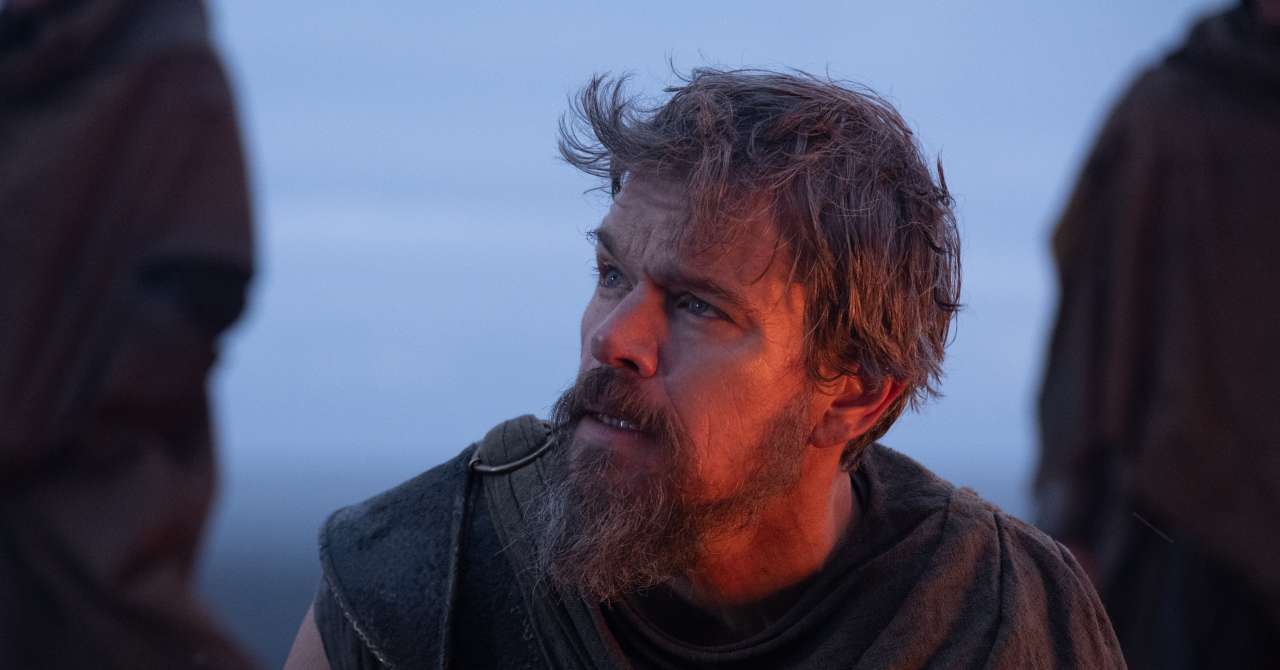
Around her, in fact, the casting is up to par. Tom Holland finds in Telemachus his first adult role: a son who searches for an absent father and discovers in the process that he will have to become a man without him. Forget Peter Parker. We perceive in the actor a new gravity, a way of holding on to the frame which reminds us that he was never more than a simple jumping kid. Matt Damonhe gives what he had never given before. We have to see what he brings to his Ulysses: a voice that has matured, a fatigue that is not played off. He composes a man who has survived his own survival, and who drags his myth like armor that has become too heavy.
That leaves the structure of the film, which is perhaps the most powerful idea in the film. During the first two thirds, we follow the adventures of Telemachus then those of Ulysses, before a finale of hallucinatory revenge. The peplum shifts without warning into film noir or western. Ulysses returns to Ithaca to find Penelope, but above all to methodically eliminate those who want to take his place. Nolan weaves a relentless settling of scores where his hero once again becomes what he has never stopped being: a killer. The transition is impressive. After hours of sea, mist, fantasy and procrastination, the epic ends behind bloody closed doors. And this is where the thesis of the film comes into its own. The war, when you win it, you bring it home, reminds Nolan.
Well, there are still some reservations. Nolan remains, in certain central areas of the film, a filmmaker who thinks about emotion more than he lets it happen on screen. As if he distrusted his characters, feared that they would escape him. This modesty (in the broad sense) is not new to him, it is his trademark and sometimes it has made him great. But The Odyssey is first and foremost a story of betrayals and (carnal!) reunions, of bodies searching for each other and bodies recognizing each other – and strangely, the filmmaker’s reserve ends up weighing on him.
We would have liked the film to vibrate or tremble at times. Particularly in all the scenes with Calypso – a little wise… Another questionable choice: having made Ulysses a unambiguous character. In Dante, he was a pervert; for a tradition of historians or Hellenists he was an ambiguous hero, a cynical manipulator, the son of Hermes. Nolan invents his own, more serious, more dignified. He is a winner who has measured the price of his victory and is no longer consoled by it.
Still, that’s the gist of the film. This very beautiful idea that we never return from a war that we have won. Nolan films a man who has overcome and will not recover. After Oppenheimer and his cursed scientist, here is his haunted king. We begin to understand, film after film, what Nolan is writing: a work about guilt and about those who can no longer return home.
By Christopher Nolan. With Matt Damon, Anne Hathaway, Tom Holland… Duration: 2h52. Released July 15, 2026