Matthew McConaughey, the last of the cowboys
For thirty years, McConaughey has played the lone cowboy, the guy who prefers the road to the group. But in the very beautiful Oklahoma Honey, he puts it all back into play. A look back at his many facets of cowboy.
For thirty years, Matthew McConaughey has established himself with a certain type of role. A guy who doesn’t belong to anyone and who, more often than not, makes his own way. A loner who prefers the hardness of the tarmac to the sweetness of home. A cowboy: this American archetype who only exists if you flee. But today, with Oklahoma Honeyhere he is doing exactly the opposite: he stays. Better: it transmits and even rebuilds a community. In this beautiful film americanahe plays Amziah King and finds one of his most beautiful characters, as the coda to his filmo. Here are nine roles to understand what “McCo” has been telling us, from the beginning, about America. And why he has (perhaps) just closed this story.
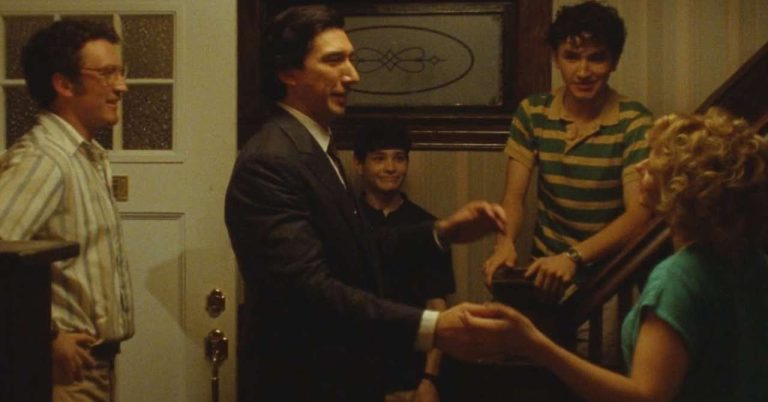
Buddy Deeds in Lone Star (John Sayles, 1996)
Buddy Deeds is the former sheriff of a small Texas town on the Mexican border. He is also the father of the current sheriff, Sam Deeds (played by Chris Cooper). Dead at the time of the story, he survives through the memories and the stories we tell ourselves. He has in fact acquired the stature of a local hero. But his son’s investigation gradually shatters the paternal myth. And so this is where it all begins. McConaughey embodies the central idea of John Sayles’ film: America has built heroes and an official history, but behind the legend lie the compromises, the lies and the gray areas on which the country has also nourished itself.
Joe Cooper in Killer Joe (William Friedkin, 2011)
The black suit. Glasses screwed on the eyes. Policeman by day, hitman by night, Joe Cooper has all the attributes of the cowboy McConaughey: the Stetson, confidence, authority and poisonous sensuality. And Friedkin makes a monster of him. In this poor suburb of Dallas where a family orders a murder to collect life insurance, the American dream is already rotten to the core. So his cowboy no longer rules the law. He charges.
Mud in Mud (Jeff Nichols, 2012)
Mud lives on an island in Mississippi, out of the world and almost out of time. He is a fugitive, a liar and an adventurer. He waits to find the woman he loves and convinces two teenagers to help him… Mud is a character escaped from Mark Twain: a guy who believes that freedom begins where society ends. But this America was a fantasy and McConaughey embodied an American myth in danger of extinction: the magnificent wanderer, free because he owns nothing.
Ron Woodroof in Dallas Buyers Club (Jean-Marc Vallée, 2013)
Texan electrician, rodeo cowboy, homophobe and individualist, Ron Woodroof discovers one day that he has AIDS. As a good American, he will use free enterprise and the law of Supply and Demand. Faced with the lack of available treatments, he obtained medicines abroad and then created a “buyers club” allowing other patients to access them. McConaughey played here on the ambiguity of the national myth: when institutions fail to protect citizens, capitalism takes over and becomes a form of rebellion. Oscar in the key.
Rust Cohle in True Detective (Nic Pizzolatto, 2014)
Rust Cohle is a Louisiana cop, solitary, obsessive, radically pessimistic, who hunts a killer with Marty Hart for nearly twenty years. Alongside it, we cross a Louisiana of refineries, churches and abandoned communities. This is one of McCo’s darkest, most disenchanted roles. The cowboy believed that he just had to go further west to start all over again. His Cohle drove to the end of the road. But in the end, there is nothing.
Cooper in Interstellar (Chris Nolan, 2014)
Former NASA pilot turned farmer on an Earth threatened by shortages, Cooper agrees to go search in space for a planet where humanity can survive. Nolan transposes a founding figure of the American imagination into science fiction. Under his overalls we (re)discover the pioneer. Cooper leaves his farm as others once left for the West, convinced that the future lies beyond the known world. With McConaughey, the old mythology of the Frontier simply changes scale: it becomes… interstellar.
Newton Knight in Free State of Jones (Gary Ross, 2016)
Newton Knight really existed. A Mississippi farmer and Confederate soldier, he deserted during the Civil War and led a group including deserters and former slaves who resisted the Confederacy in Jones County. Here the actor plays another story from the South: that of a poor white man refusing to confuse his territory with the cause of the slave owners. An American figure of dissidence, but this time taken directly from History. McCo the rebel!
Moondog in The Beach Bum (Harmony Korine, 2019)
Moondog is a poet who drifts through South Florida, between alcohol, drugs and parties, stubbornly refusing the rules. Korine pushes the great American ideal of individual freedom to the point of caricature. His Moondog seeks neither success nor even stability. It is the cowboy who has reached the end of his logic: no more territory to conquer, no more people to save. Absolute freedom. Or just a stoned guy on a beach. Like a grotesque culmination of the archetype.
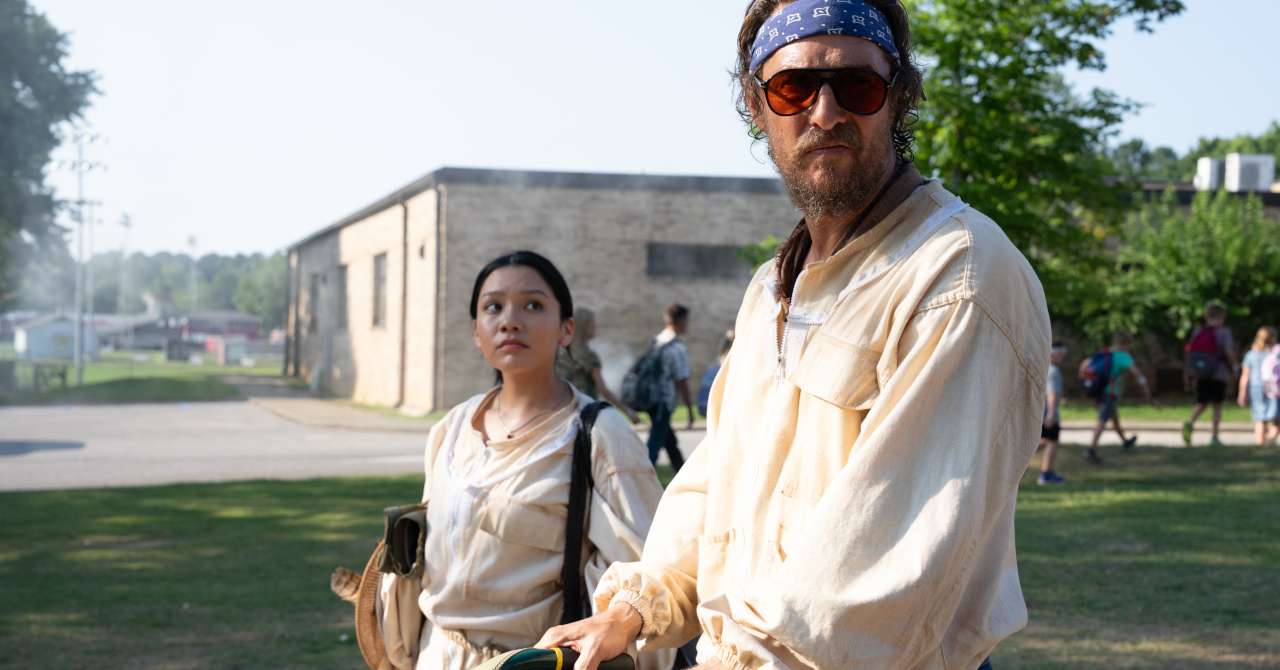
Amziah King in Oklahoma Honey (Andrew Patterson, 2025)
Amziah King is a beekeeper, honey business owner and bluegrass musician in rural Oklahoma. When Kateri, the young woman he once welcomed, returns to his life, he integrates her into his activity and the community around him. For thirty years, McConaughey played men who broke away from society; Amziah King is the one looking to rebuild one. In any case, here he embodies a man defined by what he transmits: a profession, a music, a territory, a group. Another image of rural America, where independence no longer necessarily means solitude.