
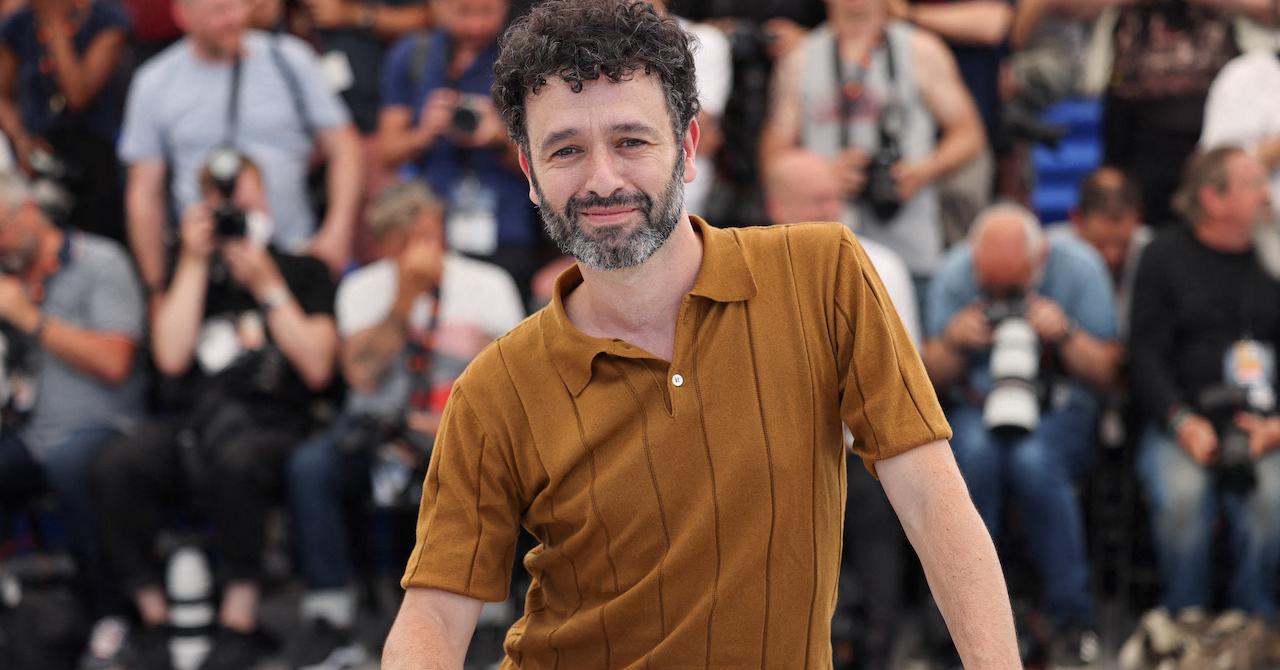
Rodrigo Sorogoyen: “My next film is almost the complete opposite of As Bestas” (interview)
Guest of honor at the Nantes Spanish Film Festival, Rodrigo Sorogoyen (As Bestas, El reino, Madre…) tells us about his working methods, dissects behind the scenes of the series Los años nuevos and discusses his future feature film with Javier Bardem and Marina Foïs.
Premiere: The first time you attended the Nantes Spanish Film Festival was as a simple spectator, in 2003. What’s the strange feeling of being back as the guest of honor?
Rodrigo Sorogoyen: I am delighted to be here because it brings me back to my youthful memories (he spent nine months on Erasmus in Nantes) and something purely cinematic. Indeed, it’s a curious feeling to go from spectator to guest of honor… Especially since I don’t particularly like to focus on myself and my career. I prefer to move forward! But I must admit that there is something pretty about it.
Between 2003 and today, what is your view on the evolution of Spanish cinema?
Has he changed a lot in… 23 years? Phew, already. In 2003, I was very young and I watched Spanish cinema with amazed eyes, I didn’t really know the environment and the industry. I started to see it differently as a director, and then the crisis changed things again… But it is obvious that it has evolved a lot and we are in an incredible moment, with the emergence of many directors.
Is there a form of national pride in this vitality?
Only for half the country. Because as with everything, there are two Spains regarding cinema: some look at it with pride and are proud of our international awards with filmmakers like Pedro Almodovar, Albert Serra, Oliver Laxe… Others brush it off. And if they are interested, they are quick to criticize: “ This film is shit, this one has no interest… »
Which part of Spain are you talking about?
The right. There is a culture war, that’s obvious.
You cited the name of Oliver Laxe, and a recent paper from New York Times came back to your supposed “clash”…
Hmmmm…
…which the journalist summarizes as a firm opposition between the dreaminess of Laxe’s cinema and the realism of yours. Does it say anything about Spanish cinema?
Oh no, I don’t think so (Laughter.) I didn’t understand this article. It was a friendly discussion about cinema, nothing more. They reported what happened between us, but took it as an example of an opposition that exists within Spanish cinema… Bullshit, it’s absurd.
So there was no real argument?
No way. And moreover, nothing opposes the different visions of Spanish cinema. There are some Oliver Laxe films that I love, but it turns out that Sirat is not one of them. Well… He’s not crazy about some of my films and likes others. It’s normal. Discussing our films with my filmmaker friends is holy, right? It’s just a frank discussion that has been blown out of proportion.
The past year was marked by the phenomenon New Yearsa series that you co-created and largely directed. Has its success overwhelmed you a little?
No, because I’m not on social media. I’m told that it worked well in Spain and France, but I don’t really realize the scale. All I can tell you is that for the moment, this success has not made me rich (Laughter.)
The series uses a lot of long virtuoso shots to convey emotion, until a mind-boggling final episode all in sequence shots. Was it also the technical challenge that interested you in this?
Working, for me, means taking risks. I love the concrete challenges that a film or series impose on daily life, but I also like confronting the challenge of a major project. And this challenge – which can be technical, but not only that – must absolutely fit with the story. New Years is a series that talks about time, and it therefore seemed very logical to me to shoot the sex scenes like those of discussions with long shots, to end with a huge episode made up of a single sequence shot. We had to be in this hotel room, with them, for 45 minutes. It was enlightenment when I had the idea, but the technical team was less enthusiastic! “ We’ll see what we can do » (Laughter.)
How many times did you replay the episode to achieve this result?
Very little. There were only five takes and we ended up keeping the last one. Everything was completed in five days, and we only really filmed on Thursday and Friday. Before that there were rehearsals and technical tests, but in pieces, never over a duration of 45 minutes. The experience was both dangerous – because you could screw up! – and very funny.
All this in a small room, full of mirrors…
We needed a room big enough to accommodate the team but not too big either, because no one would buy the characters taking the presidential suite! And it turns out that there were actually plenty of mirrors in the room. We said to ourselves that we were going to cover them, but as we went along, we realized that it wasn’t bad to have the actors’ reflections, and then such a shot allowed us to offer a game of looks with the mirror… In the end, we didn’t cover any of them!
You were talking earlier about the sex scenes, which are astonishingly realistic without being immodest. How were they imagined?
We thought a lot. I’m tired of this unrealistic representation of sex that exists in most films and series. It’s unlike anything that happens in real life when people have sex! So the objective was to touch reality. Which gave rise to some slightly awkward moments, where I said to the actors: “ No, your hand should be here and not there! » « But why? » « I assure you, do it, it’s better » (Laughs.) Fortunately, there was a lot of trust between the three of us. I can’t thank Iria del Río and Francesco Carril enough, because what they did in these scenes is incredible.
This obsession with realism that inhabits your cinema, where does it come from?
Hmm… First of all, that’s what interests me as a spectator. I can have fun watching a science fiction film, of course, but it will never touch me the way real stories do. When I watch a sci-fi film, then it has to seem possible to me, that the character really does what one would do when meeting an extraterrestrial (Laughter.) The most important thing for me in cinema is emotion.
Even when faced with a brilliant display of showmanship, if I am not deeply moved by what I see, my experience will not be great. So I naturally tend towards emotion in my cinema. It’s my engine. For other directors, it will be the wonder of bringing a dinosaur to life on screen! Everyone has their own thing.
And how do we achieve emotion while being very aware of the artificiality of the “reality” that we are creating?
It’s very difficult. We already have confidence in the script, with my co-writer Isabel Peña. But obviously, we need human beings, eyes, voices, bodies… I want life in the frame. This is why the casting phase is essential. I spend a lot of time choosing my actors, and not just the protagonists: all the roles. I love actors, and the way I manage them is to help them feel comfortable on set. So that they can give everything they are capable of. Sometimes they instinctively understand something in the scenario. Like a diagram. And if I see from the casting that they got it right, then we are in the right direction.
It’s funny, you don’t mention the staging. Because that seems less important to you than having the right actors?
No way ! And there is also lighting, editing… All of this is essential to trigger emotion. But I adapt my staging to the story and I accept, when necessary, putting myself in the background. Because sometimes a simple shot is more moving than complex movements. I think that deeply.
You are hopeful that your next film, The queridowith Javier Bardem, Victoria Luengo and Marina Foïs is in competition at Cannes?
You have to ask who you know!
Is the assembly complete?
Totally finished. Now we wait (Laughter.)
Was filming with Bardem a dream?
Of course ! He’s the best actor in the world! I have wanted to work with Javier for ten years and I grew up with him. The film was born, for Isabel and me, from the desire to bring him together with the protagonist of the film, Victoria Luengo (seen notably in The Room Next Door). It was a duo that really interested us. The querido tells the story of a father, an internationally known Spanish director, and his daughter, an actress. The film talks about parent-child relationships, guilt, abandonment…
And all this in the world of cinema, a universe which concentrates a lot of power but which is changing after MeToo and the recognition of toxic masculinity. But there is also a very meta side since we approach the notion of story. Human beings constantly tell stories: I’m telling you one, I’m telling myself another to exist in this world… And these two characters have a very strong and very difficult common past. So they tell each other a story on their own, with the desire to find a common story.
Does Marina Foïs play in Spanish?
No, she plays a French producer who is friends with Javier Bardem’s character. They both communicate in English but as they have been friends for thirty years, she sometimes says things in Spanish, he in French… I love mixing languages, as in As Bestas.
We also feel an appetite for French, which you speak fluently. Do you want to film with us?
I have a lot of ideas for films, I would like to live 200 years to make them all come true! And it turns out that one or two of them take place in France. It won’t be my next project but I would really like it. It would be a big challenge and yet, it doesn’t scare me at all.
And the United States?
It never made me dream. I realized early on that you can’t be free there, except for Scorsese and Spielberg. But I will never be Scorsese or Spielberg! The only thing you get is money, and I’m not chasing it. I live well, I don’t need luxury. But that would be too high a price to pay anyway. I’m sure you’re in a lot of pain. Because either we put pressure on you, or you put it on yourself.
We’ll have to leave it at that, but I’m curious to know what, in your opinion, is the pinnacle of your own filmography?
The querido. And New Years (Laughter.)
Why these?
They are simply the best. New Yearsit seems very easy to do, but it is actually extremely complicated. I’m very proud of it: two people in an ordinary place, talking or not talking to each other, looking at each other… for ten chapters. And they touch you. It’s incredible that we collectively managed to do this. There is something magical about it, even though it is a subject that we have already seen a thousand times. And for The queridowith my team, we took risks and experimented. We played with black and white, did strange things with sound… What I can tell you is that it’s almost the complete opposite ofAs Bestas.
The Nantes Spanish Film Festival continues until March 29. More information on the official website.


