
The children are fine, Tell him that I love him, Mektoub my Love: Canto Due: what’s new at the cinema this week
What to see in theaters
THE EVENT
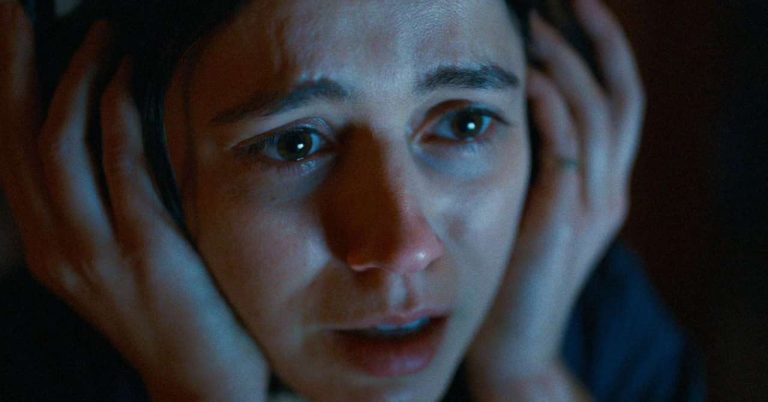
THE CHILDREN ARE OK ★★★★☆
By Nathan Ambrosioni
The essentials
A film of rare delicacy and emotional power on the consequences of a voluntary disappearance on those who remain. The winning duo of Toni en famille – Camille Cottin and Nathan Ambrosioni – works wonders again
Nathan Ambrosioni’s third feature film opens with a seemingly banal visit that Suzanne pays to her sister Jeanne. Except that the next day, Suzanne disappeared without leaving an address but a simple note to tell Jeanne that she was entrusting her with her two young children. Where did his sister go? Why did she decide to disappear without giving an explanation? And above all, how can she manage these two children from one day to the next when she herself has never been a mother and spontaneously experiences no maternal instinct? Here are all the questions that instantly rush through Jeanne’s head, both knocked out on her feet and obliged to act as quickly as possible. Transcending the subject of voluntary disappearances, Ambrosioni creates a great film about the family, the ties that unite its members and can fade or even break at any time. A film of infinite sensitivity from which we emerge as overwhelmed as amazed by the quality of this scenario and the way in which its performers handle it, Camille Cottin (Jeanne) – to whom Ambrosioni still offers a major role after Toni in the family – in the lead.
Thierry Cheze
Read the full review
PREMIERE LIKED A LOT
TELL HIM I LOVE HIM ★★★★☆
By Romane Bohringer
For her second feature film, Romane Bohringer chose to reveal her relationship with her mother Maggy. The missing piece of all the portraits dedicated to her because she abandoned her at 9 months. But the gesture of autofiction is less direct here. It goes through her discovery of Tell Him That I Love It by Clémentine Autain, the story of her no less tortuous relationship with her own mother, the actress Dominique Laffin. Romane Bohringer therefore adapts here this book in which she recognized herself while intertwining her own journey. A true work of four voices – two daughters and two mothers – whose mixture of genres which constitutes it (archive images, fictionalized scenes, off-screen readings, moving confidences from Richard Bohringer in a park, etc.) tells the chaotic path undertaken by the director to repair this damaged bond with her mother, as Clémentine Autain did, through the prism of writing, with her own. For a result that is as fun as it is overwhelming.
Thierry Cheze
Read the full review
FIRST TO LIKE
MEKTOUB MY LOVE: CANTO DUE ★★★☆☆
By Abdellatif Kechiche
Mektoub is back. Abdellatif Kechiche extracted from his imposing material (hundreds of hours of rushes shot almost immediately after the first part in 2017) a Canto Due and thus cover his controversial Intermezzo (2019 – unreleased in theaters) which had seriously damaged his aura as a great filmmaker. The traces left by Amin, Ophélie, Tony or Camélia, heroes of this Sète saga have of course not been erased on the pole-dancing bars of a nightclub (almost exclusive venue of the Intermezzo), they continue to permeate the marine and sensual air of a stretching summer. September 1994. Nobody moved. The skin, the looks, the mouths, etc., are still there. Intact. This Canto Due also introduces two new characters: an American producer and his much younger wife, actress in a famous soap, The Embers of Love. The American actress (Jessica Pennington, real revelation of this Canto Due) pierces the frame with her excitement and her gluttony. Between the new and the old, the graft operates and Kechiche always explores adolescent desires with the same sensuality but also humor. A success.
Thomas Baura
Read the full review
THE SHADOW’S EDGE ★★★☆☆
By Larry Yang
What remains of Hong Kong action cinema, which helped make the peninsula one of the epicenters of international cinema? First, stars: Jackie Chan and Tony Leung, box office stars of yesterday who convert the nostalgia of their past image into a current intrigue (robbers escape the police, in particular thanks to their clever use of artificial intelligence). One side police: Jackie Chan; the other thief side: Tony Leung Ka-fai. There is still pleasure in the claimed grandiloquence of ever more improbable action scenes for limitless staging. The film therefore never seeks to invent the powder, it prefers to put it in the hands of its luxury casting, even if it means preventing a new generation of actors from emerging. But while doing his honest part of the job, he asks a thorny question. What will become of this Hong Kong action cinema precisely, when all its stars have left us? Larry Yang certainly doesn’t have the answer.
Nicholas Moreno
LET MY WILL BE DONE ★★★☆☆
By Julia Kowalski
After a somewhat forgotten first feature (Crache coeur, 2016), it was with her medium-length film with the programmatic title I saw the face of the devil (Jean Vigo Prize 2023) that Julia Kowalski really emerged. This film was actually a (beautiful) preparatory sketch for Let My Will Be Done. In an ultra-muddy French countryside, a young possessed girl sees the return of her disturbing and wild neighbor who inevitably intrigues her. Here below, the bestial impulse of men is an inevitability, at best a motive which, by contrast, could lead to emancipation. Here below, it is just as understood, women are possessed and they must first fight against themselves to resist. The film offers a mistreated but purifying sorority. Grave + No Return + Wake in Fright + The Exorcist = a mule certainly well loaded but which does not bend. Julia Kowalski will now have to shed these cinephile shreds to assert her very singular power.
Thomas Baura
Find these films near you thanks to Première Go
FIRST TO MODERATELY LIKED
BARDOT ★★☆☆☆
By Elora Thevenet and Alain Berliner
A doc on Brigitte Bardot promises to delve back into the archives of a career as short as its resonance was immense. And these (interviews, extracts, etc.) occupy a central place in this film where BB has agreed to confide both about his journey and his fight for animals as well as about his convictions for inciting racial hatred for which we hear him express forgiveness for the first time. Bardot therefore avoids hagiography but suffers from two major problems. The use, in addition to animated moments, of scenes recreated with actors filmed from behind when the archives are lacking. And above all the weakness of the major witnesses summoned to talk about her: too many journalists or personalities of whom we wonder what they are doing there (Naomi Campbell…) and not enough directors and leading actors who would take a relevant artistic look at her. As if Bardot was too radioactive to dare to talk about her.
Thierry Cheze
TERESA ★★☆☆☆
By Teona Strugar Mitevska
There are two pitfalls to avoid when making a biopic: not forcing yourself to be exhaustive, nor making everything revolve around the same subject. Teresa avoids the first by limiting herself to seven decisive days in the life of Mother Teresa, but goes astray in the second. The film takes place in 1948 in Calcutta, when she is awaiting authorization to found her own congregation. However, what we mainly see on screen is Noomi Rapace more than Mother Teresa. Cross symbols rather than a depiction of faith undermined by poverty or the “trials” encountered by her other sisters. Despite the convincing atmosphere that it manages to impose as well as the careful development of subplots in the convent, Teresa film then finds its limit in its inability to go beyond its subject to nourish it with what is external to it. Literally, to transcend it.
Nicholas Moreno
CABO NEGRO ★★☆☆☆
By Abdellah Taïa
Abdellah Taïa, 52, is a Moroccan writer and filmmaker whose largely autobiographical work questions his relationship to his intimate identity (Taïa loudly claims his homosexuality) and the way in which it can flourish in his native country. This was already the subject of his first feature film, The Salvation Army (2013), which connects almost directly with this Cabo Negro. The title of this second film refers to a seaside resort located in northern Morocco. It is in a beautiful villa near the beaches that Soundouss and Jaäfar arrive, two young people from Casablanca at the invitation of a rich Westerner. On site, the empty house becomes both a refuge and a disturbing place that forces you to reconsider your place in the world. The bodies rest, brush against each other, meditate… The staging is imbued with sensuality and translates a certain languor that one could very well find monotonous.
Thomas Baura
REEDLAND ★★☆☆☆
By Sven Bresser
It is a first Dutch feature film, selected at the last Critics’ Week in Cannes. The plot – a lonely farmer discovers the body of a young girl on his land and tries to shed light on the tragedy – is that of an archetypal Nordic thriller. But what interests director Sven Bresser is not so much to play with the codes of the genre as to probe the question of evil, male violence and guilt, with the help of an atmospheric, quite powerful staging, which takes good advantage of the mineral presence of the actor Gerrit Knobbe and the reed fields of the north of the Netherlands, filmed as quasi-mystical zones, almost black holes. We think of Bruno Dumont, for the mixture of contemplation and trivial, even filthy, details, but the unresolved aspect of the film ends up working against it, giving it an artificially mysterious air.
Frédéric Foubert
FIRST DID NOT LIKE
FUORI ★☆☆☆☆
By Mario Martone
Mario Martone (Nostalgia) tries his hand at a portrait of a woman. And not just any woman! Goliarda Sapienza, a writer, originally from a family of Sicilian anarchist socialists, emancipated from all dogmas, sharing her sentimental life between men and women and died in 1996 without having seen her masterpiece, The Art of Joy, published. Fuori focuses on one of the episodes of his eventful existence. This moment when, rejected by all the publishing houses, she committed a jewel theft which cost her everything – reputation, social position – and landed her in prison. A strong subject, an excitingly complex character and the choice to entrust him to the always vibrant Valeria Golino: all the indicators seemed to be green! But the scenario gets lost in flashbacks and flashforwards, unnecessarily complicating a story where we remain on the surface of things, to the point that we basically learn nothing about her, nor the deeper reasons which explain the censorship of which she was the victim.
Thierry Cheze
Read the full review
And also
Billy, by Lawrence Côté-Collins
Five nights at Freddy’s 2, by Emma Tammi
Gerald the Conqueror, by Fabrice Eboué
Panic at Christmas, short film program
For Eternity, by David Freyne
The covers
Tomorrow, by Mélanie Laurent and Cyril Dion
Voltaire’s Fault, by Abdellatif Kechiche
The Angel’s Egg, by Mamoru Oshii