Chained: the series that confronts France with its history of slavery
Interview with Alain Moreau, creator of the France 2 series, which tells the story of Bourbon Island in 1807, at a time when slaves were working themselves to death on coffee plantations for the metropolis… An edifying and rare fiction in the French landscape.
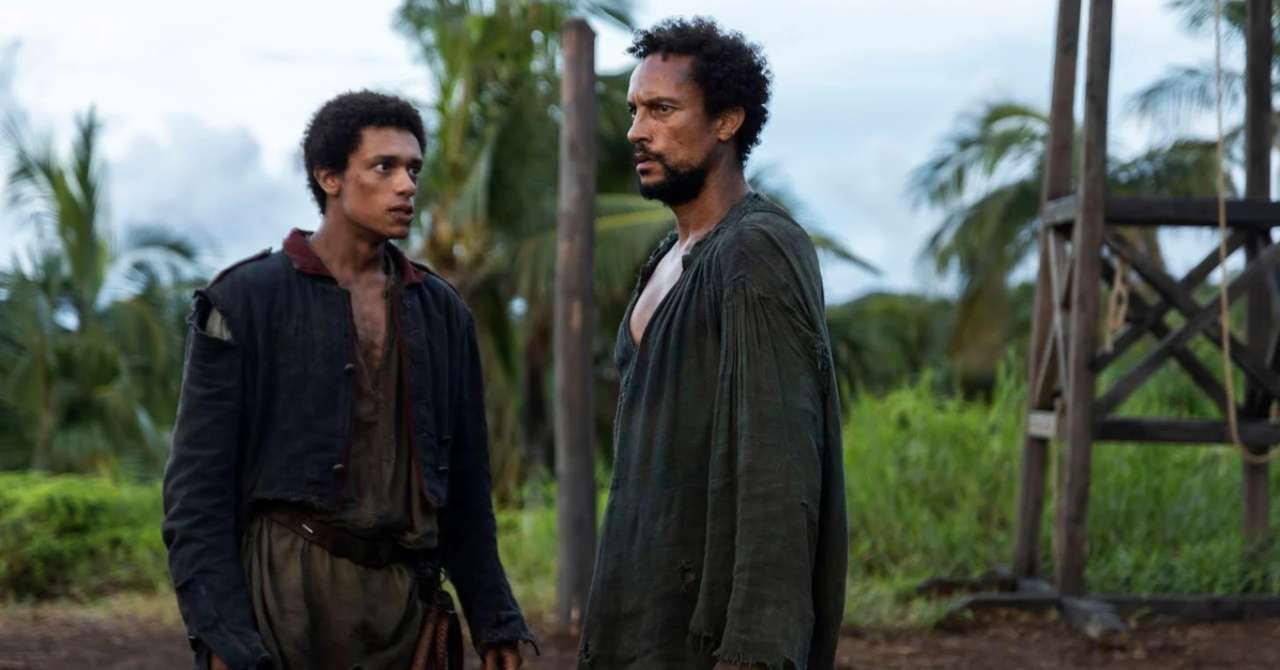
Reunion screenwriter Alain Moreau signs a large historical fresco on slavery in Reunion. Written with Adriana Barbato and Fanny Talmone, Enchaînés reminds us that France was also a slave country. A reality still too rarely explored by French fiction. Interview.
FIRST: What made you want to tell this story that depicts slavery as it was practiced in the French colonies?
Alain Moreau: I come from Reunion Island, but I knew little about its history. I immersed myself in books and discovered a lot of things, particularly about slavery, which represents a large part of the island’s history. I decided to inject all this material into a fiction project. Slavery is the entire history of Reunion Island, but also of Martinique and Guadeloupe. You should know that Bourbon Island was deserted before the arrival of the French. There were animals, vegetation, but no indigenous people. The settlement took place with French colonists, who brought in Malagasy people, then Africans, and later Indians and Chinese, to have an enslaved workforce.
“We have difficulty collectively confronting this past, because it is painful”
We have the impression that this is a largely unknown subject in France…
There is indeed a great deal of ignorance. Honestly, I didn’t know much myself before researching it. Today we speak of “white ignorance” to describe a form of denial, this refusal to see that there can still be racism and discrimination in France today. I believe that this ignorance also affects History. We have difficulty confronting this past collectively, because it is painful. And I include myself in it. Oddly enough, we sometimes know the history of slavery in the United States better, because we have been bombarded with films and series that have nourished our imagination.
Why, in your opinion, is it complicated to look back on France’s slavery past?
In France, as elsewhere in Europe, slavery was practiced in the colonies. America, which was a British colony, experienced it directly on its soil. When the United States became an independent nation, it had to embrace this history. In France, it is difficult to consider the history of the overseas departments as fully part of national history. Distance changes everything. We feel less concerned. Whereas slavery is anchored in the American collective memory, regardless of skin color or political affiliation.
Did you feel a form of responsibility in showing French slavery on screen?
Of course there is a form of moral responsibility. You shouldn’t say anything. But above all I tell a story. This is not a lesson, nor a teaching tool. Chained, this is not a Wikipedia page. Afterwards, if it makes spectators want to open a book and find out more, so much the better.
“Chained is about chains. And it resonates with the roots of Roots”
In the United States, there was Roots in 1997, which marked a turning point in television history. Was it a source of inspiration?
Yes, very strong. Even in the title: Chained, it’s about chains, those that connect us all. And it resonates with the roots of Roots. But we are not saying the same thing. The temporality is different. It nevertheless remains a major reference.
Chained also shows that the history of slavery is more complex than it seems, particularly in the human relationships between master and slave…
I knew this kind of relationship existed. In Jurassic Park, there’s this great line that says, “Life always finds a way.” There is something of this order here: even in the most inhumane situation, that is to say slavery, humanity always finds paths, little streams through which to infiltrate. It’s exciting from a storyline point of view to have characters who are not binary. Now, this must not become an excuse to minimize or put things into perspective. The danger is also to fall into the idea of the “white savior”. A bit like Brad Pitt’s character in 12 Years a Slave. The nice white guy who opposed slavery and brought justice. There have been characters like that in history, masters in Reunion who opposed the cruelty of slavery. But we must not fall into this “white savior” trap.
Olivier Gourmet perfectly embodies this form of paradoxical gentleness in this slave master!
Yes, and precisely, we had to explain to the actors, who sometimes wanted to inject more softness into their characters, that complexity should not go too far. This gentleness does not mean that they will question the order in which they live. Olivier Gourmet plays this very well: a good man, but who grew up in this system, with slavery, and who has no perspective to oppose this system.
“We were able to make exactly the series we wanted”
The particularity of French slavery is also this link between colony and metropolis…
There is a parallel to be drawn between the asymmetrical master and slave relationship, and the relationship between the metropolis and the colony. As someone who grew up in Reunion Island, I can tell you that there was a kind of fascination with the metropolis. Everything that came from the metropolis was necessarily better. There is a link of interdependence, and at the same time, a link of subjugation.
Is it complicated to sell a series like this?
I am very happy that it is broadcast on the public service. It’s his place. Could it have existed elsewhere? Maybe. But here, we were able to make exactly the series we wanted.
Chained, to see on France 2 in prime time and also on France.tv