The Electric Venus: A Comedy Marvel (review)
Pierre Salvadori in a state of grace. An irresistible quartet of actors. The 2026 Cannes Film Festival couldn’t have dreamed of a better opening!
We love Pierre Salvadori because we love his films. Since his debut in 1993 with Moving Target, he has been able, like Little Thumb, to sow little pebbles of pleasure and virtuosity along the path of our movie-loving memories. Les Apprentis (1995) and the complicity of the duo Guillaume Depardieu-Cluzet. After you… (2003), a cheerful fable about a suicidal man. Hors de prix (2006), reflection on the power of money where cruelty and malice become one. On the loose! (2018) and his incredible sense of the incredible Or even La Petite bande (2022), his Stand by me. We love Pierre Salvadori because we love the lofty idea he has of popular comedy and for the place he gives to women in it. Complex, flamboyant roles, rich in contradictions, worthy of those to whom he entrusted them: Marie Trintignant, Adèle Haenel, Audrey Tautou, Nathalie Baye, Catherine Deneuve….
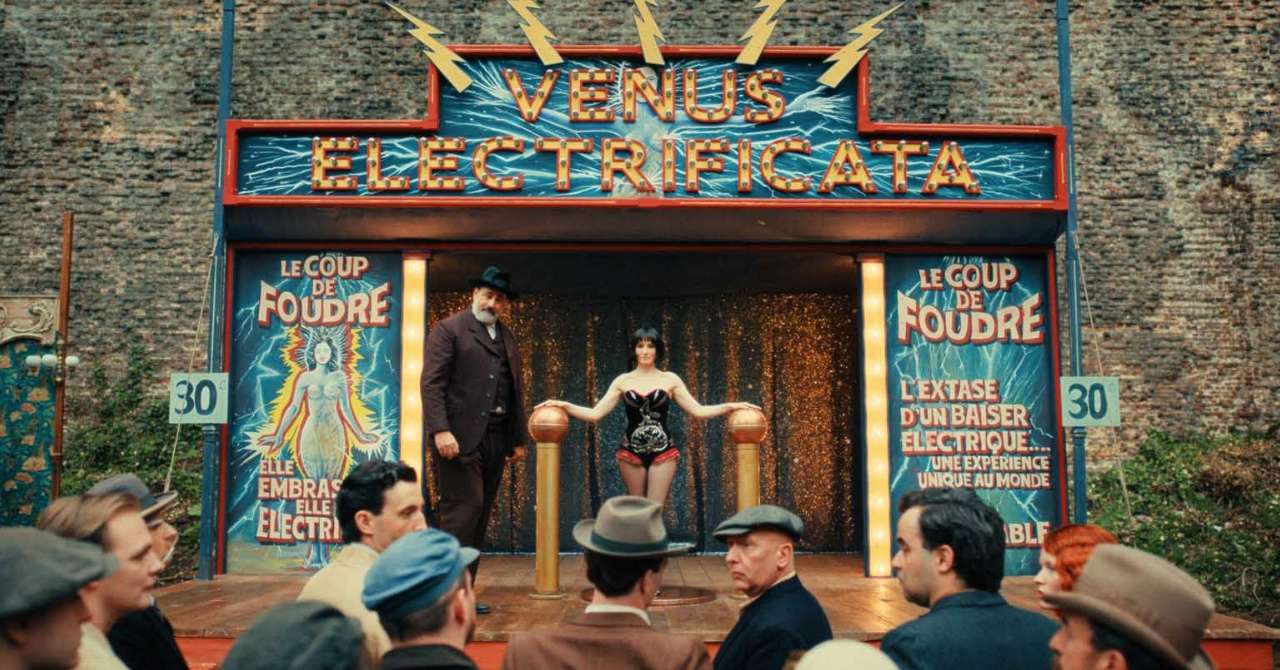
We love Pierre Salvadori… and we loved La Vénus Electrique, chosen to open Cannes 2026. Because all the virtuosity of the filmmaker is displayed over the course of 2 hours without downtime. Salvadori takes us here to the Paris of 1928 and, more precisely, a funfair in which Suzanne works, who, perched on a stage, is the heroine of a singular attraction where she sees men passing by who kiss her and experiences – in every sense of the word – love at first sight thanks to an electric discharge which runs through her body. Suzanne dreams of elsewhere. To escape from his condition. And fate will give her a helping hand when Antoine, a young fashionable painter, no longer able to create since the death of his wife, mistakes her for a clairvoyant and asks her to get in touch with his missing wife. Obviously, Suzanne is not clairvoyant. Obviously, she will still play the game. Obviously, very good at imposture, she will succeed in this sleight of hand. And obviously, everything will not stop on this one evening because Armand, friend and gallery owner of Antoine seeing him rediscover the taste for life and the desire to create, will ask Suzanne to continue her sessions, after understanding the reason for this sudden metamorphosis.
Thus begins The Electric Venus, which is based on an idea as simple as it is brilliant: characters constantly torn between sacrifice and personal interest, between manipulation and abandonment. A story of love(s) and lie(s) sublimated by Salvadori’s writing talent. His inventiveness in situations and the virtuosity of mischievously poetic dialogues. His genius in knowing how to manage – in flashbacks and flashforwards – his twists and turns by always revealing at the right time a buried secret which reshuffles the cards of our certainties. But with Julien Poupard, his ops director since En liberté!, he was also able to create a colorful, dynamic image that distances The Electric Venus from any heavy historical reconstruction. Everything here is airy. Light in appearance but poignant as soon as you scratch behind appearances.
An infinite playground for the actors who bring it to life. Accomplice of the filmmaker since In the courtyard, Pio Marmaï shines as a broken man certain of having caused the death of his wife. Anaïs Demoustier shines as a manipulator more and more despite herself. Gilles Lellouche upsets as a faithful friend devoured by an unspeakable remorse. And Vimala Pons dynamites the whole in the role of the one who pushed Antoine to paint before becoming his loving wife, loved but, also, caught up in uncontrollable racing of the heart not without consequences. Four virtuoso soloists with an intoxicating score. The perfect pairing.
By Pierre Salvadori. With Pio Marmaï, Anaïs Demoustier, Gilles Lellouche… Duration: 2h02. Released May 12, 2026