Cannes 2026: Gabin, a very beautiful Boyhood in Artois
Maxence Voiseux’s first feature at La Quinzaine, Gabin follows a boy from the North for ten years torn between his father’s butchery and his own dreams. Upsetting.
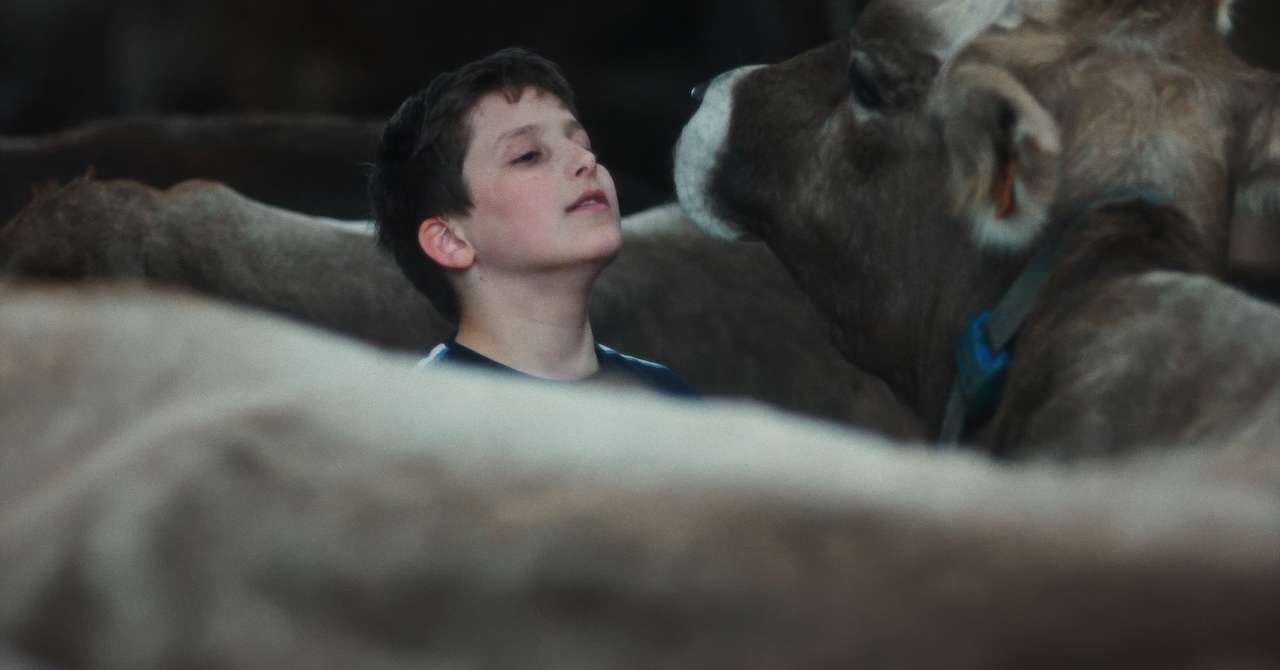
“Why are you looking at me like that?” » The very first line of Gabinlaunched by an 8-year-old kid on camera, contains the entire film in advance. Director Maxence Voiseux will spend ten years answering this childhood question – through gesture, never through words. Presented at the Fortnight, this first feature film is a work of surprising beauty and an insane concept. It’s a Boyhood documentary, shot in 4:3 in the mud and fields of Artois, which follows Gabin Jourdel from the age of 8 to 18. We see him go from the kid perched on his father’s shoulders to the teenager who must decide whether or not he will take over the family butchery.
The pitch fits on a postage stamp: the father is a butcher, the mother has her farm. The youngest loves living animals more than dead animals. How to grow, stuck between this double loyalty to satisfy? Voiseux, who already knew the Jourdel clan having devoted two courts to them (Men and beasts, The Heirs), could have put together a story of emancipation with cries, tears and wide shots of deprived lands. He does better. Because if Gabin is titled a first name, it is in reality an entire family that he films, the father, the mother, and the relatives. In the middle, this kid becomes the mirror where everyone watches themselves age. The story of emancipation is coupled, almost without knowing it, with an even more moving family saga.
But this is not just a crude recording of a peasant saga. Voiseux displays a quite astonishing sense of rhythm and beauty. Vertigo, formal and moving, arises where we least expect it. This film has the eye of a Flemish painter for the skies of Artois and the soggy pastures: certain shots of nature, of stunning beauty, evoke the Dumont of the great years – that moment when the land of the North ceased to be a setting (or a character) to become the breeding ground of an aesthetic and spiritual shock. A little later, it’s the flash of a smile caught on the fly, the light of a kid’s face that lights up in two seconds, that says it all. The first emotions too, almost nothing, a few scenes, where we see the kid discover that he can love something other than his cows or his playmobils. These are the prettiest moments of the film. And then, there is this scene, overwhelming, a father crying, completely lost in the face of his kid’s decision, who no longer knows whether he should hold back, react, let go, or simply take it. Ten years of filming to arrive at this moment, at this truth of a man who unravels under the lens, this is what few fictions achieve.
Presented at the Directors’ Fortnight of the Cannes Film Festival, Gabin films a forgotten France without ever transforming it into a postcard: neither miserabilism, nor picturesque. And if the film is titled after the kid’s name, it’s because Voiseux understood that we never tell the story of a kid alone – we tell the story of what carried him, what he leaves behind, and those who remain. A portrait then. And a saga.
Subscribe to the newsletter to follow Cannes 2026