Cannes 2026: Why Fast and Furious is a true classic
Cannes invites Vin Diesel and his Supra to Lumière to celebrate the 25th anniversary of the film. Marketing operation? No doubt. But also, the opportunity has finally come to watch Fast and Furious for what it is: a classic.
Let’s be frank for two minutes. When Cannes announced that Fast and Furious would arrive at the Grand Amphithéâtre Lumière for its 25th anniversary, we all had the same little smile. A midnight session, Vin Diesel on the Croisette, Michelle Rodriguez at the top of the stairs, Jordana Brewster in a long dress: the operation smacked of American seduction. Cannes needed US stars, Universal could use them as a springboard to restart the machine before Fast Forever in 2028, and Diesel could afford to climb the stairs in peace. There was something for everyone. We were going to count down the minutes of the standing ovation, shed a tear over Paul Walker, tweet a joke about “family”, and move on. No one is fooled: the Croisette likes motors when they bring people to the red carpet.
Except that it’s still worth spending two seconds on the apparent paradox. Fast and Furious in Cannes Classic? And after all why not? What if behind the neon and nitro was a real piece of American cinema?
Let’s start again. In 1998, the journalist Ken Li published in vibe a long report entitled Racerabout the wild races that take place at night in the streets of New York – an underworld, a mixture of Japanese tuning, hip-hop, Latina and black pride. Former producer converted to real (we owe him the beautiful dragon heart And Daylight) Rob Cohen came across the paper, bought the rights, and left for Los Angeles to attend an illegal race in the middle of the night. He’s coming back full force. There is a film, it’s obvious, all that remains is to find the faces and the money. Universal hesitates, agrees to finance on the condition that Timothy Olyphant plays Toretto. Olyphant, who comes out of Gone in 60 Secondsrefuses, judging the project to be completely stupid. And it’s Neal Moritz who draws the name of a guy we saw in Pitch Black the year before: Vin Diesel. Diesel ends up saying yes and has just signed the deal of his life.
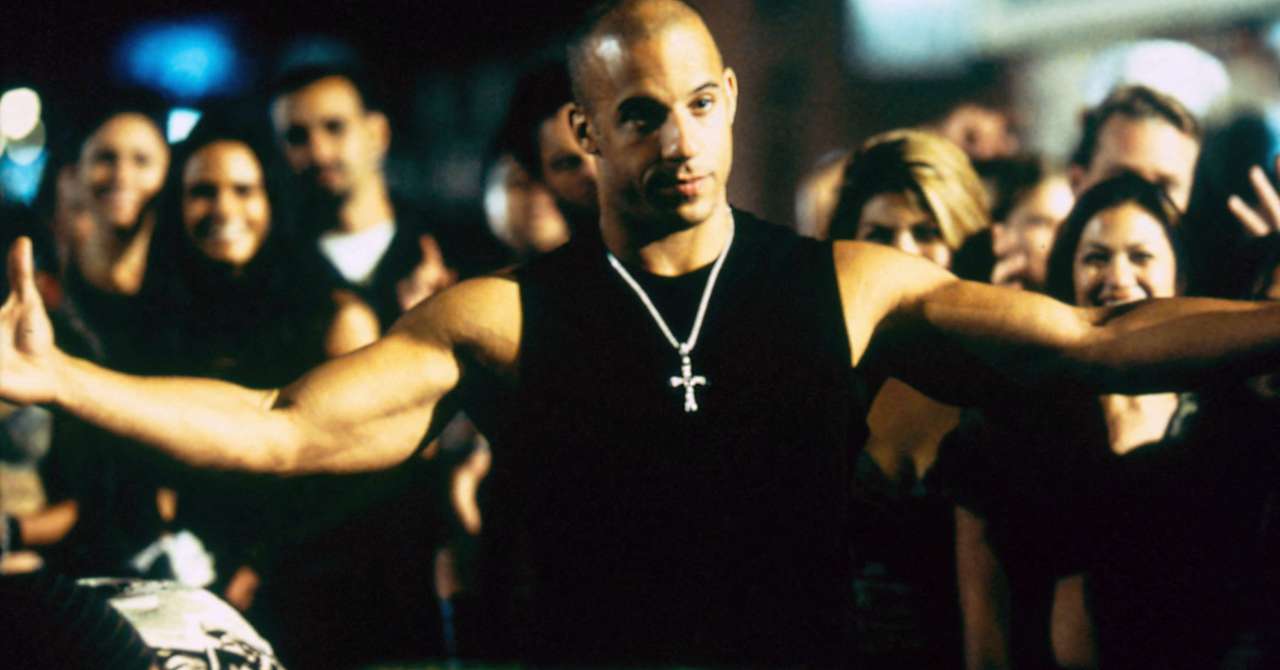
The film is him. We then saw him caricature himself so much, muttering “family” with his cross on his tank top in twelve sequels, that we somewhat forgot what he was inventing there. At the time, a critic of Chicago Reader spoke of a disturbing mix of zen tranquility and poorly contained rage, and it is exactly that: a massive body that speaks in a low voice, a granite rock that looks slowly and saves every gesture. In short: he’s a Mitchum or a Victor Mature from the 2000s. A Cagney from the 21st century. When we rewatch the films today we understand that Toretto was never an action hero. He is a mythological figure. The big brother who protects his crew, the garage patriarch, the guy who says grace before the barbecue because that’s how we do it in this family. An absolutely brilliant invention.
Okay. But not enough to bring the Dodge Chargers onto the crossroads between a Ken Russell and a Kurosawa.
However, the film really fits into a nobler lineage of cinema than expected. Obviously, the first F&F was openly inspired by Point Break (with its undercover cop, its community of outlaws and its virile bromance). But there is another lineage, nobler and more secret. Which takes the film back to Walter Hill and, beyond that, to Howard Hawks.
Hill? The Driver, The Warriors, Streets of Fire : an urban cinema of pure stylization, where rival gangs move through the American night as in a silent opera, with their colors, their territories, their ritualized duels. The Toretto team is that too: Echo Park Warriors, samurai in Mazda RX-7 with the Sunday barbecue instead of the midnight subway. Cohen films LA as Hill filmed New York: a fragmented territory where every crossroads is a border, where every car is a badge. And the final race, Supra against Charger, is Hill multiplied. The geometry, speed, and editing are extremely readable. No digital chaos, no camera drunk. Classic cutting. A marvel.
Howard Hawks is perhaps less obvious. And you don’t even need to go get your final car movie (Red line 700). The whole saga Fast and Furious is obsessed with competence. The guys have to know how to drive, how to repair, how to hold their place on the team. Respect is earned through experience, never through bullshit. The scene where Brian saves Vince from the burning truck is Only Angels Have Wings, but with Honda Civics. Male brotherhood, the code of honor and a job well done as an absolute moral value: we are at home with the filmmaker from Rio Bravo. And basically, Cohen didn’t make a blockbuster with the first film, he signed an urban western (with rodeos!). When Brian hands the keys to the Supra to Dom so he can escape, the sun rising on the straight, it’s the hero who chooses friendship over the law.
For the rest, we will still advise you to put away your little contemptuous smiles. Cohen is an inventive craftsman. He films a Los Angeles that we have rarely seen in the cinema. A Chicano, Asian and black melting pot, where the (white) hero is the intruder, a foreign body who infiltrates a world that is not his own and ends up integrating into it. In 2001, Hollywood didn’t know how to do that. Mann had sketched it in Heat but in its own way, icy and geometric. Cohen films the sweat, the smells of methane, the languages crossing without subtitles, without an agenda. Twenty-five years ago Fast and Furious invented a mixed, diverse and super sexy cinema.
Presenting it in Light in 2026 was not just fan service, nor a simple marketing operation disguised as recognition. We can also see it as the recognition, belated but justified, of a B series which ended up crossing time as the great B series films always do. Through the back door, sliding from the ends of the shoulders to the top of the stairs. The family triumphed. once again