
Lanterns: John Stewart’s Origins Explained
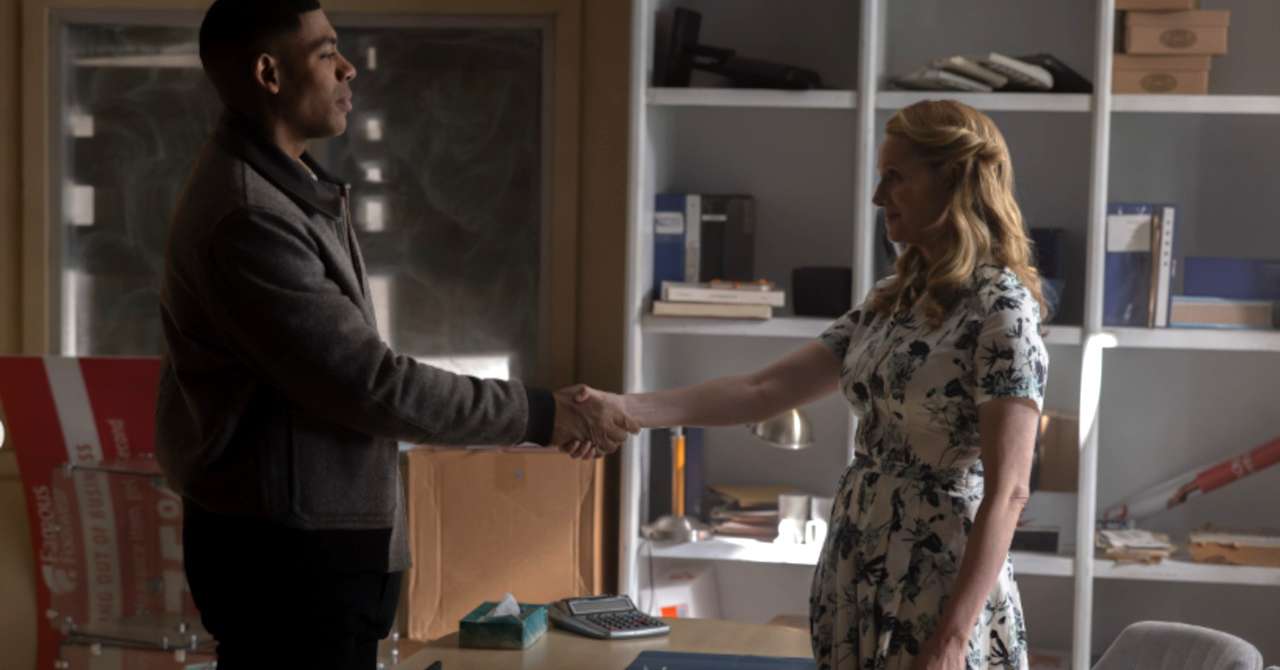
The third episode of the HBO Max series looks back on the childhood of John Stewart, played by Aaron Pierre, and reveals how his parents prepared him from a young age to become a Green Lantern. A bold and ambitious storyline.
From the opening scene of Lanterns, John Stewart seems destined to one day become Green Lantern. But the third episode goes back in time to explain how this destiny was constructed, year after year, by his parents. Spoiler alert!
Flashbacks notably reveal that his father, John Stewart Sr. (J. Alphonse Nicholson), had himself been tested by the Guardians and failed to become Green Lantern because he showed fear. From there, his parents decided to invest all their energy in their son’s future. To prepare John, they put him through particularly brutal tests: shooting an apple placed on his father’s head, being abandoned alone in a dangerous neighborhood or even making him believe that the Guardians are constantly observing him through birds.
For Aaron Pierre, this childhood allows us to understand the character and everything that led him to become the man he is today. “It was a gift to have the opportunity to explore each of these characters in such depth. It’s not given to everyone to be able to spend so much time with a character and to live so much with them in their interpretation,” he explains to Variety about the filming of this episode.
A planned childhood
Everything John does in his life seems to have been designed to achieve one goal: becoming Green Lantern. His commitment to the Marines, his training and even his isolation from others are part of this quest. “He has accumulated an incredible amount of life experiences, more than people two or three times his age have ever had,” explains Aaron Pierre.
For Jasmine Cephas Jones, who plays Bernadette, his mother, it was important to show that behind this extremely strict upbringing lies above all a mother convinced to do what is best for her son.
“I really wanted to show this activist side of her, and the fact that she made this decision very young for him, because she considers it to be her destiny. Whatever happens, she is going to stick to it,” she explains to Variety.
The weight of inheritance
But this education inevitably ends up having a price. When a young John discovers that his parents have lied to him about the Guardians and that they are not actually observing him through the birds, his world falls apart. Above all, he understands that he was not chosen. And that he will have to work harder than the others to prove that he deserves this place.
This is also when Lanterns gives a more political dimension to John Stewart’s journey. Bernadette then explains to him: “Sometimes a black man has to raise his hand himself. It doesn’t mean you’re not good enough, it doesn’t mean you’re not better. It just means they don’t see us…”
For Jasmine Cephas Jones, this idea is essential to the construction of the character:
“The importance of not being afraid in a society, but also being a person of color in this country… fear is also in our heritage. It was also important to talk about it. How do we remove that fear from John so that he can become the Green Lantern?”
J. Alphonse Nicholson, who plays John Stewart Sr., also believes that this dimension needed to be addressed.
“It’s real, man. I know we all want to escape it, but sometimes these questions need to be addressed, even in our fictional worlds. Why do they make us feel these things? Why do they exist? Asking the questions sometimes just gives people space to talk about them. And I think that’s what great screenwriters do.”
The father’s trauma is another key to this story. John Stewart Sr. failed to become Green Lantern. And his entire obsession now consists of preventing his son from experiencing the same failure.
“He doesn’t want to let his son down. Deep down he feels like he’s let himself down, his community and his wife. So now he has to make sure his son doesn’t feel the same way and doesn’t fall into the same spiral of depression,” Nicholson says. “It’s really interesting to see him protect his son in a very tough way. But it’s tough love.”
“John Stewart has always been like that”
This political dimension also sparked some reactions among fans, with some accusing Lanterns of being too “woke”.
Vanessa Baden Kelly, screenwriter of the third episode, responded to these criticisms in an interview with TheWrap. She explains having seen certain spectators share panels from comics from the 1970s to denounce the series.
“I came across people calling the show ‘woke,’ and people were sharing boards in reactions and comments. And they were boards from John Stewart in the 1970s. He was calling people ‘Whitey’ or opposing wars, and I was like, ‘Oh my God.'”
For the screenwriter, these reactions therefore forget an essential part of the character’s history.
“I’ve read a lot, but I haven’t been able to read everything, and you just say: that’s it, you have to keep in mind that this is who John Stewart has always been.”
The character, created in 1971 by Dennis O’Neil and Neal Adams, was in fact designed as a proud and self-confident black hero, particularly inspired by Sidney Poitier.
To build this new origin, the Lanterns team asked itself a simple question: what does it mean to be a black man and receive this ring when other characters have already worn it?
The answer involves the idea that John must do more than the others to be accepted. Vanessa Baden Kelly thus compares her childhood to that of great black athletes like Tiger Woods or the Williams sisters, trained from an early age to achieve excellence.
This new origin therefore allows Lanterns to deepen a character who already has a rich history in the comics, while giving a new explanation for his lack of fear.
Co-creator Damon Lindelof, however, knows that the DC canon must be handled with care. He admits in The Wrap:
“When you play with the cannon, you have to treat it like you’re handling plutonium. But at the same time, there’s not really any fun, creativity or originality in it if you can’t do it.”


