
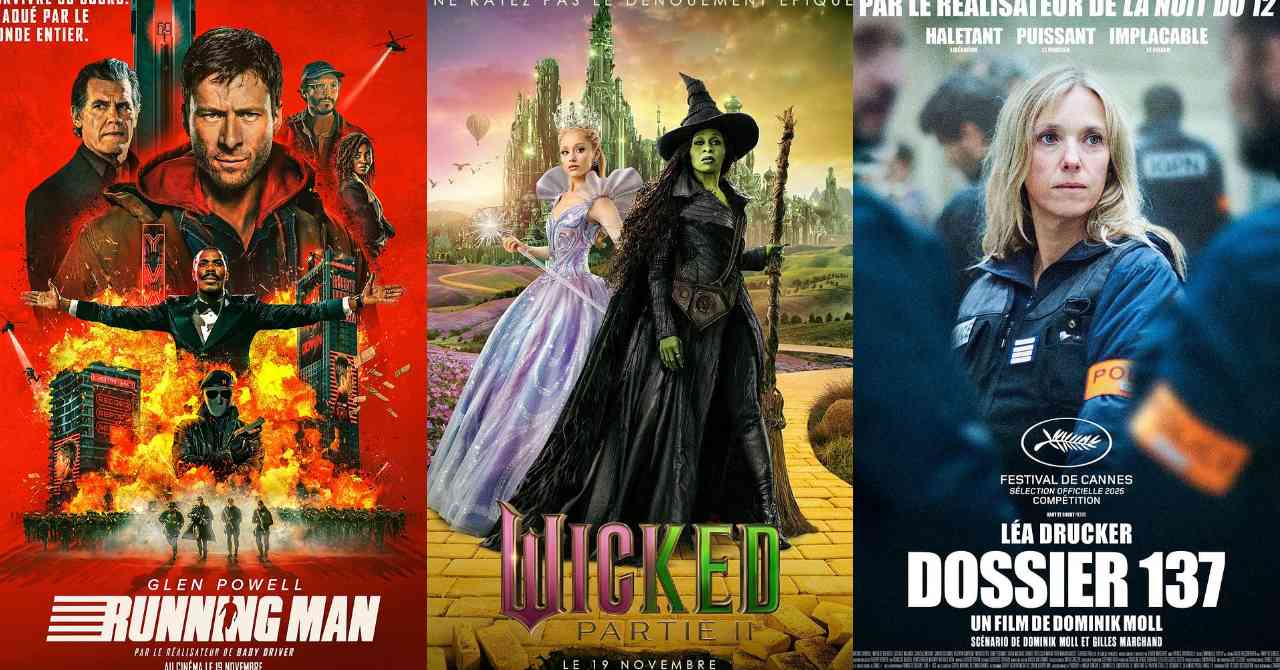
Running man, Wicked: Part II, File 137: what’s new at the cinema this week
What to see in theaters
THE EVENT
RUNNING MAN ★★★☆☆
By Edgar Wright
The essentials
The director of Baby Driver delivers an imperfect but muscular and committed show, where Glen Powell attempts to take up the torch from the icons of action cinema.
Running Man is neither a saga nor a franchise. And certainly not an insurmountable monument of cinema. We’re talking about a little cult film from the 1980s, directed by Paul Michael Glaser, where Arnold Schwarzenegger participates in a macabre television game in a dystopian future where the United States has become a totalitarian dictatorship. This somewhat forgotten film was therefore an ideal playground for an unbridled filmmaker who just wanted to have fun with a beautiful toy. And we have a feeling that the director of Baby Driver is going to want to have the time of his life. But without compromising completely. With Glen Powell in the central role – a worker oppressed by the system because of his big mouth who finds himself unemployed while he has to pay the medical expenses of his sick daughter – this Running Man fully assumes the political scope of Stephen King’s novel and even displays an anti-corporation speech – denouncing fake news, the concentration of power and the manipulation of opinion by big companies through the media – quite daring when we take a step back. Messy, messy, sometimes cacophonous, but always sincere and generous, the Running Man version 2025 is the antithesis of the recent Tron: Legacy. A true director’s film with soul, everything the public demands from blockbusters, and unfortunately the kind of blockbuster that may not find its audience. E
Edward Orozco
Read the full review
PREMIERE LIKED A LOT
WICKED: PART II ★★★★☆
By Jon M. Chu
Last year, the first part of Wicked, the adaptation of the famous Broadway musical, inspired by The Wizard of Oz, conquered the public (especially American but also worldwide), with its super duo of actresses (Ariana Grande and Cinthya Erivo) and its unstoppable hits. But it was still necessary to transform the test with the sequel. Filmed at the same time as the first film, Wicked: Part 2 picks up the plot where we left off and reveals itself to be a pure spectacle, a master class in production and musical scenes, a great film about friendship, love and tolerance, but also an entertainment which does not fail to tell something. Because, in fact, it is difficult not to have a parable of Donald Trump’s anti-immigration policy in the arc of the animals, ostracized and chased out of Oz by the Wizard. But where part 2 surpasses part 1, it is in its rhythm and its conciseness Of entertainment, of truth, which proves that the love story between Broadway and Hollywood, which began almost a century ago, still has a bright future ahead of it.
Edward Orozco
Read the full review
PROOFS OF LOVE ★★★★☆
By Alice Douard
Céline and Nadia are a couple and awaiting the birth of their first child, whom Nadia is carrying. And the story, inspired by what the filmmaker went through, takes us into the intimacy of these two women and their daily lives turned upside down by this upcoming birth and the questions she asks Céline in search of legitimacy and a place. Proofs of Love evolves in a perfect balance between the concrete and the feelings of things, necessarily different for two women with such dissimilar personalities. Here we are at the antipodes of the banal film about the subject. Thanks to the quality of Alice Drouard’s writing but also to the complicity and incarnation of their characters by Ella Rumpf and Monia Chokri. They emit an energy, a generosity that makes the harshest moments poignant without ever forcing the point. Irresistible from start to finish.
Thierry Cheze
Read the full review
POMPEII, SOTTO LE NUVOLE ★★★★☆
By Gianfranco Rosi
In the year 79, the eruption of Vesuvius completely covered Pompeii, freezing it almost forever. Today, this city would be almost chained to its past, museumized to the point of suffocation. All the beauty of Gianfranco Rosi’s direction lies in this ambivalence of times: a black and white in the present, a heritage cinema which broadcasts great films to an empty theater today… Like the multiple petrified bodies from the eruption which give a fragmented image of what life could have been like at the time, the documentary offers a cinematic transcription of this method, by filming daily life in 2025 in Pompeii, Naples and Vesuvius. The title of the film, “Under the Clouds”, evokes with all the poetry contained in the film, how here on Earth, very little has ultimately changed in 2000 years of history. Starting with our need to keep traces, before the disaster begins again.
Nicholas Moreno
FIRST TO LIKE
ELEANOR THE GREAT ★★★☆☆
By Scarlett Johansson
Scarlett Johansson’s first production, Eleanor the Great has the modesty of a film that doesn’t bring her back – but also, sometimes, the blandness of a TV movie that’s a little too tame. We follow Eleanor, a nonagenarian with a piquant verb (June Squibb e), who, upon the death of her best friend, appropriates fragments of the story of her, a former survivor of the camps. This imposture will put her on the path of Nina, a student who gradually becomes both her lifeline and her moral mirror. Softness of tone, sensitive subject, the film exudes a little Allenian scent, with its mixture of dry sarcasm, cold humor and veiled melancholy. Every time the camera focuses on Eleanor, Johansson finds the tempo and June Squibb electrifies the screen. But as soon as the story focuses on the restorative friendship between Nina and Eleanor, the adventures unfold mechanically, and the vibration fades. And if the tearful finale disappoints a little, the chronicle retains enough delicacy to move.
Peter Lunn
Read the full review
JEAN VALJEAN ★★★☆☆
By Eric Besnard
From the Taste of Wonders to The Spirit of Family, we have criticized Eric Besnard’s cinema enough in these columns not to salute the way in which he takes on Hugo’s Les Miserables (while waiting for Fred Cavayé’s version with Vincent Lindon at the end of 2026). He chooses here to focus on the genesis of the hero of this monumental work and tell how this man, ravaged by the anger and resentment born from his 20 years in prison, will metamorphose. A plea for a second chance that resonates strongly with our times where it is hardly in progress. The incredible power of Grégory Gadebois – worthy of those of his glorious predecessors, Gabin or Ventura – raises Jean Valjean to a high foundation and offers truly great scenes, including the entire impressive prison sequence. There are certainly here and there failures in the direction of actors and unnecessary drone shots, in contradiction with the dry and harsh simplicity of the whole. But it is obviously his best film.
Thierry Cheze
FRANZ K. ★★★☆☆
By Agnieszka Holland
A year after the very academic Kafka, last summer, here is the author of The Metamorphosis again at the heart of a new biopic… which constitutes the perfect counterpoint. Decidedly in spirit after The Shadow of Stalin and Green Border, Agnieszka Holland dynamites this exercise often reduced to imposed figures. By having fun with its form – characters who break the fourth wall and express on camera what they think of Kafka – and by multiplying the back and forth between yesterday and today with scenes taking place in a Prague museum, testifying to the monetization of his work, in a form of surrealism that he would not have denied. The filmmaker therefore chooses the kaleidoscope, the breaks in tone, rhythm and staging to embrace the complexity of a man who keeps his part of mystery intact despite everything that has been said and written about him. Not everything is perfect, but this playful aspect skillfully challenges the preconceived idea of a man with ideas as dark as his works.
Thierry Cheze
THE TREE OF KNOWLEDGE ★★★☆☆
By Eugene Green
A teenager falls into the hands of a man, nicknamed the Ogre, who has made a pact with the Devil, who uses him as a tout for tourists who he transforms into animals to eat! So much for the well-lit pitch of the new Eugene Green (Le Pont des Arts, Le Fils de Joseph…) which reveals a certain sense of comedy little highlighted until now in a demanding and cutting-edge work. And, between farce and fantasy, his charge against the combined harms of tourism and the excesses of capitalism in Portuguese society hits the mark.
Thierry Cheze
Find these films near you thanks to Première Go
FIRST TO MODERATELY LIKED
FILE 137 ★★☆☆☆
By Dominik Moll
After La Nuit du 12, Dominik Moll once again mixes the behind the scenes of the police institution and the news. This time he adopts the point of an IGPN investigator (Léa Drucker), confronted with a potential blunder by the BIS: an LBD shot having seriously injured a young man, in the context of a tense demonstration. While the cops involved plead self-defense, she tries to shed light on this affair, even if it means alienating her colleagues. A fictional affair which is obviously inspired by reality, and which Dossier 137 persists in treating with administrative coldness. And if the viewer will have little doubt about the guilt of the agents, the film obviously plays it safe to avoid being accused of being anti-cops. Moll therefore puts the ball back in the center, refuses a clear opinion and forces File 137 to try to embrace a function of reconciliation between the France of roundabouts and that of flash balls. A suit way too big to wear.
François Leger
Read the full review
TRANS MEMORIA ★★☆☆☆
By Victoria Aquarius
It may not seem like it, but Trans Memoria is oriented towards life: the director films her experience of transition and through her words brings to life her friend Meril, the only one with whom she shared this event. It’s a shame then that its staging tends towards still life: the inanimate fixed shots and the use of voice-over reduce the scope of this memory, preserved by the images.
Nicholas Moreno
And also
7 days in June, by David Aboucaya
Melting Ice, by François Péloquin
First snows, short film program
Shelby Oaks, by Chris Stuckmann
Thelma of the Land of Ice, by Reinis Kalnaellis
The recovery
The Last Days of Mussolini, by Carlo Lizanni


