The Last Duel on M6: this Ridley Scott summit did not deserve its flop (critic)
At the height of his mastery, the director delivers a brutal and splendid story of a medieval news story, which resonates more than ever in the present by encapsulating all the violence in the world.
Released in cinemas in 2021, The Last Duel was a dismal failure at the box office, with only 30 million in revenue for a 100 million budget. All the more cruel since this medieval drama with a luxury cast (Matt Damon, Jodie Comer, Adam Driver and Ben Affleck) is one of Ridley Scott’s best recent films. If you don’t have it yet, catch up session this Wednesday evening, with its first unencrypted broadcast on M6. Here is our review published at the time:
Without having seen The Last Duelwe said to ourselves, in the penultimate issue of Firstthat Ridley Scott could be one of the last classic filmmakers. Now that we have seen The Last Duel, we can say this without being too mistaken. Yes, Ridley Scott is indeed a classic filmmaker, and The Last Duel is a classic film. In the sense that the filmmaker, like his film, adheres to a tradition, and that this adherence could be synonymous with excellence.
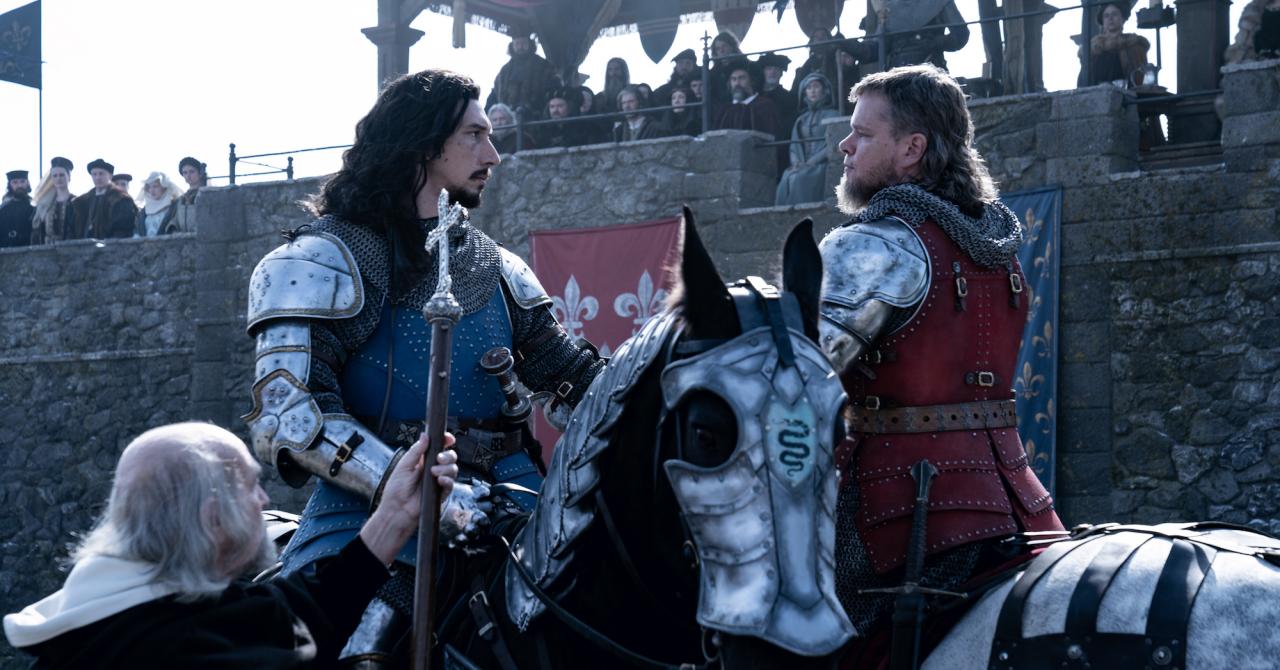
The Last Duel adheres to the tradition of cinema as a total art, where the spectacular and the reflective can – and must – exist together. Okay, that’s enough for the theory: The Last Duela classic film, is a fucking great film. The film is inspired by a true story (or rather the account given by academic Eric Jager in a “ready-to-adapt” book), that of the last legal duel, regulated by law, having taken place in France; it was in December 1386, and the knight Jean de Carrouges confronted to death a squire, Jacques Le Gris, the former accusing the latter of having raped his wife Marguerite.
If Jean wins, Jacques is guilty, and if Jacques wins, Marguerite will be burned alive. This is the “judgment of God”. We will obviously have to wait until the very end of the film to witness this “last duel”, while the film adopts a structure in three chapters, each espousing the point of view of one of the three protagonists of the affair. And this is where the film becomes exciting.
This process is not a simple gimmick imitating the Rashomon by Kurosawa, to put the truth into perspective by changing points of view. We begin with the story of Jean – perfectly played by an aged and injured Matt Damon – an honorable warrior, shady, penniless, and overwhelmed by the intrigues of the courtiers, who makes a self-interested marriage to expand his domain and save the honor of his family. But after the story of Jacques, and finally that of Marguerite, this beautiful image is deconstructed, decomposes before our eyes.
Jean appears to be a man as violent as Jacques. Knights like Jean here are war professionals, who fight not for abstract notions like freedom or honor but for money and survival. The few battle scenes, of incredible brutality, plunge us into mud and blood, emphasizing movements and maneuvers as worthy of Braveheart (limbs cut off ad nauseam) than Game of Thrones (treacherous blows and very dirty stratagems): this image where Damon impales an enemy on his sword that has fallen to the ground clearly shows that we are not at the court of King Arthur, in an idealized Middle Ages.
There is nothing to reproach with the overpowering technique of the film (another classic trait) and the cinematic power of the reconstruction of France at the end of the 14th century, but The Last Duel thus opens another path for Scott than that of his exciting Robin Hood And Exodus: Gods and Kingswith its crooks who become heroes and prophets to found the law.
No, the time is no longer for heroism, for the great bellicose speeches of GladiatorOr Kingdom of Heaventhese great romantic films including The Last Duel would be the exact -normal reflection, since the romantic and the classic are opposed. Put them in the same movie, and they fight to the death. “There is only money, or the absence of money”writes Don Winslow in The Power of the Doghis fabulous novel about cartels that Scott almost adapted, “there is only power, or the absence of power”.
“Only the power of men counts”says Marguerite’s stepmother, who will later admit to her during a terrifying scene that she was also raped, affirming that we have to live with it, that things are like this and that we can’t change anything. Marguerite (Jodie Comer, brilliant) thus becomes the heroine of the film, its center, the only worthwhile issue.
The Last Duel although classic, it is a film in the present, whose final explosion of violence exorcises nothing, cures nothing, does not even delight. Only the power of men remains. And a definitely immense film, which seems to contain all the violence in the world.