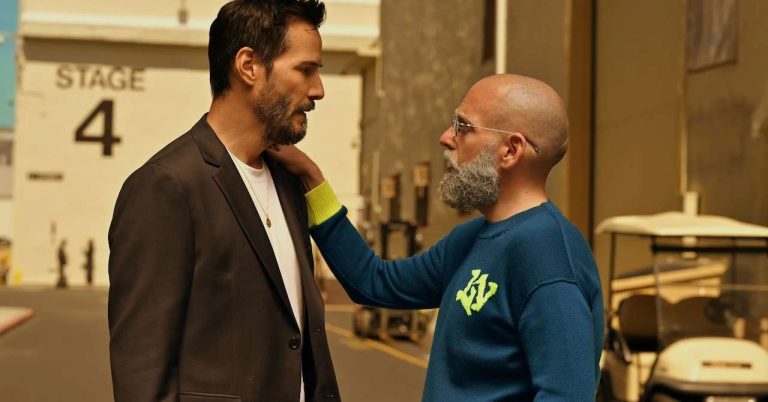

The Mage of the Kremlin: didactic, talkative and without harshness (review)
By adapting Giuliano da Empoli’s best-seller on the rise of Putin, Olivier Assayas gets lost in the twists and turns of a film-file that rings false.
Probing the mysteries of the Russian soul with English-speaking international stars? This was already one of the errors of the recent Limonov, the ballad, a portrait of the anarchist writer Eduard Limonov by Kirill Serebrennikov. This paradox is once again at the heart of The Mage of the Kremlin, adaptation by Olivier Assayas (with a helping hand from Emmanuel Carrère on the screenplay) of the book by Giuliano da Empoli recounting the slow consolidation of Putinian authoritarianism. Jude Law may be quite good as Putin, but we can’t help but think that it all rings false. It must also be said that the very monotone tone used by Paul Dano (the “mage” of the title, gray eminence of the Kremlin), in the long confession which serves as a common thread for the film, frankly does not help it take off.
The Mage of the Kremlin is a succession of didactic and chatty scenes, interspersed with cards indicating academically which historical event will be discussed during the following twenty minutes (Orange Revolution, annexation of Crimea, etc.), and sprinkled with aphorisms on Russia and power, all stated in a penetrating tone. Assayas does not find here the energy which propelled his Carlos, another big film-file which had for him to play the card of thriller and action, rather than that of hushed conversations between spin doctors in suits and ties. We sometimes have the impression when watching The Mage of the Kremlin that we are watching a digest (lasting 2h36 all the same) of a standardized mini-series, responding to the canons of globalized and impersonal storytelling.
By Olivier Assayas With Paul Dano, Jude Law, Alicia Vikander… Duration 2h36. Released January 21, 2026