
The Rope Around Your Neck: Gus van Sant’s return to form (review)
Inspired by a hostage situation filmed live in America in the seventies, the 73-year-old filmmaker questions media madness and the way it blurs reality.
Born in 1952, well before the advent of digital coldness, Gus van Sant is a filmmaker of organic matter. Material that he kneads, questions, eroticizes, becoming the champion of a sensuality most often forged on adolescent skin. With him, the formats are changing and the image can experience different regimes. Thus in Paranoid Park (2007) his last major film explored the torments of his protagonist through a mixture of images in Super 8, 35 mm, slow motion, etc., thus reflecting an unstable spatialization.
We find more or less this process in this Rope around the neck (which, for budgetary reasons, he had to give up shooting on film) What for others would have the value of stylistic affectations therefore refers to the filmmaker’s desire to become one with the very texture of the film, to capture the vibrations of the frame. However, there would be a risk here of redundancy or even pleonasm since the subject of this dramatic comedy is the way in which a poor guy supposedly deceived by a loan company will use the media – therefore image and sound – to make himself heard.
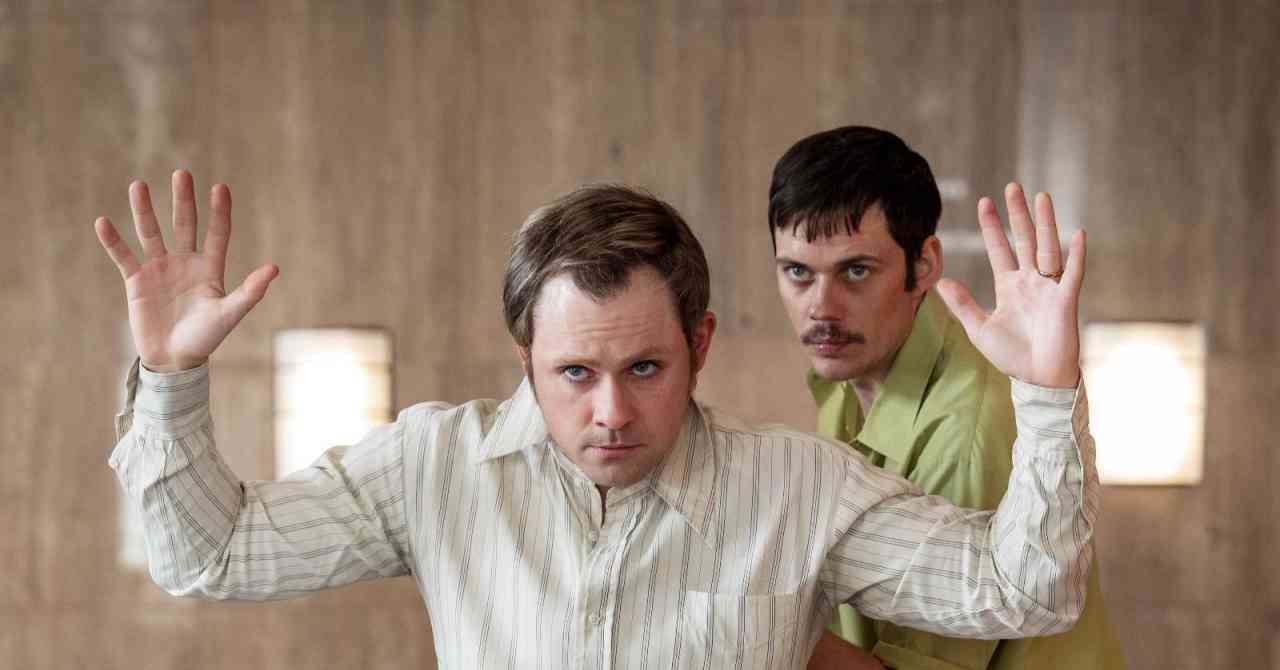
In February 1977 in Indianapolis, Tony Kristis (Bill Skarsgård) kidnapped the son of the boss of the company in question (Dacre Montgomery), held him at home with his gun in hand, demanded reparation, becoming in the space of a few hours the cathodic hero of an America suddenly seized with passion for this desperate act performed almost live. Using a deliberately tone-on-tone aesthetic (dominantly bland colors to better place its protagonists in a dormant setting), this Rope on the Neck dialogues with the recent The Mastermind by Kelly Reichardt. Both share this distant outlook towards an era stripped of its usual romantic veneer.
Kristis’ story is true and the filmmaker is based on period archives, the disclosure of which during the end credits reflects (valid?) the form used. The clashing and very moving images of the report are superimposed on still images and other vintage effects (splitscreens), when they are not extracts from old westerns captured in the cubic station in Kristis’ apartment. The staging reflects the tension of suddenly amplified current events, aware that the events described here are the original moment of what we are experiencing today. “We no longer control what happens on the air now!” Strange anxiety regarding a still exceptional live broadcast.
Sidney Lumet with his Dog Afternoon in 1975 (whose main actor, Al Pacino, is also in the credits of The Rope on the Neck) had however pushed this madness to an unequaled level of incandescence. Softer, van Sant even tends to attenuate the flashes of reality. One of the famous archives of the real Kristis shows him surrounded by a crowd of officials and journalists. Suddenly an intruder comes to place himself between him and the camera lens. He immediately withdraws, aware of his fault: “Sorry, it’s your show!”
Gus van Sant, filmmaker of carnal desire, re-examines the relevance of a body in a space saturated with itself. As soon as this body is aware of its value, it loses its purity. In her Ready for Everything (1995), we remember that the heroine’s cathodic ambitions required omnipresence and therefore the elimination of what could act as a screen between her and the frame. Kristis, certainly guided by despair, almost unknowingly replays the same monstrous score.
By Gus van Sant. With Bill Skarsgard, Dacre Montgomery, Colman Domingo… Duration: 1h45. Released April 15, 2026


