Cannes 2026 – Nicolas Winding Refn: “Was my place really on a streaming platform?”
The director of Drive and The Neon Demon returns with a film under the influence of Brian De Palma, Mario Bava and David Lynch. Encounter.
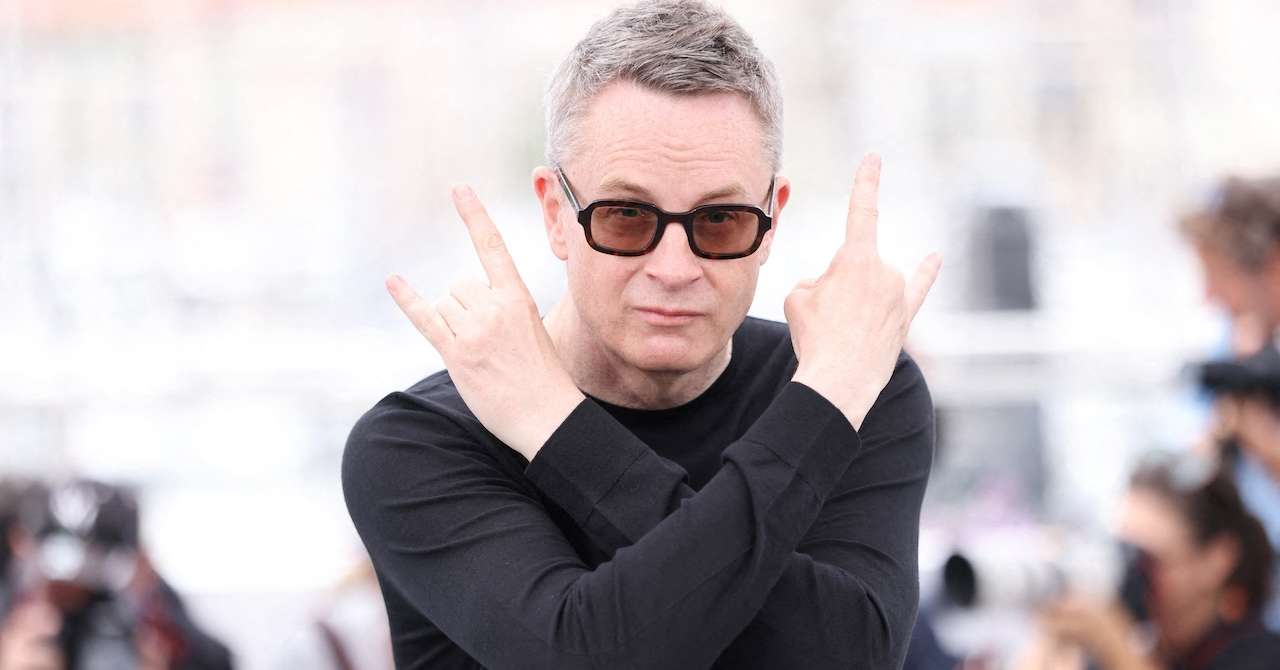
He died and came back to life but we were not in the loop: a few hours before his press conference where he announced that he had left our world for 25 minutes due to heart failure, we took a little time with a surprisingly smiling Nicolas Winding Refn. The director even went so far as to pull out an armchair to ensure that we were in the shade, far from the harsh Cannes sun. We didn’t ask for so much from the director of the very experimental Her Private Hellout of competition at Cannes, where it plunges Charles Melton and Sophie Thatcher into a futuristic metropolis that looks a lot like hell.
Nicolas Winding Refn: Are you okay, are you comfortably seated?
First: Perfect. How is this Cannes going?
Alright ! But it’s always good, Cannes.
You have worked on series in the meantime, but it has been ten years since you last directed a film (The Neon Demon2016). Why this long break?
When I finished The Neon Demonthe television was in full explosion. Opportunities abounded and a lot of money was invested. Streaming was going to be the ultimate playground. So like everyone else, I was very interested in the new formats that we would be able to produce there and I produced my first series with Amazon, Too Old to Die Young. But I’m not sure Amazon liked it very much (Laughter.)
Because of the audiences?
No, I think the result scared them a little, they didn’t necessarily agree with what I was offering them. Did I really belong here? And then I did another series with Netflix, which I also had a lot of fun making, but I ended up realizing that these platforms, as good as they are, operate according to a different financial algorithm than what I’m used to. They want flow, and it doesn’t matter what’s in that flow. A fireplace or a series, what’s the difference? (Laughter.)
Content.
Yes, content. And I obviously completely understand the ecosystem that goes with it, as well as the financial infrastructure, but I’m not sure I find it particularly interesting. So now that I felt like I was through this phase of my life, the question was, “What do I want to do now?” »And I felt that I had to go back to the cinema, away from all that. Well, we all know that what we do as filmmakers will end up on a streaming platform, but I remain convinced that we must first make films for the theater. It’s rough, but I believe more than ever in the collective experience. Politicians divide us, art brings us together. Cinemas should be sacred like churches, everywhere on Earth.
Coming back to the platforms, did you want to try to imagine other forms of storytelling?
Absolutely, because these platforms could be a great space for freedom, but the problem is that they know exactly what they want and how to get it. They have ten to fifteen years of analysis and collection of usage data, which allows them to understand how to create success. But it’s very sad because we’re just feeding the same desire… It’s very dangerous on a human level.
We could have imagined a “big” Winding Refn for your return, but Her Private Hell is actually very modest in its form.
Because I had to make sure I had absolute control over what I was doing. I had to produce it and direct it. It’s very simple: the less money you ask for, the more control you have. Hence the modest budget.
Did the film cost so little money?
Really very little. Far too little. No, let me rephrase: I just had to get creative. But I am used to transforming weaknesses into strength. No excuse for it not to work.
We think of Brian De Palma, Mario Bava, David Lynch… The project was to put all these influences in a blender and see what came out?
Let’s say it’s a mixture of all the things I’ve accumulated over the course of my life, and which are somehow interconnected. When I arrived in New York at 8 years old, I discovered television. You have the old sets, where you had to turn a knob to change the channel. I was constantly skipping. It was my first approach to the moving image, through this commercial enterprise that is television. I saw extracts from films, entertainment shows, talk shows, sports… Snippets that came together and around which my brain began to construct a story. Her Private Hell is a direct result of this experience. An attempt to make a film in pieces, but where everything is interconnected.
And how do we write that?
Well… Neon had agreed to blind finance the film, so the question was: what was the story going to be? Very interesting challenge. What started everything else was the idea of a girl coming to a town that doesn’t exist, and a man wanting to go to hell to bring his daughter back.
Put like that, it almost sounds like a video game that your friend Hideo Kojima could have made.
Hideo is my best friend and I envy him a lot, because the form of his art evolves along with technology. Cinema is more fixed. But how to expand the borders? Maybe it’s not about producing the best story, the best story arc, the best lighting, or the best editing, because all of those things are very easy to replicate. So you have to experiment, push the limits of the story. The change won’t come from lenses, cameras, sound or even themes. It’s the way we tell a story that must move, in a world where there are more and more boxes. And smaller and smaller cases.
Kojima told us a few years ago that he imagined a future of cinema where films will change depending on the weather or the period in which we watch them. Does this mean anything to you?
Yes, because with Hideo, we talk a lot about how the mind works in the face of an interactive experience. Obviously, I have real humans at my disposal; he has computer-generated characters. There are pros and cons for each case. The fact is that there is no perfect art form, and there will never be a substitute for these art forms. Simply new opportunities.
Are you talking to me about AI?
Yes, and it’s already affecting certain forms of art, because you can use it to do things for a lot less money. But that doesn’t mean it replaces anything else. It’s simply a new option that we can choose. So it wouldn’t be bad if we stopped complaining about AI and used it more to see what we can actually do with it.
I was just wondering if you used AI to generate the scenery for the city of Her Private Hell.
Yeah, I loved that. I really like this almost “candy” look in the film. And I am sure that AI will create worlds that would otherwise be impossible.
But the subject is explosive at the moment in Hollywood…
Because it affects the financial ecosystem. Some people’s livelihoods are at stake, and that’s a whole other discussion. We have to be careful, because when people are exhausted, we end up with a revolution, like in France. Let’s hope that history serves us as a lesson. But on the purely creative side of things, it’s simply a new tool that we’re given, and we can choose to work with it or not. I can see how it can be used for special effects, but the limit concerns AI-generated actors. Would spectators be up for watching artificial beings? This is the fundamental question.
And the answer is?
There is a segment of the population that will fetishize artificiality and we cannot prevent it. However, I remain convinced that the majority and most people will always want to see real human beings. But who knows, maybe I’m wrong.
Her Private Hell, with Sophie Thatcher, Charles Melton… No French release date.