Emmanuel Marre: “I wanted to show how political violence is based on intimate neuroses”
While we dream of seeing him appear on the list this evening, we met the director of “Our Salvation”, a fascinating dive into the daily life of the “little hands of Vichy, inspired by his personal story.
Your first solo feature film, Our salvationdepicts the compromises of a collabo civil servant, strongly inspired by your great-grandfather. When and how was the idea for this film born? In the wake of Nothing to give a damn that you co-directed with Julie Lecoustre, discovered right here in Cannes at Critics’ Week 5 years ago?
Emmanuel Marre: It all goes back even further. When 10 years ago I came across a box containing the epistolary correspondence between my great-grandfather and my great-grandmother during the Second World War. Beyond my curiosity in discovering these exchanges, I was struck by the modernity of the language, particularly when my great-grandfather spoke about his work. This character belongs to the family of those on the side of the frame. Those who have always fascinated me. And taking control of his life would allow me to embrace the question of the responsibility of intermediaries and by extension the functioning of a system, its layers. To show how political violence relies on people’s intimate neuroses. These letters offered me an incredible insight into that daily life.
But while relying on these exchanges, we quickly perceive your refusal to concentrate on a single character…
Yes, Our salvation is nothing like a biopic. Marre’s name is mentioned but only once, out of honesty with the viewer. He very quickly becomes a sort of almost replicable figure. In fact, the movement of the film is that of constant zooming in and out. We start with a detail and put it in context. Or, conversely, we start from a very broad perspective to focus on a specific element. And behind all this, there is a question of fear, not of fascism – because I find that unfortunately it has become a bit of a portmanteau word – but of these regimes which put violence above the law. They are the ones who scare me. And in making this film, I wanted to find out why it scared me so much.
And how is this path built from these letters that you found?
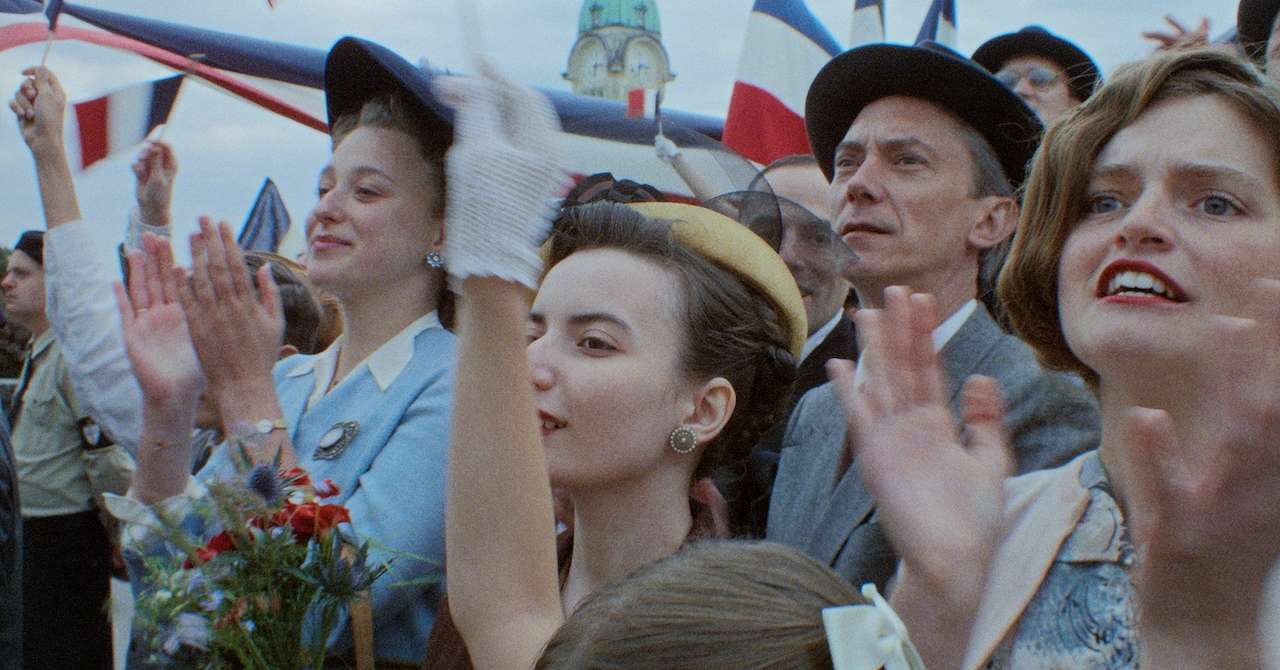
It all starts from analyzing these 300 letters. I also spent a year going regularly to the National Archives, where I was able to find traces of my great-grandfather’s work for the Vichy regime. And I wanted to offer spectators a form that would marry what I had experienced. This moment for example when I discovered in the archives, this little file on this Henri Marre, Commissioner for the fight against unemployment. There were only a dozen rooms. And these pieces didn’t fit together. I wanted that in terms of writing and editing, we would find this idea of disparate pieces – in this case scenes – which would shake the viewer in terms of chronology and mental state. Things that don’t fit together well. Finally, another decisive element was the discovery of the filming locations. Since we film in “real” locations. In Limoges, in Vichy. We started from these places and we accepted the fact of not making them perfectly historically credible, without undermining their veracity. And the same logic prevailed on the casting, which was taken care of by Julie Sokolowski and Julie Lecoustre
In what way?
This casting took place over 8 months. And we very often chose, in the supporting roles, people who, in life, do the same job as their characters in the film. Small bosses from Limousin play small bosses of the time. Sometimes with a bit of mischief: one of them is thus embodied by the boss of France Travail in the region. For the telephone pole installation scene, we called on someone who manages the site teams at Enedis. I designed the shoot as a place of reflection for everyone across these bridges between the way they experience work today and how it was experienced at the time.
These anachronisms are also found in the costumes…
But they start from a reality! With the costume designer, looking at images from the time, we noticed these anachronisms. Guys in leather jackets with zips that looked straight out of the 80s. We wanted to play with these inaccuracies without marking the anachronisms with Stabilo. The main thing was to immerse the viewer alongside Henri and Paulette, in the present of those years, never losing sight of the fact that they themselves did not know the end of the story. I also explained to my actors that the only way to get closer to what it was like to live in that era was to cleanse oneself of their knowledge.
How did you design the musical and dance scenes that punctuate the story where hits from the 80s resonate like Life is life ?
The music came very early. If only because by reading intimate correspondence from the period, I saw that people loved to dance, including – or even especially – during this troubled period. But I immediately thought that if I showed what they were listening to then – Trénet for example – the spectator of 2026 would not feel what we physically feel when we hear a hit. I also didn’t want to use music from 2026 to avoid a stabylo side in modernity. I simply started from the image I have of the Vichy regime. A diet that seeks modernity while being completely out of date. Unlike Italian fascist imagery, which is much more eye-catching, for example. And what better way to translate this than 80s music? Because it was both modern at the time with the use of synths before becoming mega old-fashioned. And the dance scenes are really there to raise the question of obscenity head-on. Because today basically and even more so in a place like Cannes, we continue to dance, to have fun, to take pleasure. But basically what are our steps dancing on?
Our salvation brings together Swann Arlaud and Sandrine Blancke in front of your camera. How did you choose them?
These two choices really have a history. I met Swann for tests for a project that never saw the light of day. And it suddenly came back to my mind… for its connection to the costume. Because in a suit, Swann can look crazy elegant, like a little boy. But Pierre Marre is precisely a character who dreams of a suit too big for him. From the first attempts, it was obvious. But Swann first explained to me that he didn’t think he could play that, that he wasn’t capable of it.
How did you manage to convince him otherwise?
Through an exchange, the beginning of companionship. By explaining to him how I saw this role, as someone lost, which fully corresponded to his state in front of this character. But also how I was going to work by dividing the shoot into two parts, with an editing period in between at the end of which – and not before – I would know what we would shoot in the second part. I think Swann wanted to test this method where he himself would be a little lost.
OUR SALVATION SEEN BY SWANN ARLAUD AND SANDRINE BLANCKE
And for Sandrine Blancke who plays his wife?
We have known each other for 20 years, we had already done little things together. But what’s crazy is that ten years ago, I filmed her on 16mm reading letters from my great-grandmother. It turns out that we botched the development of the reels – I only have 7 seconds of these images left – and I lost the recordings! But Sandrine remained in the back of my mind. And when we did tests between Swann and her, it was so obvious. I instantly had this couple in front of me who have 25 years in the bottle. Sandrine has this really wonderful thing of combining a very deep reflection on her character and coming back to something incredibly concrete and simple on the set. She and Swann are actors who have understood that discretion is not erasure.
Your film is not the story of a man but of a couple…
And this idea even constitutes, in my eyes, the heart of the political thought of the film. Our salvation questions whether there is not a link between the weariness of love and the weariness of faith in democracy. Don’t both basically work on the same springs? And aren’t we ready to do anything to find the flame again?
Our salvation. By Emmanuel Marre. With Swann Arlaud, Sandrine Blancke, Mathieu Perotto… Duration: 2h30. Released September 30, 2026